10 Webinar Presenter Best Practices for B2B SaaS Success in 2026
Discover 10 actionable webinar presenter best practices for B2B SaaS marketers. Boost engagement, ROI, and content efficiency with our expert guide.

In the competitive landscape of B2B SaaS, a webinar is far more than a presentation; it is a critical touchpoint for demand generation, client engagement, and establishing market authority. Yet, many marketing teams struggle to transform their subject matter experts into compelling virtual presenters. The result? Disengaged audiences, high drop-off rates, and a missed opportunity to demonstrate value, directly impacting your return on investment and cost-per-lead metrics.
With limited resources and constant pressure for consistent content output, this challenge is amplified. This guide moves beyond generic advice to provide a comprehensive list of actionable webinar presenter best practices specifically designed for B2B SaaS marketing professionals. We will delve into strategies that not only captivate your audience but also maximise the return on your content investment through strategic repurposing. To truly transform your firm's virtual presence, understanding the fundamentals of how to create webinars effectively is paramount.
This article details the specific tactics needed to elevate your virtual events from simple presentations to high-performing assets. You will learn how to:
- Structure your narrative for maximum impact and audience retention.
- Master delivery skills and on-camera presence to build authority.
- Integrate engagement techniques that keep attendees focused and interactive.
- Optimise production quality to reflect your company’s professional standards.
- Plan for strategic repurposing to multiply your content's value and reach.
Each point is designed to provide practical, implementation-ready steps, ensuring you can turn every webinar into a powerful component of your demand generation engine. Let’s explore the practices that separate standard presenters from exceptional performers.
1. Master the Art of Strategic Pacing and Content Flow
One of the most critical webinar presenter best practices is controlling the rhythm of your session. Strategic pacing isn't about rushing through slides; it's about deliberately structuring your content delivery to hold attention and maximise comprehension, especially when dealing with complex technical products. A well-paced webinar prevents cognitive overload, keeping your audience of technical buyers and decision-makers engaged from start to finish. This translates directly to better lead quality, with engagement rates often increasing by 15-20%.
The core principle is to break dense information into digestible, logically connected segments. This structure not only improves the live experience but also streamlines your content repurposing efforts, creating natural breakpoints for short-form video clips or blog post sections, significantly improving content production efficiency.
How to Implement Strategic Pacing
Start by mapping your content flow before you even build your slide deck. For a standard 60-minute webinar, plan for only 40-45 minutes of core content, leaving ample time for introductions, audience interaction, and a dedicated Q&A.
- Adopt the Rule of Three: Structure your key points clearly. First, introduce the problem (e.g., inefficient data processing). Second, explain your unique approach or solution. Third, provide a real-world case study showing a client who achieved a measurable outcome, like a 30% reduction in processing time.
- Use Themed Content Blocks: Organise your presentation into distinct modules, each lasting 6-10 minutes. For instance, a webinar on a new SaaS feature could be structured into three blocks: 1) The Core Problem We Solve, 2) Feature Deep Dive & Demo, and 3) Implementation & ROI Case Study. This modular approach makes complex topics easier to follow.
- Incorporate Strategic Pauses: In both live and pre-recorded sessions, a deliberate 3-5 second pause after revealing a key statistic or concluding a major point gives the audience a moment to absorb the information. This simple technique dramatically improves information retention.
By mastering content flow, you transform your webinar from a simple presentation into a structured educational journey, reinforcing your company's authority and ensuring your key messages resonate long after the session ends.
2. Establish Clear Authority and Credibility Early
One of the most crucial webinar presenter best practices, especially for B2B SaaS, is establishing your expertise within the first 60-90 seconds. Audiences evaluate presenters against high technical and professional standards from the outset. Failing to project immediate authority can lead to disengagement and undermine the impact of your message, directly affecting lead quality and the perceived value of your insights.
Establishing credibility isn't about arrogance; it’s about providing context so the audience trusts the information you're sharing. This initial confidence-building measure signals that their time investment will be worthwhile, framing your company as a definitive authority on the subject matter before the core content even begins.
How to Implement Early Credibility Cues
Integrate your credentials seamlessly into your introduction, rather than dedicating a separate, self-congratulatory slide. The goal is to be concise, relevant, and impactful, reassuring the audience that they are in expert hands.
- Lead with Audience-Relevant Credentials: Tailor your introduction to the specific audience. Instead of a generic biography, highlight the most pertinent experience. For example, state, "Having helped over 50 B2B SaaS companies automate their marketing workflows, I've seen firsthand what it takes to scale," which is far more powerful than saying you have "extensive experience."
- Show, Don't Just Tell: Use on-screen graphics and branded overlays to reinforce your credentials visually. When introducing speakers, display their name, title, and a key credential (e.g., "Former Head of Product at a well-known tech company") simultaneously. This adds a layer of professional polish.
- Reference Tangible Achievements: Ground your authority in specific, verifiable accomplishments. Mentioning a recent industry report you authored, a major product launch you led, or quantifiable client results is highly effective. A fintech SaaS, for instance, could open by referencing a recent report where they were named a market leader.
By front-loading your credibility, you set a professional tone and create an environment where your key messages are received with greater attention and respect, ultimately strengthening your company's reputation and the webinar's ROI.
3. Leverage Visual Storytelling Over Text-Heavy Slides
A critical component of effective webinar presenter best practices is shifting from text-heavy slides to compelling visual narratives. Your slides should support your spoken words, not duplicate them. For B2B SaaS companies explaining complex workflows, data analytics, or technical architecture, this approach is not just aesthetic; it’s essential for clarity and audience comprehension. Visual storytelling transforms abstract data and dense concepts into memorable, digestible insights, preventing audience disengagement.
This method directly impacts engagement metrics, as visually stimulated audiences are more likely to remain focused, participate in polls, and ask questions. It also enhances your brand perception, positioning you as a sophisticated, forward-thinking authority that can distil complexity into actionable intelligence.

How to Implement Visual Storytelling
Begin by treating each slide as a billboard, not a document. Its purpose is to make a single, powerful point quickly. Instead of listing bullet points that you read aloud, use visuals to illustrate the core idea, allowing you to provide the detailed narrative. For example, successful SaaS companies often use animated workflow diagrams to explain their platform's functionality without relying on cluttered text.
- Embrace the Five-Word Rule: Challenge yourself to limit the text on each slide to five words or fewer. This forces you to identify the single most important takeaway and find a visual way to represent it, whether through a powerful statistic, an icon, or a chart.
- Develop Custom-Branded Visualisations: Avoid generic stock imagery. Invest in creating custom graphics, charts, and infographics that reflect your company's unique insights and brand identity. A cybersecurity SaaS might use a visual metaphor of a digital fortress to explain its layers of protection, making the concept instantly understandable.
- Prioritise Data Integrity and Sourcing: When presenting data visualisations, always include clear source citations. This is a non-negotiable step for maintaining credibility. Building a library of these pre-vetted visual assets can significantly accelerate future webinar production and ensure brand consistency, a key efficiency gain for busy content teams.
By replacing walls of text with meaningful visuals, you cater to modern learning preferences, make your complex subject matter more accessible, and create a far more professional and engaging webinar experience.
4. Perfect Your Opening Hook Within 30 Seconds
The first 30 seconds of your webinar are the most valuable real estate you have. Another crucial entry on our list of webinar presenter best practices is crafting an opening that immediately seizes your audience's attention. A powerful hook isn't just a warm-up; it's a strategic tool that frames the entire session, validates the attendee's time investment, and prevents the dreaded multi-tasking drift that plagues virtual events. For B2B SaaS marketers, this means cutting through the noise with an insight that speaks directly to a primary business pain point or untapped opportunity.
This initial engagement sets the tone for the entire presentation. By leading with a compelling statistic, a provocative question, or a relatable anecdote, you signal that the content to follow will be substantive and directly relevant to their professional lives. This immediately elevates the perceived value of your content and your company’s expertise, which is essential for capturing high-quality leads.
How to Implement a Powerful Opening Hook
Before you even finalise your introduction, script and time your opening hook with precision. It should be delivered with confidence and clarity within the first half-minute to establish momentum and authority.
- Lead with a Contrarian Statistic: Open with a data point that challenges conventional wisdom in your industry. For a martech SaaS webinar, an impactful opener could be: “90% of marketing teams say they are data-driven, yet our latest research shows 65% are still making key decisions based on gut feeling. Today, we'll close that gap.”
- Ask a Provocative Question: Pose a question that reveals a gap in your audience's thinking or highlights a problem they hadn't fully considered. A project management SaaS might open with: “What if your team could reclaim 10 hours of wasted time each week? We're about to show you the three workflow bottlenecks you need to eliminate.”
- Start with an Anonymised Client Story: Ground your topic in a real-world scenario. A sales enablement SaaS could begin: “Last quarter, one of our clients, a mid-market tech firm, was struggling with a 12% sales rep attrition rate. Today, we'll break down the three-step onboarding process we helped them build to cut that number in half.”
By perfecting your opening, you transform a passive audience into active, engaged listeners from the very first moment. This initial buy-in is fundamental to holding their attention and ensuring your key messages are not only heard but also absorbed.
5. Master Interactive Elements and Real-Time Engagement Techniques
A key element of effective webinar presenter best practices is the strategic use of interactive moments. Engagement is not a passive activity; it must be actively cultivated. By integrating polls, moderated Q&A, and interactive exercises, you create a sense of psychological participation that keeps attendees invested. For B2B SaaS companies, this transforms a one-way broadcast into a two-way dialogue, helping you understand audience pain points and identify high-intent prospects in real time.
This approach prevents audience attention from waning, which is critical for maintaining engagement through dense, technical content. Interactive elements provide valuable data points, helping you segment your audience and tailor your follow-up, thereby increasing the ROI of your webinar programme. A poll revealing that 70% of your audience struggles with API integration, for example, is a powerful signal for your sales team.
How to Implement Real-Time Engagement
Plan your interactive moments as carefully as you plan your core content. Instead of being an afterthought, they should be woven into the narrative to reinforce key points and gather crucial insights. Aim for an interactive element every 8-12 minutes to maintain momentum.
- Design Polls to Inform Content: Use polls not just for engagement but to guide your presentation. A SaaS company can use an initial poll to ask attendees about their biggest challenge, allowing the presenter to then tailor subsequent examples and language specifically to address the most-voted-for pain point.
- Batch and Moderate Q&A: To avoid derailing your presentation's flow, create dedicated Q&A windows. Announce that you will pause for questions every 10-15 minutes. Have a moderator filter and group similar questions, allowing you to address common themes efficiently and demonstrate a deep understanding of the audience's challenges.
- Use 'Put it in the Chat' Prompts: Encourage active participation with low-friction prompts. For example: "We're about to discuss integration challenges. In the chat, type the one system you wish was easier to connect with." This generates engagement and provides valuable, unprompted market intelligence.
By mastering these techniques, you shift the audience from passive viewers to active participants. This not only improves the live experience but also surfaces valuable engagement signals that your business development team can use for more effective post-webinar outreach. To explore this topic further, discover more ways on how to make webinars interactive and keep your audience captivated.
6. Develop Authentic Presenter Presence and Delivery Skills
One of the most impactful webinar presenter best practices is cultivating an authentic and engaging on-camera presence. B2B SaaS audiences, particularly technical buyers and decision-makers, are highly attuned to authenticity. A stiff, over-rehearsed delivery can undermine credibility, whereas a natural, conversational style enhances your perceived expertise and builds trust, directly contributing to higher engagement and better lead quality.
Authentic presence is a combination of vocal variety, confident body language, and a genuine passion for the subject matter. It's about connecting with your audience as individuals, even through a screen. Mastering this skill transforms a one-way information broadcast into a valuable, two-way interaction that reinforces your company's authority.

How to Develop an Authentic Presence
Building a natural delivery style requires deliberate practice, not just memorising a script. The goal is to internalise your key points so you can speak about them with confidence and flexibility, which is a hallmark of great tech industry presenters.
- Rehearse Aloud, Not Silently: Reading your script in your head is not the same as speaking it. Rehearse out loud a minimum of three times to identify awkward phrasing and internalise the flow. This practice moves your content from short-term memory to a place where you can discuss it conversationally.
- Record and Review Critically: Use your webcam or phone to record a full practice run. Watch it back specifically to spot filler words ("um," "ah," "so"), identify moments of monotone delivery, and check your pacing. This self-assessment is one of the fastest ways to improve.
- Frame for Engagement: Position your camera so it captures your upper body and hands, not just a tight shot of your head and shoulders. Hand gestures add energy and help convey meaning, making your delivery far more dynamic and engaging for the viewer.
- Imagine a Conversation: To avoid a stiff, "presenting to a void" feeling, picture yourself speaking to a single, ideal customer. This mental shift encourages a more natural tone, better eye contact with the camera lens, and a more personable delivery.
By focusing on authentic delivery, you ensure your expertise shines through, creating a memorable experience that holds audience attention and drives post-webinar action.
7. Implement Strategic Call-to-Action Architecture
A core objective for B2B SaaS webinars is converting high-value content into tangible pipeline opportunities. This is one of the most vital webinar presenter best practices, as it bridges the gap between education and demand generation. Strategic call-to-action (CTA) architecture involves more than just a single "book a demo" slide; it's about placing the right offer in front of the right audience segment at the optimal moment, guiding them through their decision-making journey without appearing overtly sales-focused.
This structured approach ensures your company maximises conversion potential by aligning CTAs with the audience's engagement level and informational needs. It acknowledges that not every attendee is ready for a sales conversation, thereby capturing leads at different stages of the funnel and improving overall marketing efficiency.
How to Implement Strategic CTA Architecture
Your CTA plan should be integrated directly into your content flow, not added as an afterthought. This means matching the "ask" to the value you have just delivered.
- Map CTAs to the Buyer's Journey: Structure your offers logically. Start with a low-friction "soft CTA" early on, like an invitation to download a related case study or implementation checklist. Reserve the "hard CTA," such as booking a demo or starting a free trial, for the end of the session after you have comprehensively demonstrated your expertise and the value of your solution.
- Use Mid-Point Engagement Triggers: The peak engagement moment, typically 15-20 minutes into a webinar, is a prime opportunity for a relevant, value-added CTA. For example, after showing data on industry benchmarks, a SaaS company could offer a free, personalised assessment tool that helps attendees see how they stack up.
- Vary Your CTA Formats: Not all CTAs need to be a direct link. An interactive poll can serve as a seamless transition into a CTA. For example: "Seeing that 65% of you are struggling with manual reporting, we've opened up a few slots for a one-on-one strategy call to discuss automation. The link is in the chat."
By building a deliberate CTA architecture, you transform your webinar from a passive presentation into an active conversion engine, effectively monetising your content marketing efforts. For more inspiration, you can explore a variety of powerful webinar CTA examples to suit different scenarios.
8. Optimize Audio and Visual Production Quality
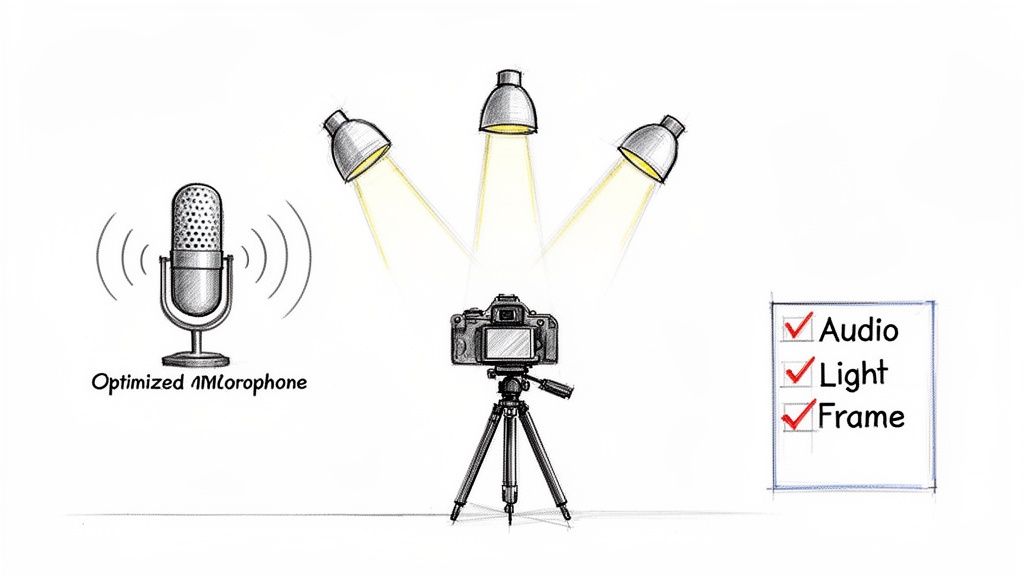
In the competitive B2B SaaS sector, production quality is a direct reflection of your company's brand and technical competence. This is one of the most crucial webinar presenter best practices because your target audience has high expectations. Crystal-clear audio, professional lighting, and sharp video are non-negotiable elements that build credibility, while poor production quality will undermine even the most insightful content and damage your brand's premium positioning.
High production value isn't just about aesthetics; it directly impacts viewer engagement and completion rates. Data shows that professional-quality webinars can see a 25% higher average watch time compared to those with poor audio or video, demonstrating a clear return on investment.
How to Implement High-Quality Production
Your primary goal is to eliminate any technical distractions that could pull the audience's focus away from your message. This means moving beyond basic webcam and laptop microphone setups. A comprehensive webinar quality assurance checklist is essential for consistency, especially for content teams managing multiple speakers.
- Prioritise Audio Over Video: If budget is a concern, invest in a high-quality external microphone (e.g., a USB condenser mic like the Blue Yeti, costing around US$100-US$150) before upgrading your camera. Audiences are far more forgiving of slightly soft video than they are of crackling, muffled, or inconsistent audio.
- Master Your Lighting and Background: Use a three-point lighting setup (key, fill, and back light) to create a clear, professional look without harsh shadows. Your background should be clean, on-brand, and free of distractions, whether it's a physical space or a high-resolution branded virtual background.
- Conduct a Full Technical Rehearsal: Test every single technical element at least 24 hours before the live event, not 24 minutes. This includes your internet connection (hardwired, not Wi-Fi), presentation software, microphone, camera, and lighting. This rehearsal gives you time to troubleshoot and implement a backup plan if needed.
By treating your webinar as a broadcast-quality event, you align its execution with the calibre of your content and expertise. This reinforces your company’s market-leading status and ensures your message is delivered with the authority it deserves.
9. Create Clear Narrative Structure and Content Architecture
A key differentiator in B2B SaaS is moving beyond a list of features to a compelling narrative. Creating a clear content architecture is a critical webinar presenter best practice that transforms your presentation from a product demo into a logical, persuasive journey. This approach guides your audience from a recognised pain point to a clear, actionable solution enabled by your technology, reinforcing your company's authority and thought leadership.
This structured narrative isn't just about storytelling; it's a strategic framework that improves comprehension and drives action. For a technical audience, this organised progression demonstrates the rigorous, methodical thinking they expect, making your proposed solutions more credible. It also simplifies post-webinar repurposing, as each narrative section can become a standalone asset, increasing content velocity.
How to Implement a Narrative Structure
Begin by mapping your webinar's arc before creating a single slide. The goal is to build a logical path that naturally leads your audience to your intended conclusion and call-to-action.
- Follow the 'Problem-Agitate-Solution' Model: This is the backbone of your narrative. Start by defining a critical market problem (e.g., high customer churn). Then, agitate the problem by exploring its negative business impacts (e.g., increased acquisition costs, lower revenue). Finally, present your SaaS platform as the solution that directly addresses this pain point.
- Build a Framework-Based Flow: Structure your webinar around a unique framework or methodology. A typical flow could be: 1) The State of the Industry & Key Challenges, 2) Our 3-Step Framework for Success, 3) Case Study: Applying the Framework, and 4) Your First Steps to Implementation. This makes your expertise tangible and memorable.
- Clearly Signpost Transitions: Use verbal cues and title slides to signal shifts between sections. For instance, say, "Now that we've established the financial impact of poor data quality, let's explore a practical, three-part framework for cleaning your database." This guides the audience and creates clean edit points for creating video clips later.
By architecting your content with a clear narrative, you ensure your webinar is not only informative but also influential, guiding prospects through a thought process that logically concludes with the value of your SaaS solution.
10. Plan Strategic Repurposing, Asset Multiplication, and Continuous Measurement
One of the most impactful webinar presenter best practices for resource-constrained content teams is shifting your mindset from producing a one-off event to creating a long-term content engine. Strategic repurposing, or "asset multiplication", involves planning from day one how a single webinar will fuel weeks or months of marketing activity across various channels. This approach maximises your investment of time and resources, ensuring every piece of content delivers sustained value and contributes directly to your demand generation goals.
The core principle is to view your webinar not as the final product but as the source material for a portfolio of high-value assets. By identifying repurposing opportunities before you even press record, you can seamlessly create clips, quotes, and reports that engage different audience segments on their preferred platforms, drastically increasing your content's reach and ROI.
How to Implement Strategic Repurposing and Measurement
Start by integrating asset creation into your pre-production planning brief. This ensures your production team and presenters are aligned on capturing specific moments and data points. For example, a single SaaS webinar can be strategically deconstructed into a full-length YouTube video, a dozen LinkedIn clips, a podcast episode, and a downloadable executive summary.
- Plan Your Asset Menu in Advance: Before the webinar, create a checklist of desired assets. This might include 6-8 short video clips for social media, 3-5 key data points for an infographic, a downloadable PDF of the slides, and a summary blog post. Brief your presenter to deliberately create 'clip moments' with clear, concise statements.
- Mark Natural Breakpoints During Delivery: As a presenter, consciously create logical pauses and self-contained segments. For example, after explaining a complex feature, summarise its core benefit in a single, powerful sentence. This makes it simple for your post-production team to isolate and package the segment for platforms like LinkedIn or X.
- Track Asset-Specific Performance: Go beyond just tracking webinar attendance. Use analytics dashboards to measure the performance of each repurposed asset. A marketing automation SaaS might discover that short "how-to" clips generate 3x higher engagement than thought leadership segments, guiding future content strategy. Tracking this data allows for continuous improvement and demonstrates clear ROI to leadership.
By planning for repurposing and continuously measuring performance, you transform your webinar programme from a series of isolated events into a highly efficient, data-driven content marketing machine that consistently delivers qualified leads.
Top 10 Webinar Presenter Best Practices Comparison
| Item | Implementation complexity | Resource requirements | Expected outcomes | Ideal use cases | Key advantages |
|---|---|---|---|---|---|
| Master the Art of Strategic Pacing and Content Flow | Moderate — requires detailed scripting and rehearsal | Moderate time for planning, rehearsal, and editing; producer support helpful | Higher retention, lower dropout, natural clip breakpoints | Technical deep dives, product demos, long-format webinars | Improves comprehension and watch-time; aids repurposing |
| Establish Clear Authority and Credibility Early | Low — simple to add but must be accurate | Low — presenter credentials, branded visuals/overlays | Immediate trust boost and better lead conversion | B2B prospecting, thought leadership webinars, first-impression presentations | Rapidly increases perceived authority and trust |
| Leverage Visual Storytelling Over Text-Heavy Slides | High — needs design coordination and timing | High — designers, data-viz tools, production time and budget | Stronger retention, polished brand perception, higher social performance | Data-driven presentations, case studies, technical demos | Makes complex ideas accessible; creates engaging assets |
| Perfect Your Opening Hook Within 30 Seconds | Low — requires audience insight and rehearsal | Low — research and rehearsal; A/B testing recommended | Reduces early dropout, improves replay and clip performance | Any webinar where initial attention is critical; social clip creation | Quickly captures attention and sets engagement tone |
| Master Interactive Elements and Real-Time Engagement Techniques | High — technical setup and moderation protocols needed | High — polling/Q&A tools, moderators, trained staff | Higher engagement metrics, richer audience data, better lead quality | Live webinars, training sessions, lead-generation events | Creates dialogue, yields behaviour-based lead signals |
| Develop Authentic Presenter Presence and Delivery Skills | Moderate — coaching and repeated practice required | Moderate — rehearsal time, recording equipment, optional coach | Greater trust, more memorable delivery, improved retention | Executive briefings, thought leadership, client-facing sessions | Differentiates via authenticity; boosts credibility |
| Implement Strategic Call-to-Action Architecture | Moderate — needs alignment with content and teams | Moderate — gating tools, CRM integration, copywriting | Improved lead capture, better segmentation, measurable pipeline impact | Conversion-focused webinars, decision-stage content, nurture programs | Balances thought leadership with conversion; measurable ROI |
| Optimize Audio and Visual Production Quality | High — requires AV expertise and quality control | High — microphones, lighting, cameras or production vendor | Increased perceived professionalism, fewer technical distractions | Executive presentations, major product launches, brand-sensitive content | Strong credibility signal; improves accessibility and repurposing |
| Create Clear Narrative Structure and Content Architecture | Moderate — requires content design and case development | Moderate — subject-matter experts, case materials, planning time | More memorable, actionable content and smoother CTA flow | Framework-led sessions, implementation-focused webinars | Guides audience through logical journey; supports repurposing |
| Plan Strategic Repurposing, Asset Multiplication, and Continuous Measurement | High — cross-channel planning and analytics setup required | High — editors, social managers, analytics, distribution budget | Extended ROI, multi-channel reach, data-driven content optimization | Programs aiming for scalable content ROI and ongoing lead gen | Turns one webinar into many assets; provides performance insights |
Your Strategic Partner in Webinar Excellence
Navigating the landscape of modern B2B SaaS marketing demands more than just showing up online; it requires the strategic execution of every audience touchpoint. The comprehensive list of webinar presenter best practices we have explored is not merely a checklist but a blueprint for transforming standard online presentations into powerful, revenue-driving assets. From mastering strategic pacing and establishing immediate authority to leveraging visual storytelling and perfecting your interactive engagement, each practice builds upon the last, creating a holistic framework for excellence.
The journey from a good webinar to a great one is marked by intentionality. It's the difference between a text-heavy slide deck and a compelling visual narrative, between a generic welcome and a powerful 30-second hook that captures immediate attention. It’s about understanding that every element, from your audio quality to your call-to-action architecture, contributes to the overall audience experience and, ultimately, to your bottom line. Mastering these skills elevates your brand, establishes undeniable thought leadership, and creates a direct path from education to conversion.
From Practice to Performance: Implementing Your Strategy
The true value of these principles is realised in their consistent application. This is where many resource-constrained marketing teams face a challenge. Implementing broadcast-quality production standards, developing an authentic presenter presence, and planning for strategic content repurposing requires a unique combination of skills, time, and technology. It’s a significant undertaking that can divert focus from core marketing activities.
Consider the long-term impact of your webinar programme. Effective execution of these best practices directly influences key performance indicators:
- Higher Engagement Rates: Techniques like real-time polls, Q&A sessions, and strategic pacing can increase audience interaction by over 30%, signalling a more invested and qualified audience.
- Improved Conversion: A clear narrative structure combined with a strategic call-to-action can lift conversion rates on offers, such as demo requests or content downloads, by a significant margin.
- Enhanced Brand Perception: Professional production quality and a polished presenter delivery position your brand as a credible, authoritative leader in your industry.
- Maximised Content ROI: Thinking about repurposing from the outset turns a one-hour live event into a dozen or more lead-generating assets. To amplify your content's reach and longevity, effective repurposing is crucial; investing in robust webinar transcription software can significantly streamline the creation of derivative assets like blog posts and whitepapers.
Your Next Step Towards Webinar Mastery
Embracing these webinar presenter best practices is a commitment to quality and a strategic investment in your content marketing engine. It's about moving beyond simply hosting webinars to architecting experiences that captivate, educate, and convert. The principles outlined provide a clear path forward, empowering you to refine your approach, measure your impact, and continuously improve. By focusing on delivering tangible value through exceptional presentation and strategic planning, you don’t just host an event; you build a lasting connection with your audience and a powerful pipeline for your business.
Ready to implement these best practices without overwhelming your internal team? Cloud Present acts as your outsourced webinar production studio, transforming your subject matter experts into polished presenters and turning every webinar into a high-performance marketing asset. Discover how our browser-based platform and expert services can elevate your webinar strategy by visiting Cloud Present.


