8 High-Impact Webinar CTA Examples to Maximise B2B Conversions
Boost your firm's ROI with our guide to 8 powerful webinar CTA examples. Get actionable tips for B2B SaaS marketing and professional services teams.
For B2B SaaS marketing professionals, webinars are a cornerstone of demand generation. Yet, many fall short of their potential ROI due to one critical element: the Call-to-Action (CTA). A generic 'Register Now' button fails to engage sophisticated audiences, leaving valuable leads on the table. To drive meaningful engagement and convert prospects into qualified leads, marketing and content teams need a strategic arsenal of CTAs tailored to specific goals and audience intent.
This guide moves beyond basic buttons to provide a detailed breakdown of high-performing webinar CTA examples. We will dissect the strategy behind each one, offering actionable insights and professional quality standards that your content team can implement immediately. You will learn how to craft compelling CTAs that address common pain points for B2B marketers: limited resources, the need for consistent content output, and relentless demand generation targets.
The goal is to transform every webinar from a simple presentation into a powerful, lead-generating asset. We will provide specific metrics and implementation steps to help you maximise efficiency and demonstrate the tangible value of your virtual event strategy. Instead of just asking for a registration, you will learn to create CTAs that build urgency, communicate value, and guide prospects seamlessly through your sales funnel. This curated list is designed to give B2B marketing professionals the replicable methods needed to improve conversion rates—often by 20% or more—and unlock the full commercial potential of their webinar programmes.
1. The Urgency-Driven Limited-Time Offer CTA
Urgency is a powerful psychological trigger in B2B marketing. For webinar registrations, it can be the critical factor that moves a prospect from consideration to action. This call-to-action (CTA) framework leverages time-bound incentives to create a compelling reason for your audience to register now, not later. It combats procrastination by introducing scarcity, whether through limited seats, expiring offers, or approaching deadlines, directly addressing the pain point of converting passive interest into active registration.

This approach is especially effective for B2B SaaS firms, where feature updates, regulatory changes, or market shifts are time-sensitive. A fintech company, for example, can drive registrations with messaging like, "Join our live briefing before new FCA regulations take effect." A SaaS provider can boost sign-ups by offering an exclusive discount: "Register by Friday to lock in a 15% discount on your first year." This tactic directly links registration to a tangible, immediate benefit, increasing the perceived ROI for the attendee.
Strategic Breakdown & Implementation
When to Use This CTA:
- Time-Sensitive Topics: Ideal for webinars covering new software releases, market shifts, or compliance updates where the information has a short shelf life.
- Premium or Paid Content: Works perfectly for driving early-bird sales for paid workshops, generating upfront revenue and gauging interest.
- High-Value, Limited-Capacity Events: Use it for exclusive roundtables or "ask me anything" sessions with industry leaders where seat scarcity is genuine.
Actionable Tips:
- Quantify the Scarcity: Instead of "limited seats," use specific numbers like "Only 25 seats left for this interactive workshop." This makes the scarcity feel real and can increase conversion rates by up to 15%.
- Visualise the Deadline: Embed a countdown timer on your registration page. Visual cues amplify the sense of urgency and provide a clear, constant reminder. You can find more tips in our guide to webinar landing page best practices.
- Combine Urgency with Value: Always pair the deadline with a clear benefit. For example: "Register before Friday to save $200 and get our exclusive pre-webinar toolkit." This frames the deadline as an opportunity, not just a pressure tactic.
Efficiency Note for Content Teams: For time-sensitive content, plan your promotion cycle carefully. A well-executed urgency campaign can condense your registration window, freeing up resources for other demand generation activities.
2. The Educational Value-First CTA
In B2B SaaS, credibility is currency. The educational value-first CTA shifts the focus from promotion to empowerment, leading with the tangible knowledge attendees will gain. Instead of generic promises, this approach prioritises concrete learning outcomes and actionable insights, framing registration as an investment in professional development. It answers the prospect’s most important question: "What specific problem will this solve for me, and how will it improve my workflow?"
This strategy is particularly potent for firms targeting sophisticated B2B audiences who are wary of sales pitches. A marketing automation platform can attract its target user base with, "Learn the 3 automation workflows that cut lead nurturing time by 40%." Similarly, a cybersecurity SaaS can build trust with a CTA like, "Discover the framework for a zero-trust architecture used by leading CIOs," positioning themselves as educators first and vendors second. This addresses the pain point of audiences seeking genuine solutions, not just product demos.
Strategic Breakdown & Implementation
When to Use This CTA:
- Complex or Technical Subjects: Perfect for webinars that demystify new technologies, complex software integrations, or intricate market dynamics.
- Building Thought Leadership: Use it to establish your firm’s authority and expertise, attracting high-quality leads who value deep insights.
- Targeting Senior Decision-Makers: C-suite executives value their time; a clear educational promise with specific, data-backed outcomes increases the likelihood of engagement.
Actionable Tips:
- Lead with Numbers and Outcomes: Quantify the knowledge. Use phrases like "Master 3 data-driven frameworks..." or "Learn how to reduce customer churn by 18% with..." This makes the value proposition specific and measurable.
- Highlight Speaker Credentials: Prominently feature your speakers' qualifications next to the CTA. Phrases like "Learn directly from our Head of Product with 15+ years of SaaS experience" add immense credibility.
- Promise Exclusivity of Insights: Emphasise that the data or frameworks are unique to the event. For example: "Get 3 proprietary data insights exclusive to this live session." This creates a compelling reason to attend live rather than waiting for a recording.
Content Repurposing Note: This value-first approach creates powerful micro-assets. Use Cloud Present's editing tools to clip key educational takeaways from your webinar. Turn these snippets into insightful social media videos or short articles to increase webinar attendance for future events, maximising your content ROI and addressing the need for consistent content output.
3. The Exclusive Access/VIP Registration CTA
Exclusivity is a powerful motivator that appeals to a professional’s desire for elite status and insider knowledge. This call-to-action (CTA) framework positions your webinar not as a public broadcast, but as a private briefing for a select group. It creates a sense of belonging and prestige, transforming a standard registration into an invitation to an exclusive club.
This approach is particularly potent for high-value B2B SaaS, where lead qualification is paramount. Instead of casting a wide net, you attract a highly relevant, pre-qualified audience. For instance, an enterprise analytics platform can target key accounts with an invitation like, "Exclusive product roadmap briefing for our enterprise clients." Similarly, a martech company can organise a "CMO-only roundtable – invitation required," ensuring the conversation remains at a high strategic level.
Strategic Breakdown & Implementation
When to Use This CTA:
- Nurturing High-Value Clients: Perfect for strengthening relationships with top-tier customers by providing them with content not available to the general public, reducing churn.
- Targeting C-Suite or Senior Leadership: Use it for webinars covering strategic topics where the presence of senior executives is crucial for peer-to-peer value exchange.
- Introducing Premium Products or Services: Ideal for launching an upmarket offering to a curated list of prospects who meet specific qualification criteria, improving sales efficiency.
Actionable Tips:
- Define Qualification Criteria Clearly: Be explicit about who the event is for. For example: "This C-suite exclusive is designed for VPs and Directors in the fintech sector." This not only attracts the right people but also empowers them to self-qualify.
- Use Personalised Invitation Channels: Ditch the generic, open registration link. Send direct, personalised emails from a senior leader or account manager. This reinforces the feeling of a personal invitation and can increase response rates by over 50%.
- Create Tiered Access Levels: You can still capture broader interest by offering a "standard" registration for a future, on-demand version, while the live, interactive session remains exclusive. Frame it as: "Register for the on-demand recording, or apply for a VIP seat at the live roundtable."
Pro Tip for Cloud Present Users: Your exclusive webinar content is a high-value asset. After the live event, use Cloud Present's platform to gate the recording and repurpose it as a premium lead magnet in your automated nurture sequences, extending its ROI for months and fuelling your content pipeline.
4. The Multi-Option CTA (Flexible Attendance Formats)
Not every prospect can commit to a fixed time slot, especially in global B2B markets. The multi-option CTA acknowledges this reality by offering flexible ways to engage with your content. It removes the primary friction point of scheduling conflicts, thereby capturing leads who are interested in the topic but unavailable for the live event. For content teams with limited resources, this approach transforms a single webinar into a versatile, evergreen asset from the outset.
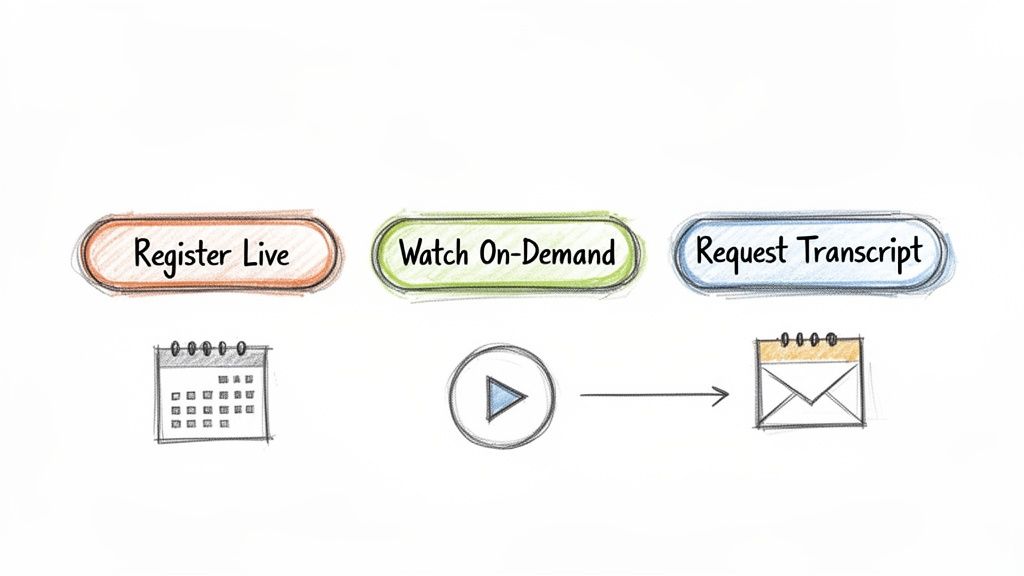
This strategy is highly effective for global SaaS companies serving a diverse, time-poor audience. A project management software company might offer, "Join the live demo on Tuesday, or watch the 15-minute on-demand overview now." Similarly, a data analytics firm could present options like, "Register for the live Q&A or request the summary + slide deck for your team." These flexible webinar CTA examples cater to individual preferences and can widen the potential lead pool by up to 30%.
Strategic Breakdown & Implementation
When to Use This CTA:
- Globally Distributed Audiences: Essential when marketing to professionals across different continents and time zones.
- Evergreen Content: Perfect for foundational topics that have a long shelf life, allowing you to generate leads from the content long after the live date.
- Senior-Level Targets: C-suite executives and senior managers have demanding schedules; offering on-demand access is often the only way to secure their engagement.
Actionable Tips:
- Clearly Label Each Option: Differentiate the value of each choice. For example: "Join Live for Interactive Q&A" versus "Get On-Demand Access to Watch at Your Pace." This helps users self-select the best format for their needs.
- Automate Delivery Workflows: Set up your marketing automation to instantly deliver the on-demand link or resources to those who choose that option. A delay can lead to a drop in engagement and a poor user experience.
- Set Clear Expectations: Be transparent about replay availability. Specify if access is permanent or time-limited, such as "You'll receive 48-hour access to the replay." This clarity builds trust and encourages prompt viewing.
Pro Tip for Cloud Present Users: Leverage the pre-recorded webinar format to offer immediate on-demand access from the moment of registration. You can simulate a live environment with scheduled chat and Q&A features, combining the urgency of a live event with the flexibility of on-demand content to maximise registration and engagement.
5. The Social Proof & Authority CTA
In B2B SaaS, trust is not a bonus; it’s a prerequisite for a sale. This call-to-action (CTA) framework leverages social proof and authority signals to build that trust directly into your registration prompt. It reassures prospects that committing their valuable time to your webinar is a sound decision by showing who else has benefited, highlighting speaker credentials, and showcasing endorsements. This method is particularly potent for B2B audiences who prioritise expertise and peer validation.
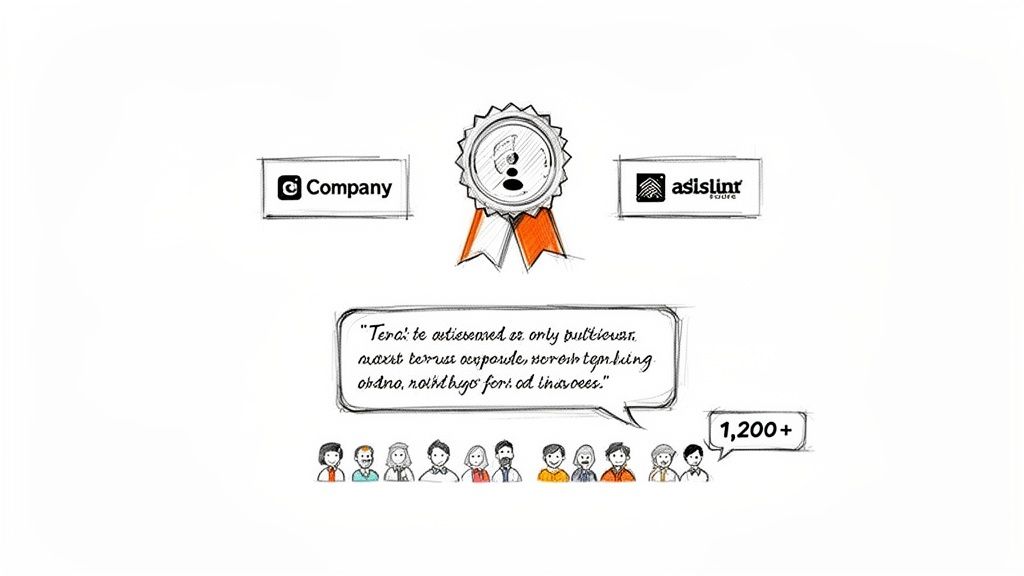
This approach moves beyond simply stating the topic and instead answers the crucial question in a prospect's mind: "Why should I trust you to teach me this?" For a legal tech firm, a CTA like, "Join 500+ in-house counsel from Fortune 500 companies" is far more compelling than a generic "Register now." Similarly, a cybersecurity SaaS can build immense credibility with, "Presented by a former GCHQ director and CISSP with 20+ years of experience."
Strategic Breakdown & Implementation
When to Use This CTA:
- Highly Technical or Regulated Topics: Essential for subjects like data privacy, financial compliance, or cybersecurity, where speaker expertise is non-negotiable.
- Building a New Audience: When your brand is less known, leveraging the authority of a well-respected speaker or citing impressive attendance from past events can overcome initial scepticism.
- Competitive Markets: Use social proof to differentiate your content. Highlighting that executives from companies like Microsoft or Salesforce attended your last event sets you apart.
Actionable Tips:
- Be Hyper-Specific: Vague claims like "attended by industry leaders" are weak. Use specific, verifiable numbers and logos: "Attended by 2,000+ executives from Microsoft, Salesforce, and HubSpot."
- Place Credentials Prominently: Don’t bury your speaker’s impressive bio. Feature key credentials, such as "CISSP Certified" or "Former Gartner Analyst," directly beside the CTA button. This reinforces value at the point of decision.
- Automate Testimonial Collection: To bolster your social proof, leveraging a tool like a testimonial generator can streamline gathering feedback. Follow up post-webinar with a survey asking, "What was your single biggest takeaway?" and request permission to use the responses.
Effectiveness Note for B2B SaaS: For marketing professionals, seeing logos of well-known companies that have attended your events is a powerful form of B2B social proof. It signals that your content is valued by respected organisations. To understand which company profiles are driving your registrations, you can use our Registration Analyser to gain deeper insights.
6. The Problem-Solution CTA
This call-to-action leads with a specific, validated pain point your audience is experiencing and immediately positions your webinar as the direct solution. It cuts through the noise by demonstrating a deep understanding of your prospect’s frustrations, making the value proposition of attending incredibly clear. By framing the event as the answer to a known problem, you shift the focus from a generic topic to a tangible outcome—a critical tactic for demand generation.
This approach is highly effective because it mirrors the internal monologue of a target prospect. For instance, a sales enablement SaaS can target sales leaders with a CTA like, "Sales team missing quota? Learn the 3-step coaching framework that increased deal velocity by 25%." Similarly, an HR tech platform can engage HR managers with, "Struggling with employee retention? Discover how to reduce turnover by 15% without increasing salary budgets." This method turns a passive invitation into an active problem-solving opportunity.
Strategic Breakdown & Implementation
When to Use This CTA:
- Targeting Niche Audiences: Perfect for speaking to a specific vertical or job role with well-defined challenges (e.g., 'Head of Demand Gen' or 'Compliance Officer').
- Bottom-of-Funnel Conversion: Excellent for prospects who are aware of their problem and are actively seeking a solution, indicating high purchase intent.
- Introducing New Methodologies: Ideal when your webinar presents a new framework or process that directly addresses a persistent industry bottleneck.
Actionable Tips:
- Validate the Pain Point: Use data from client conversations, support tickets, or industry reports to ensure the problem you're highlighting is real and urgent. This research is non-negotiable for the CTA to land effectively.
- Lead with the Problem: Your headline and opening sentence should state the problem clearly. For example, instead of "Webinar on Content Marketing," use "Content pipeline feeling slow? Learn the 5-step process to double your output without hiring."
- Quantify the Solution: Make the promised outcome tangible by using specific metrics. "Reduce reporting time by 10 hours per month" is far more compelling than "Improve reporting efficiency." This is one of the most powerful webinar cta examples because it provides a measurable promise of ROI.
Cloud Present Pro-Tip: Don't let the value end when the live event does. Use our platform to repurpose your webinar into problem-specific asset bundles. You can easily clip out key moments where your experts address each pain point and package them with related slides and resources. This creates highly-targeted follow-up content that continues to solve problems long after the webinar is over, maximising your content's ROI.
7. The Credentialed Learning CTA (CLE/CPE Integration)
For professionals in regulated industries, continuing education isn't just a benefit; it's a mandatory requirement. This call-to-action (CTA) framework transforms your webinar from a simple learning opportunity into an essential career-development tool by integrating professional credits like Continuing Legal Education (CLE) or Continuing Professional Education (CPE). It presents a powerful dual-value proposition: gain critical insights and fulfil professional obligations simultaneously.
This approach is highly effective for SaaS companies serving legal, accounting, or finance sectors where maintaining licensure is non-negotiable. By front-loading the availability of credits, you immediately capture the attention of an audience actively seeking accredited training. The decision to register is no longer just about interest in the topic but also about the tangible, practical value of the offered credentials, which dramatically lowers the barrier to entry.
Strategic Breakdown & Implementation
When to Use This CTA:
- Regulated Industry Content: Essential for webinars targeting lawyers, accountants, financial advisors, project managers (PDU credits), or any profession with mandatory continuing education.
- Complex or Technical Topics: Perfect for deep-dive sessions on new legislation or compliance frameworks where official accreditation adds significant authority.
- Building Client Relationships: Offering credits positions your firm as a valuable educational partner, strengthening loyalty and demonstrating a commitment to your clients' professional growth.
Actionable Tips:
- Be Explicit and Specific: State the credit type, the number of hours, and the relevant jurisdictions or governing bodies directly in the CTA copy. For example: “Earn 1.5 CLE credits in Ethics, approved in NY & CA.” Ambiguity creates doubt and reduces conversions.
- Lead with the Credits: The primary driver for this audience is often the accreditation. Make it the first piece of information they see. For instance, start your button copy with "Register & Claim Your CPE Credit" instead of a generic "Register Now."
- Automate Compliance Documentation: The administrative burden of tracking attendance for credit purposes can be significant. Use a webinar platform that automates the generation and delivery of certificates, simplifying the process for you and your attendees and saving valuable team resources.
Compliance Note for Professional Services Firms: Accreditation rules are strict and vary significantly by jurisdiction and profession. Ensure your webinar content and delivery meet all requirements for the credits you advertise. Misrepresenting accreditation can lead to serious reputational damage. Always verify your provider status.
8. The Direct Consultation Booking CTA
For high-value B2B services, the ultimate goal isn't just webinar attendance; it's securing a qualified sales conversation. This call-to-action bypasses intermediate steps and invites high-intent prospects to book a direct consultation or strategy call with an expert. It strategically positions the webinar as a valuable educational tool that qualifies and warms up leads, making the subsequent one-to-one engagement far more productive and efficient for the sales team.
This approach is highly effective for sectors where a tailored solution is critical to the sales process, such as enterprise SaaS or professional services. For example, a management consultancy can present a webinar on restructuring and conclude with, "Ready to explore strategies for your organisation? Schedule a confidential planning session." Similarly, a data analytics platform can follow a technical demo with, "Discuss your integration roadmap with our lead engineer - book a private consultation."
Strategic Breakdown & Implementation
When to Use This CTA:
- High-Ticket Services: Perfect for complex solutions where the deal size (e.g., over $25,000 ARR) justifies a direct sales conversation.
- Post-Webinar Follow-Up: Use this CTA in follow-up emails to attendees who showed high engagement (e.g., asked questions, stayed for the full duration).
- Targeting Bottom-of-Funnel Leads: Ideal for audiences who have already consumed other content and are exhibiting clear buying signals.
Actionable Tips:
- Clearly Define the Consultation's Value: Set precise expectations. Instead of a generic "Book a call," use specific language like "Book a complimentary 30-minute platform audit with our solutions expert." This clarifies the purpose and increases perceived value.
- Credential the Expert: Boost credibility by naming the specific expert the prospect will be speaking with. For instance, "Schedule your session with Jane Doe, our Head of Customer Success."
- Ensure Seamless Booking: Integrate a calendar scheduling tool directly on the webinar console or landing page. Reducing friction is key to maximising conversion rates from interest to a booked meeting.
Expert Tip: Leverage your webinar platform's analytics to enhance the consultation. For Cloud Present users, the consultant can review an attendee’s engagement data—like polls answered or questions asked—before the call. Referencing these points ("I saw you were interested in our discussion on risk mitigation...") creates a highly relevant and personalised conversation, which can accelerate the sales cycle significantly.
8 Webinar CTA Examples — Quick Comparison
| CTA | Implementation complexity | Resource requirements | Expected outcomes | Ideal use cases | Key advantages |
|---|---|---|---|---|---|
| The Urgency-Driven Limited-Time Offer CTA | Low–Medium: set up timers, deadline copy, discount tiers | Minimal tech (countdown), marketing coordination, authentic deadlines | Short-term conversion lift (≈25–35%), predictable registration velocity | Time-sensitive webinars: regulatory updates, compliance training | Drives immediate action through scarcity; increases enrollment velocity |
| The Educational Value-First CTA | Medium: extensive content, clear learning objectives, agenda layout | SME time, detailed content creation, speaker bios and prep | Qualified leads, higher post-event engagement and conversion | Thought leadership, client education, technical/complex topics | Builds credibility and trust; reduces no-shows by setting expectations |
| The Exclusive Access/VIP Registration CTA | Medium: gated flows, invite lists, qualification logic | High-touch outreach, segmentation, curated programming | Lower volume but higher-quality leads; deeper engagement | High-value client briefings, executive roundtables, private briefings | Self-qualifies prospects; increases perceived value and intimacy |
| The Multi-Option CTA (Flexible Attendance Formats) | Medium: multiple CTAs, automation, calendar integration | Replay hosting, gated on-demand infrastructure, email workflows | Significant conversion lift (≈40–50%); extended content ROI | Global/time-zone audiences, busy professionals, large firms | Accommodates preferences; reduces no-shows and extends lifespan |
| The Social Proof & Authority CTA | Low–Medium: collect testimonials, metrics, speaker credentials | Authentic testimonials, verified metrics, design assets | Reduced hesitation (≈30–40%), increased trust and first-time signups | New markets, unfamiliar prospects, trust-sensitive industries | Leverages third-party validation to build credibility quickly |
| The Problem-Solution CTA | Medium: targeted messaging, validated pain-point research | Market research, data/statistics, tailored content examples | High-intent, self-selected leads with clear conversion potential | Campaigns addressing specific operational or regulatory pain points | Resonates with buyers actively seeking solutions; clear value prop |
| The Credentialed Learning CTA (CLE/CPE Integration) | High: accreditation approvals, documentation, jurisdiction handling | Regulatory approvals, transcript automation, compliance checks | Strong registrations from licensed professionals; tangible credit value | Regulated professions: lawyers (CLE), accountants (CPE), PMs (PDU) | Combines required credits with learning—powerful incentive for compliance-driven audiences |
| The Direct Consultation Booking CTA | Medium: scheduling integration, routing to experts | Expert/partner availability, calendar tools, sales follow-up | Accelerates sales cycle; higher deal values from qualified leads | High-ticket B2B services: M&A, restructuring, strategic advisory | Moves hot leads to 1:1 quickly; enables personalized conversion and qualification |
From Clicks to Clients: Making Your CTAs Work Harder
Throughout this article, we've dissected a wide array of high-performing webinar CTA examples, moving far beyond the standard "Register Now" to explore the strategic nuances that drive meaningful action. We’ve seen how urgency, exclusivity, educational value, and social proof are not just abstract concepts but powerful levers that, when applied correctly, can transform a simple button into a compelling gateway for your target audience.
The journey from a passive website visitor to an engaged webinar attendee, and ultimately to a qualified lead, is paved with carefully chosen words. As we've analysed, the most effective call-to-action is never an afterthought. It is a strategic component deeply integrated with the webinar's objective, the audience's pain points, and the stage of the buyer's journey you are targeting. From the Urgency-Driven Limited-Time Offer CTA that creates scarcity to the Direct Consultation Booking CTA that shortens the sales cycle, each example demonstrates a core principle: clarity and value are paramount.
Synthesising the Strategy: Key Takeaways for Your Team
To truly master the art of the webinar CTA, your marketing team must shift from a "one-size-fits-all" mentality to a more segmented and intentional approach. The examples provided, from problem-solution framing to credentialed learning offers, highlight the importance of aligning your micro-copy with specific audience motivations.
Here are the most critical takeaways to implement immediately:
- Context is King: The placement of your CTA (on a landing page, in an email, or on a social media post) dictates its tone and format. A CTA on a high-intent pricing page will differ significantly from one in a top-of-funnel blog post.
- Verb-Driven and Specific: Strong, action-oriented verbs are non-negotiable. Replace passive phrases like "Click Here" with compelling commands like "Reserve My Spot," "Download the Playbook," or "Claim My CPE Credit." The more specific the action, the clearer the value proposition.
- Test, Measure, Refine: Your first attempt is rarely your best. A/B testing is not an optional extra; it is fundamental to performance. Test button colour, copy, placement, and even the surrounding social proof to identify what truly resonates with your audience and boosts conversion rates. To truly maximise the impact of your webinar CTAs and drive B2B conversions, it is vital to apply top Conversion Rate Optimization best practices.
Beyond the Button: The Broader Impact on Your B2B Funnel
Mastering your webinar CTAs has a powerful ripple effect across your entire marketing and sales funnel. A well-crafted call-to-action doesn't just increase registration numbers; it attracts a more qualified and engaged audience. When attendees arrive with clear expectations, having been drawn in by a value-centric CTA, they are more receptive to your message, more likely to participate in polls and Q&A, and more inclined to take the next step you propose.
This improvement in audience quality directly translates into higher-value conversations for your business development team. It means fewer no-shows and more attendees who are genuinely interested in solving the problem your webinar addresses. By strategically deploying the various webinar CTA examples we've covered, you are not just filling seats; you are building a pipeline of educated, motivated prospects who see your organisation as a trusted authority. This strategic precision is how leading B2B firms turn their content programmes from a cost centre into a predictable revenue-generating engine.
Struggling to produce broadcast-quality webinars that support these advanced CTA strategies? Cloud Present acts as your strategic partner, managing the entire production process from recording to repurposing, so your team can focus on strategy and content. We help you create polished, on-demand assets that drive engagement and turn every webinar into a powerful conversion tool.


