A Guide to Webinar Quality Assurance for B2B SaaS Marketers
Elevate your virtual events with our guide to webinar quality assurance. Learn proven strategies to boost engagement, generate leads, and maximize ROI.

Webinar quality assurance is a structured process for reviewing every technical and creative component of your webinar to ensure it meets a professional standard. This happens before, during, and after you go live. It’s far more than a quick tech check; it’s what turns your virtual events from a high-stakes gamble into a reliable, high-performing asset that builds your brand and drives demand. For B2B SaaS marketers who depend on webinars to generate leads and prove their authority, this systematic approach is essential for delivering measurable ROI.
Why Webinar Quality Assurance Is No Longer Optional
In the crowded B2B SaaS landscape, your webinar isn’t just a presentation—it’s your digital stage. Marketing teams are under constant pressure to produce a consistent stream of high-quality content with limited resources. A single technical hiccup can instantly shatter the trust you’ve worked months to build. Bad audio, off-brand slides, or an unstable platform? To a high-value prospect, that just screams unprofessional and wastes their time.
This is exactly where a solid webinar quality assurance process shifts from being a nice-to-have to a core part of your demand generation strategy. It stops being about polish and starts being about ROI. When you systematically check every detail, you’re actively mitigating the risks that directly impact your sales pipeline and cost-per-lead.
From Technical Checks to Strategic Advantage
A formal QA process tackles the most common pain points for B2B marketing teams by creating a repeatable system for getting it right every time. It ensures every webinar consistently reflects your brand’s expertise, turning each event into a powerful engine for content repurposing and efficient lead generation.
This structured approach is particularly crucial in the UK, where the events industry thrives on rigorous quality standards. We're talking about a £61.65 billion ecosystem where digital professionalism is the price of entry. A platform like Cloud Present gives marketing leaders a strategic edge by delivering broadcast-quality pre-recorded webinars with performance dashboards—a must-have as digital trends evolve. You can dive deeper into the state of UK fundraising and digital adoption in Blackbaud’s 2025 report.
Think of webinar QA like a pilot’s pre-flight checklist. No pilot would dream of taking off without methodically checking every single system. In the same way, no B2B SaaS marketer should go live without confirming every technical, content, and branding element is flawless. The stakes—your brand's reputation and revenue—are just as high.
Ultimately, investing in a proper QA workflow makes your team more efficient. It eliminates the chaos of last-minute fixes and frees everyone up to focus on strategy instead of firefighting. It guarantees that the significant time and budget you pour into a webinar actually deliver a measurable return. It’s the difference between an amateur presentation and a professional broadcast that captivates prospects and accelerates their journey through the sales funnel.
Impact of Webinar Quality on Key B2B Metrics
The difference between a polished, professional event and one riddled with technical issues isn't just aesthetic; it has a direct and measurable impact on your marketing funnel. A robust QA process is a strategic investment that pays dividends across lead generation, brand perception, and audience engagement.
The table below breaks down the stark contrast between the outcomes of poor versus professional webinar quality, showing exactly what’s at stake for your demand generation efforts.
| Metric | Poor QA Outcome (Risk) | Professional QA Outcome (Opportunity) |
|---|---|---|
| Lead Quality & Volume | High drop-off rates, low engagement, unqualified leads. | Higher MQL-to-SQL conversion; an event in Q2 2023 saw a 22% increase in MQLs. |
| Brand Perception | Seen as unprofessional, unreliable, and amateurish. | Builds authority, trust, and positions brand as a market leader. |
| Audience Engagement | Distracted attendees, low participation in polls/Q&A. | High retention, active participation, positive post-event feedback. |
| Content Repurposing ROI | Unusable footage, poor audio quality limits asset creation. | Creates 10+ high-value on-demand assets, social clips, and podcasts from a single event. |
| Sales Cycle Velocity | Sales team lacks credible assets to share with prospects. | Provides polished, persuasive assets that accelerate deals. |
As you can see, the ripple effects of webinar quality extend far beyond the live event. Investing in a systematic QA process isn't just about avoiding embarrassment—it's about maximising the strategic value of every minute of content you create.
The Seven Pillars of a Flawless Webinar Experience
To stop webinar quality assurance from being just a vague concept, we need to break it down into a concrete, repeatable process. Think of a flawless webinar not as a single task, but as a structure built on seven distinct pillars. If even one is weak, the whole experience can feel wobbly, putting your brand’s credibility and the event's ROI at risk.
For B2B SaaS marketing teams, especially those juggling multiple priorities, focusing on these seven areas provides a clear blueprint for success. This isn't just about ticking boxes; it's a systematic approach that makes sure nothing gets missed, from the first technical checks right through to the final analytics review. It’s the framework that holds up a professional, engaging, and genuinely profitable virtual event.
This diagram shows how a solid QA process is the foundation for brand credibility, which in turn drives your return on investment.
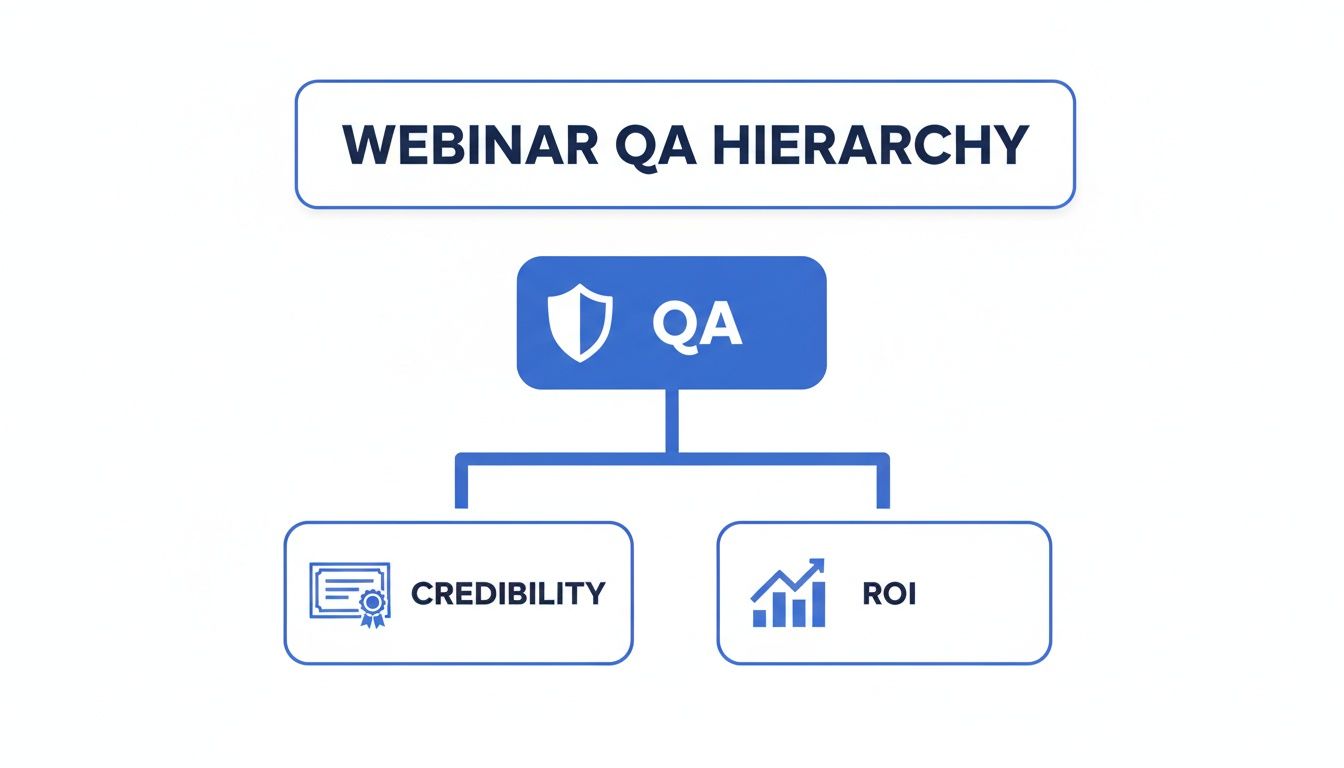
The key takeaway? QA isn't just a tech check. It’s a core business activity that protects your reputation and delivers real commercial results.
1. Technical and Platform Integrity
The most brilliant content in the world is useless if your audience can’t see or hear it. This first pillar is the absolute bedrock of your webinar. It’s all about stress-testing your platform, ensuring your stream resolution is up to scratch (1080p is the standard), and having a solid plan for backup recordings.
Implementation Step: Run a full technical rehearsal 48 hours before the event. Use the exact same computer, microphone, and internet connection that you'll use on the day. This one action can flag bandwidth issues or software conflicts that could completely derail your live event, saving you from a high-stress disaster.
2. Audio-Visual Excellence
Poor audio is the number one killer of webinar engagement. Muffled, echoing, or quiet sound will make attendees drop off faster than anything else. This pillar is all about delivering crystal-clear audio and sharp, professional visuals.
Implementation Step: Mandate that all speakers use an external USB microphone (e.g., a Blue Yeti or Rode NT-USB). A small investment of US$100-US$150 here solves over 80% of common audio issues and dramatically improves perceived quality. Ensure the speaker is well-lit from the front and the camera is at eye level.
3. Content and Brand Cohesion
Your webinar is a direct extension of your brand. Every slide, logo, and talking point needs to feel consistent with everything else you do. This pillar is about making sure everything aligns, from the colour palette on your slide deck to the tone of voice your presenters use.
One of the most common mistakes is using an old slide template or off-brand imagery. It creates a disjointed experience that quietly chips away at your brand’s authority. A quick QA check against your official style guide is all it takes to fix this.
4. Compliance and Accuracy
For any SaaS business in a regulated industry like finance, healthcare, or legal, this pillar is absolutely critical. It involves a final check to verify all content is accurate, up-to-date, and includes any necessary legal disclaimers or GDPR notices. One factual error or a missing compliance statement can have serious blowback. Think of this QA step as your last line of legal and factual defence before you go live.
5. Digital Accessibility
A truly professional webinar is one that everyone can access. This pillar is about being inclusive. To deliver a genuinely flawless experience, you need to think about adding high-quality Webinar Transcription Captions. It also means making sure your registration pages and on-demand content work properly with screen readers. With over 16% of the global population experiencing a significant disability, making your content accessible isn't just the right thing to do—it's smart business.
6. Post-Event Asset Readiness
The value of a webinar doesn't end when the live event is over. This pillar is all about getting your recording ready for its second act as on-demand content. QA checks here involve optimising the metadata for SEO, creating a compelling thumbnail, and ensuring the final edit is clean. This prep work dramatically increases your ROI by turning a single event into a library of lead-generating assets.
7. Performance Analytics
You can't improve what you don't measure. The final pillar is about making sure your analytics are set up correctly to track what matters. This means confirming that your engagement tracking is active, lead scoring rules are applied, and all that valuable data is flowing correctly into your CRM or Marketing Automation Platform. This QA step ensures you can accurately prove your webinar's impact on demand generation and pipeline.
Putting a QA Workflow and Checklist into Practice
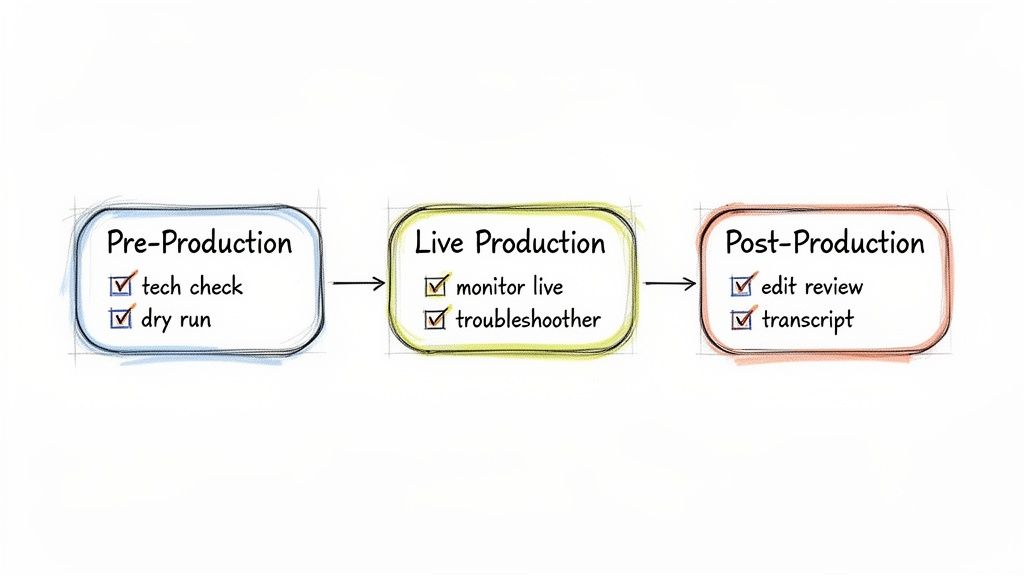
Right, let's turn theory into action. This is where you move from knowing what good looks like to building a repeatable process that delivers it every single time. For B2B SaaS marketing teams, especially when you’re stretched thin, a structured workflow isn’t a nice-to-have; it’s your best defence against chaos and inefficiency.
Without a clear plan, teams end up firefighting—making last-minute fixes that spike stress levels and let preventable errors slip through. A solid QA workflow flips that script. The trick is to break the entire production into three distinct stages: Pre-Production, Live Production, and Post-Production. This approach makes sure every detail gets checked at the right time, by the right person, drastically cutting the risk of those brand-damaging mistakes.
Phase 1: Pre-Production – Nailing the Foundations
This is where you solve 90% of potential problems before they even happen. The pre-production phase is all about proactive preparation. Get the content, tech, and speakers dialled in long before you even think about hitting ‘Go Live’.
One of the most critical steps is a full technical dry run with every single speaker. This isn't just a quick "Can you hear me?" check. It's a proper test of their exact setup—microphone, camera, lighting, and internet connection. This is your only chance to catch the tinny audio from a laptop mic or spot an unstable Wi-Fi connection that could completely derail the live show. For a deeper dive into this stage, our ultimate webinar planning checklist is a great resource.
Key pre-production checks include:
- Content and Branding Review: Go through every slide. Does it match your latest style guide? Check for the correct logos, fonts, and colour palette to ensure the whole experience feels cohesive and professional.
- Speaker Tech Check: Confirm your speaker is using a decent external mic, positioned correctly (about 6-8 inches away is a good rule of thumb), and ideally, an external camera for a crisp, 1080p feed.
- Platform Familiarisation: Make sure every presenter is comfortable with the webinar platform. They need to know how to advance slides, launch polls, and manage the Q&A panel without fumbling.
Phase 2: Live Production – The Eyes and Ears on the Ground
On the day, your focus shifts from prep to active monitoring. The best way to handle this is by assigning a dedicated QA Lead or troubleshooter. This person’s only job is to watch the live feed from an attendee's point of view, keep an eye on the chat for technical complaints, and communicate silently with the production team via a private channel like Slack.
This role is your early warning system. Without a designated troubleshooter, the first person to notice a problem is often an annoyed attendee posting in the public chat. A dedicated QA Lead can flag an audio issue or a frozen screen in seconds, allowing the moderator to address it before it disrupts the entire event.
This person is not the moderator or a speaker. They are the silent guardian of quality, allowing the rest of the team to focus on delivering a killer presentation, confident that someone has their back.
Phase 3: Post-Production – Maximising the Asset’s Value
The work isn’t over when the live session ends. The post-production QA phase is what turns the raw recording into a polished, high-value asset for on-demand viewing and content repurposing. A rushed edit or an inaccurate transcript can completely undermine all the hard work you’ve already put in.
This final review ensures the on-demand version is just as professional as the live event.
Key post-production checks include:
- Editing and Branding Review: Watch the final cut. Are the transitions smooth? Are the branding overlays correct? Have any false starts or awkward silences been trimmed out?
- Transcription and Caption Accuracy: Go through the auto-generated transcript with a fine-tooth comb. Pay close attention to names, industry jargon, and acronyms, as this is where AI often stumbles. Accurate captions are non-negotiable for accessibility and SEO.
- Asset Readiness Check: Before you hit publish, double-check everything on the on-demand page. Is the title right? Is the description compelling? Do you have an engaging thumbnail and a clear call-to-action?
By working through these three phases methodically, you create a predictable system. One that ensures every webinar meets your standards, strengthens your brand, and delivers a real return.
Webinar QA Checklist Template
To make this process even more concrete, here's a practical checklist template your SaaS team can adapt. It assigns clear ownership and tracks progress, ensuring nothing falls through the cracks. It's a simple tool, but it's incredibly effective at bringing order to the pre- and post-webinar chaos.
| Phase | Check Point | Responsible Team Member | Status (Done/Pending) |
|---|---|---|---|
| Pre-Production | All speakers confirmed and briefed on content | Marketing Manager | Done |
| Full technical dry-run completed with all speakers | Technical Producer | Done | |
| Slide deck reviewed for branding and content accuracy | Brand Manager | Done | |
| Landing page and registration form tested and live | Web Team | Done | |
| Promotional emails scheduled and copy approved | Email Marketer | Pending | |
| Live Production | QA Lead assigned to monitor attendee experience | Marketing Coordinator | Done |
| Moderator has final script and Q&A plan | Marketing Manager | Done | |
| All speaker audio and video levels checked 15 mins before go-live | Technical Producer | Done | |
| Post-Production | Raw recording downloaded and backed up | Technical Producer | Done |
| Final video edited for clarity and branding added | Video Editor | Pending | |
| Transcript reviewed and corrected for 100% accuracy | Content Specialist | Pending | |
| On-demand landing page built with video, transcript, and CTA | Web Team | Pending | |
| Follow-up emails to attendees and no-shows scheduled | Email Marketer | Pending |
This checklist transforms the QA process from a vague idea into a series of actionable steps. By integrating it into your workflow, you create a culture of quality that pays dividends with every webinar you produce.
How to Measure the ROI of Your QA Process
For any marketing leader, every investment has to answer one simple question: what’s the return? A solid webinar quality assurance process isn't just about looking professional; it’s a direct driver of business growth. To prove its value, you need to look past vanity metrics like registration numbers and focus on KPIs that draw a clear line between quality and revenue.
Meticulous production has a real impact on how your viewers behave. For instance, data shows that professional, broadcast-quality audio can boost average watch time by up to 40%. When attendees stick around longer, they absorb more of your message, engage more deeply, and are far more likely to become qualified leads. This isn't just a minor detail—it's a huge lever for improving performance.
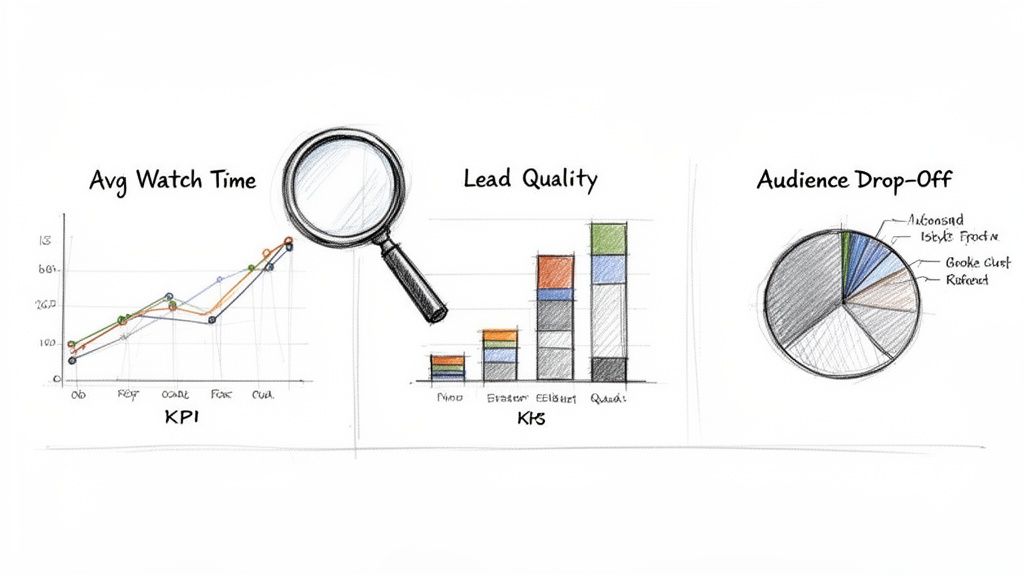
This tangible impact is especially critical in high-value sectors. Think about the UK events industry, where virtual sessions are a cornerstone of business engagement. In 2023, the sector was valued at a staggering £61.65 billion, with business events alone chipping in £33.6 billion.
For marketing leaders in regulated industries, guaranteeing broadcast quality through end-to-end production is absolutely vital. This is where a service like Cloud Present, with its 3–5 day turnaround and compliant transcriptions, really shines. Poor quality will alienate this high-value audience, but professional execution—and repurposing that content into 10+ assets—massively amplifies lead generation.
Key Metrics to Track
To build a compelling business case for investing in webinar QA, you need to track the right data. Here are three critical metrics that connect quality directly to your bottom line:
- Audience Drop-off Rate: This shows you the exact moment viewers lose interest. A sharp drop-off early on? That often points to poor audio or a clunky intro. A quality-assured webinar holds attention, keeping this rate low and ensuring your message gets delivered.
- Key Moment Engagement Score: Pinpoint the most engaging parts of your webinar by tracking poll responses, Q&A submissions, and resource downloads during specific sections. High engagement around key product features or case studies is a strong indicator of a high-quality lead.
- Webinar-Sourced Pipeline Value: This is the ultimate ROI metric. Track the leads generated from a webinar and measure the total pipeline value they represent in US Dollars. Compare the pipeline from high-quality webinars to those with less QA oversight—the difference will speak for itself.
A simple formula to get started is: (Total Pipeline Value from Webinar Leads - Total Cost of Webinar) / Total Cost of Webinar = ROI. This gives you a clear, defensible figure to justify your investment in quality.
To really demonstrate the value of your quality assurance efforts, you need a thorough and accurate way to measure effectiveness, much like you would for a comprehensive meeting ROI calculation. This approach transforms the conversation from a simple cost into a strategic investment.
By focusing on these metrics, you can shift the internal view of webinar QA from an operational task to a strategic function that directly feeds revenue. The data will prove that every dollar spent on professional production, accurate transcriptions, and crisp branding is an investment in a healthier, more valuable sales pipeline. This data-driven approach allows you to justify resources and build a powerful, efficient content engine.
The Strategic Case for Outsourcing Webinar Production
For most B2B SaaS marketing teams, the time, expertise, and sheer focus needed for flawless webinar QA can quickly turn into a major bottleneck.
Every hour spent fiddling with audio settings, correcting slide decks, or editing recordings is an hour stolen from core strategy, campaign planning, or talking to customers. Outsourcing your webinar production isn't just about handing off tasks; it's a strategic investment in efficiency, scale, and a polished brand presence.
This approach transforms webinar production from a high-stress, high-risk activity into a predictable, high-return content engine. It frees up your subject matter experts to do what they do best—deliver brilliant content—while a dedicated production partner handles every technical detail with broadcast-level precision.
Calculating the Hidden Costs of In-House Production
Before writing off outsourcing as just another expense, it’s worth doing an honest audit of the true, often hidden, costs of keeping it all in-house. These costs go way beyond a few software subscriptions.
Think about the real resource drain:
- Staff Hours: Tally up the hours your marketing manager, content specialist, and designer spend on pre-flight checks, live monitoring, and post-show editing. If a single webinar eats up 40-50 internal hours, that's a huge drag on your team's strategic capacity, easily costing thousands in salary time alone.
- Software Fees: A professional tech stack doesn't come cheap. High-end webinar platforms, video editing software, transcription services, and hosting can easily run from US$500 to US$1,500 per month, or even more.
- The High Price of Errors: What’s the real cost of a technical meltdown during a webinar with a C-suite audience? One bad experience can damage brand credibility, lose high-value leads, and undo months of marketing and sales work. This reputational cost often dwarfs every other expense combined.
The Tangible ROI of a Production Partner
Bringing on a specialist partner like Cloud Present completely reframes this calculation. The investment shifts from managing a complicated, error-prone process to securing guaranteed, professional outcomes. Instead of weeks of internal back-and-forth, you get a polished, broadcast-quality webinar delivered in just 3–5 days.
This isn't just a matter of speed; it's about strategic velocity. By compressing the production timeline, your team can get high-value content to market faster, respond more nimbly to industry trends, and maintain a consistent, authoritative presence.
A strategic partner also multiplies your content output. That single one-hour webinar recording is professionally repurposed into over 10 high-impact assets—from social media clips and audiograms to blog post summaries and quote graphics. This systematically solves the relentless demand for fresh content, giving your team a rich library of materials to fuel campaigns for weeks on end. If you're weighing your options, our guide on in-house vs. agency vs. hybrid approaches breaks down the pros and cons of each model.
By outsourcing the technical heavy lifting, you aren’t just buying a service. You are investing in efficiency, mitigating brand risk, and unlocking the potential to scale your content marketing far beyond what your internal team could achieve alone. It's the fastest route to a more professional brand and a more productive marketing engine.
A Few Common Questions About Webinar QA
Even with the best plan in the world, trying to build a proper webinar quality assurance process always throws up a few curveballs. For anyone in B2B SaaS marketing, knowing how to handle these common hurdles is the difference between a virtual event being a source of stress or a reliable engine for generating demand. Let's tackle the questions we hear most often.
What's the Single Biggest QA Mistake You See Teams Making?
Hands down, the most damaging mistake is treating quality assurance like a last-minute tech check just before the webinar goes live. It's a reactive approach, and honestly, it's a recipe for disaster. Real webinar QA is a mindset, a proactive process that should kick in the second you start planning.
When you're only checking audio levels and flicking through slides five minutes before showtime, you have zero time to fix any real problems. What if the speaker's home internet is flaky? What if the key message on the slides is completely off-brand? A last-minute check catches the tiny, superficial stuff but leaves the deep, strategic flaws to blow up in your face live on air.
The goal is to weave QA into every single stage—from the first content brief to the final review of the post-event analytics. This is how you shift from constant firefighting to calm, strategic execution. Quality gets built in from the ground up, not just patched on at the end.
How Much Time Should We Actually Budget for QA?
There’s no magic number here, but a solid rule of thumb is to dedicate 15-20% of your total webinar production time purely to QA tasks. So, if your team usually spends about 40 hours planning, creating content for, and promoting a webinar, you'll want to earmark at least 6-8 of those hours for proper quality assurance.
That time isn't just one big block. It should be spread out across the entire lifecycle:
- Pre-Production: This is where you should invest the most time. Block out 4-5 hours for a full-scale technical dry-run, a detailed content and branding review of the slide deck, and testing every link on your registration and landing pages.
- Live Event: Have one person on your team act as the dedicated QA Lead during the live broadcast (around 1.5 hours for a one-hour webinar). Their only job is to watch the stream from an attendee's perspective and flag issues.
- Post-Production: Set aside 1-2 hours to review the final edited recording, check the transcript for glaring errors, and test the on-demand landing page before you set it live.
Structuring your time this way makes QA a non-negotiable part of your workflow, so it doesn't get squeezed out when deadlines loom.
We're a Small Team. How Can We Possibly Manage All This?
When you're short on resources, you have to be strategic—and a little ruthless—with your priorities. You can't check everything with the same obsessive detail, so you need to focus on the things that have the biggest impact on the audience's experience and your brand's reputation.
Start by creating a simple but non-negotiable "minimum viable QA" checklist. This list should cover the absolute deal-breakers.
Your core checklist should include:
- Audio is King: Make it a rule that every single speaker must use an external USB microphone. This one, low-cost requirement solves over 80% of common audio problems.
- One Proper Dry-Run: Conduct a single, comprehensive technical rehearsal with all speakers at least 48 hours before the event. This is your best shot at catching major technical or content issues while you still have time to fix them.
- Brand & Content Sanity Check: Assign one person to spend 30 minutes scanning the final slide deck against your style guide. Their only mission is to spot obvious branding errors and typos.
- Quick Transcript Review: Don't try to perfect the whole thing. Just focus on correcting the first five minutes of the transcript and any key terms, names, or calls-to-action. That ensures the most-viewed part of your on-demand asset is solid.
For small teams, outsourcing the most time-sucking parts of production can also be a game-changer. Working with a specialist like Cloud Present can give you access to broadcast-level quality without needing an in-house video editor or technical producer, freeing up your team to focus on the content and strategy.
Is QA Different for Pre-Recorded Webinars?
Yes, the focus shifts quite a bit. With pre-recorded webinars, the pressure of a live broadcast evaporates, but the expectation for polished, post-production quality goes way up. Your audience expects a seamless viewing experience, meaning there is zero tolerance for technical glitches, awkward pauses, or shoddy editing.
For pre-recorded events, your webinar quality assurance process should be heavily skewed towards post-production.
Here’s where you need to concentrate your efforts:
- Recording Quality: First things first, make sure the original recording is captured in high resolution (1080p is the absolute minimum) with crystal-clear audio. The old principle of "garbage in, garbage out" has never been more true.
- Editing and Pacing: The final edit needs to be tight. This means cutting out all the filler words ("ums," "ahs"), trimming any dead air, and ensuring the whole thing flows smoothly and keeps people engaged.
- Branded Graphics and Overlays: This is what makes it look pro. Add polished intros, outros, lower-thirds for speaker names, and branded transitions to elevate the final product from a simple screen recording to a professional broadcast.
- Compliance and Accuracy: Because this content will live on forever, a final review for factual accuracy and any necessary legal disclaimers becomes even more critical.
Pre-recording gives you total control over the finished product. A meticulous QA process ensures you use that control to create a flawless asset that represents your brand perfectly.
A robust webinar quality assurance process isn't just a nice-to-have; it's the foundation of a successful virtual event strategy. It protects your brand, engages your audience, and turns your content into a powerful engine for demand generation.
If your team is ready to move beyond amateur-hour webinars and start delivering broadcast-quality content that drives results—without the internal headaches—Cloud Present can help. We become your dedicated production partner, handling everything from recording and polishing to repurposing, so you can get back to focusing on your core marketing strategy.
Discover how Cloud Present can elevate your webinar strategy.


