A Guide on How to Increase Webinar Attendance
Discover how to increase webinar attendance with data-backed strategies. Our guide offers B2B marketers actionable insights to boost registrations and ROI.
You can't just send out a few invitations and hope for the best. To really pack a virtual room, you need a solid strategy before you even think about promotion. This is about building a compelling reason for a very specific person to show up and setting goals you can actually measure, like hitting a 45% attendance rate or generating 50 marketing-qualified leads (MQLs). This groundwork is what separates an average webinar from an event that delivers measurable ROI.
Building a Strategy to Maximise Webinar Attendance
Long before you draft a single promotional email, the fate of your webinar is being decided. For B2B SaaS marketing professionals facing limited resources and constant pressure to generate demand, you need a framework that ties your event directly to business results and maximises your content production efficiency.
And that process doesn’t start with a topic. It starts with an audience.
Define Your Ideal Attendee Persona
You have to move beyond vague job titles. The goal is to build a laser-focused persona that truly understands the day-to-day pressures and technical challenges of your ideal attendee.
Don’t just target "Marketing Managers." Instead, think about the unique challenges facing a "Marketing Operations Manager at a Series B FinTech company struggling with lead attribution" versus a "Content Marketing Lead at an enterprise HR tech firm trying to scale content production." That level of detail lets you craft a value proposition that hits home because it speaks to a problem they're trying to solve right now.
For instance, the Marketing Ops Manager is worried about data integrity and demonstrating ROI to the board. The Content Marketing Lead is focused on efficiency and pipeline influence. Your webinar must promise a practical solution to one of their immediate headaches.
A sharp persona is the difference between a webinar that feels like a generic lecture and one that feels like a private consultation. It’s how you make your audience feel seen—and that’s the first step to getting them to show up.
Set Measurable and Realistic Goals
Forget vague goals like "increase brand awareness." They’re impossible to track and give you no real direction. Your objectives need to be specific, measurable, and plugged directly into your company's marketing and sales funnel. This ensures every decision serves a clear purpose and demonstrates clear ROI.
Before you start, you need to know what success looks like. Is this about lead generation? Pipeline acceleration? Customer retention? The answer changes everything.
To help define success from the outset, here is a simple framework for aligning your webinar goals with tangible business outcomes.
Webinar Goal-Setting Framework for B2B SaaS
| Webinar Objective | Primary KPI | Secondary KPI | Example Goal (SaaS Company) |
|---|---|---|---|
| Demand Generation | Marketing-Qualified Leads (MQLs) | Cost per MQL, Registration Rate | Generate 50 MQLs from a target list of 500 enterprise accounts. |
| Customer Education | Registrations from Client Accounts | Live Attendance Rate, Post-event Feedback | Secure registrations from 25% of our premium-tier customer accounts. |
| Pipeline Influence | Sales Pipeline Sourced | Sales-Qualified Leads (SQLs) | Source US$100,000 in new sales pipeline within 90 days. |
| Audience Engagement | Live Attendance Rate | Average Viewing Time, Questions Asked | Achieve a 45% live attendance rate from all registrants. |
These goals will dictate your entire game plan. A demand generation webinar needs a broad promotional push, while a customer education event calls for a targeted, high-touch invitation process.
By setting these metrics upfront, you create a clear benchmark for success and can show tangible ROI to stakeholders. It’s how you turn your webinar programme from a simple marketing activity into a reliable engine for business growth.
Ready to put this strategy into action? The expert team at Cloud Present can help you plan, produce, and repurpose high-impact webinars that deliver measurable results.
Optimising Your Pre-Event Promotional Playbook
A great webinar doesn’t just happen. It’s the direct result of a smart, sustained promotional campaign that builds momentum over time. Sending a couple of last-minute emails and hoping for the best simply won’t move the needle. To increase webinar attendance, you need a multi-channel, surround-sound approach that keeps your event top-of-mind from the moment you announce it.
I've seen it time and again: effective promotion starts weeks, not days, before the event kicks off. A well-mapped-out timeline gives you the space to layer your messaging, connect with different audience segments, and build genuine anticipation. For B2B SaaS teams where every marketing dollar counts, this strategic planning is the difference between a packed house and an empty room.
It all boils down to three core pillars: understanding your audience, crafting an irresistible value offer, and tying everything back to clear business goals.
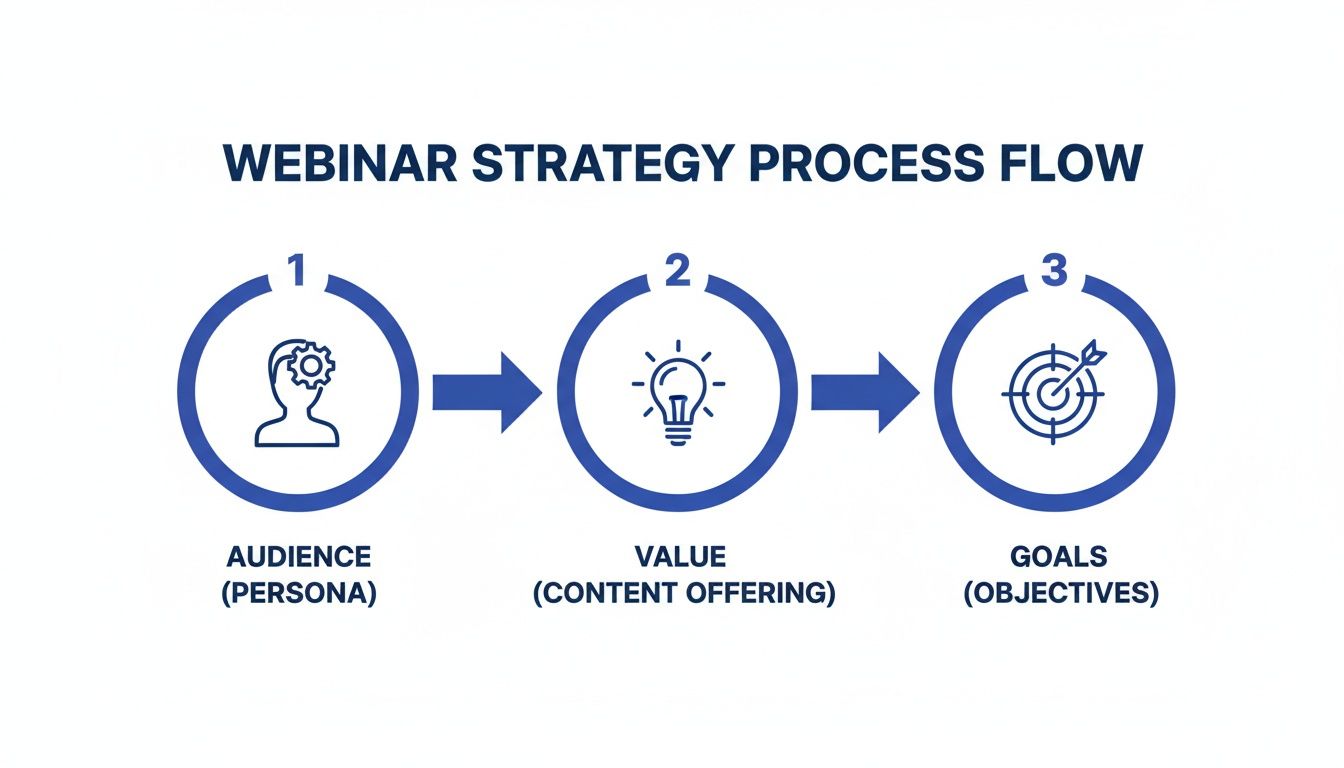
This process makes it clear—without a rock-solid grasp of who you're talking to and what they care about, even the most creative promotional tactics will fall flat.
Crafting a High-Conversion Registration Page
Your registration page is the single most important piece of real estate in your promotional playbook. This is where casual interest converts into a committed attendee, so every single element needs to be optimised for one thing: action. Think of it less as a sign-up form and more as a sales page for your event.
Start by A/B testing your headlines. Pit a benefit-driven headline against a question-based one and see what performs better. For example, you might compare "Master Your Q4 Content Planning" with something like "Is Your Q4 Content Strategy Ready for 2025?". Small tweaks like this can deliver a surprising lift in conversions, sometimes as much as 10-15%.
Your landing page must clearly and quickly articulate:
- The Core Problem: Nail the specific pain point your target audience is wrestling with.
- The Promised Solution: Use sharp, concise bullet points to spell out the key takeaways and practical benefits.
- The Expert Speakers: Feature professional headshots and brief, punchy bios that build credibility.
- The Social Proof: Add logos of well-known companies that have attended past events or client testimonials if you have them.
Your registration page must answer one critical question for the visitor in under five seconds: "What's in it for me?" If the value isn't immediately obvious, they will leave without a second thought.
Deploying a Strategic Email Marketing Sequence
Email is still the undisputed champion for driving webinar registrations, but a single "blast" just won’t cut it. To nurture interest and drive sign-ups, you need a multi-part email sequence that unfolds over several weeks. A well-planned sequence can be responsible for over 50% of your total registrations.
The key is to offer value at every touchpoint, not just hammer the same call-to-action repeatedly.
- Initial Announcement (4 Weeks Out): Introduce the topic, the speakers, and the core problem you’re going to solve.
- Teaser Content (3 Weeks Out): Share something valuable and related, like a surprising statistic, a short video clip from a speaker, or a relevant blog post.
- Speaker Spotlight (2 Weeks Out): Go deeper into your speaker's background. Why are they the perfect person to tackle this subject?
- Final Push (Week Of): Create a sense of urgency with a final reminder and a "last chance to register" message.
This multi-touch approach ensures your webinar stays top-of-mind and builds anticipation, directly contributing to a higher attendance rate.
Expanding Your Reach with Paid Social and Partnerships
To break through the noise and attract fresh faces, you have to look beyond your own email list. This is where strategic partnerships and targeted paid campaigns become crucial for scaling your registration numbers. Co-hosting with a complementary, non-competitive SaaS company can instantly double your promotional reach to a highly relevant audience.
For B2B marketing, LinkedIn is an absolute powerhouse. With a modest starting budget of around US$500, you can run a targeted ad campaign aimed at specific job titles, industries, and company sizes. Aim for a cost-per-registration of US$15-US$25, but keep a close eye on your metrics.
As you plan your pre-event promotions, think about incorporating video. Video ads on LinkedIn often outperform static images, driving higher engagement and lower costs per click. This multi-pronged approach ensures your message reaches your ideal audience, wherever they happen to be.
Perfecting Your Timing and Format for Engagement
All the promotional muscle in the world gets people to your registration page, but it's the 'when' and 'how' of your webinar that convinces them to actually block out their calendars and show up. For the B2B SaaS professionals you're trying to reach, time is a non-renewable resource. If you pick a slot that clashes with their workflow or a format that doesn't scream "tangible value," you’re guaranteed to see your attendance numbers plummet.
This isn’t about guesswork. It’s about using data to align your event with your audience’s professional rhythm. For B2B audiences in the UK and Europe, a clear pattern has emerged that gives savvy marketers a real advantage.
Scheduling Based on Data, Not Guesswork
The classic Monday morning scramble and the Friday afternoon wind-down are webinar dead zones for a reason. Professionals are either planning their week or trying to close it out. The sweet spot is right in the middle, where focus is high and calendars are more receptive to learning opportunities.
Data consistently shows that Wednesdays are the peak day for B2B webinar attendance. In fact, scheduling your webinars on a Wednesday can boost attendance rates for UK B2B audiences to around 48%—the highest of the week. This isn't a fluke; the Tuesday-to-Thursday window captures a whopping 76% of all successful UK webinars. We’ve even seen B2B tech firms achieve 19% year-over-year attendance growth just by sticking to this midweek timing.
The time of day is just as critical. You want to aim for slots that avoid the common lunch hour rush and the chaos at the very start or end of the day.
- 10 AM or 11 AM: This catches professionals after they’ve cleared their morning emails and are ready to settle into focused work.
- 2 PM: This hits that post-lunch productivity window, offering a valuable break from routine tasks without interfering with the end-of-day wrap-up.
By picking these proven time slots, you’re removing a massive barrier to entry and making it that much more likely a registration turns into a live attendee.
Choosing a Format That Delivers on Your Promise
The format of your webinar isn't just a delivery mechanism; it’s a core part of the value you're offering. A mismatch between your content and how you present it can lead to instant disengagement and a poor return on your production investment. Your choice should always be dictated by your primary goal.
- Panel Discussions: Perfect for generating thought leadership and sparking a lively debate. Get a diverse panel of experts together to discuss a high-level industry trend. This format naturally encourages audience questions and creates a dynamic, unscripted feel that builds serious credibility.
- Technical Workshops & Deep Dives: Ideal for customer education or showing off your product expertise. This hands-on format is incredibly effective for topics that need detailed explanation, like mastering a specific software feature or implementing a new marketing automation workflow.
- Fireside Chats: A more intimate, one-on-one conversation with an industry leader or a key customer. This approach is fantastic for storytelling and sharing practical insights, helping you build a much stronger, more human connection with your audience.
The right format makes your content memorable and actionable. A technical deep-dive needs to be a workshop, not a lecture. A debate on industry futures needs the energy of a panel, not a solo presentation. Aligning the format with the content’s purpose is non-negotiable for engagement.
The Strategic Edge of Pre-Recorded Webinars
For B2B SaaS teams where professional quality and brand consistency are paramount, live events can introduce unnecessary risk and logistical headaches. This is where pre-recorded webinars—a speciality here at Cloud Present—offer a decisive advantage.
When you pre-record your session, you move from a live performance to a polished production. This gives you time for meticulous editing, the seamless integration of branded assets, and ensures every piece of information is accurate and on-message. That last point is absolutely critical for maintaining brand standards.
This approach also unlocks huge efficiency gains for your content team. Your subject matter experts can record their segments whenever it suits them, eliminating the stress of trying to coordinate multiple busy schedules for one live slot. The final, broadcast-quality asset can then be scheduled for its "live" premiere at the optimal time, followed by on-demand availability to capture a global audience across different time zones.
To really elevate the experience, particularly in an educational context, you can integrate techniques like an AI teaching hack to boost student engagement. A pre-recorded format gives you the control to weave in interactive elements perfectly, transforming a one-time event into a durable, demand-generating asset that keeps delivering ROI long after its initial broadcast.
Turning Registrations into Live Attendees
Securing a registration is a huge win, but let's be honest—it’s only half the battle. That crucial window between a professional signing up and your webinar going live is where potential attendees are either won or lost for good.
On average, only 35% to 45% of registrants actually show up live. This means every single thing you do in that pre-event window directly impacts your event's ROI. This is all about building anticipation, removing friction, and constantly reminding them of the value they signed up for.
Architecting an Effective Reminder Sequence
A generic "your webinar is starting soon" email is just noise. It’s easily ignored. A strategic reminder sequence, on the other hand, is a powerful nurture campaign that guides people from sign-up to show-up. Your goal is to make joining feel both essential and completely effortless.
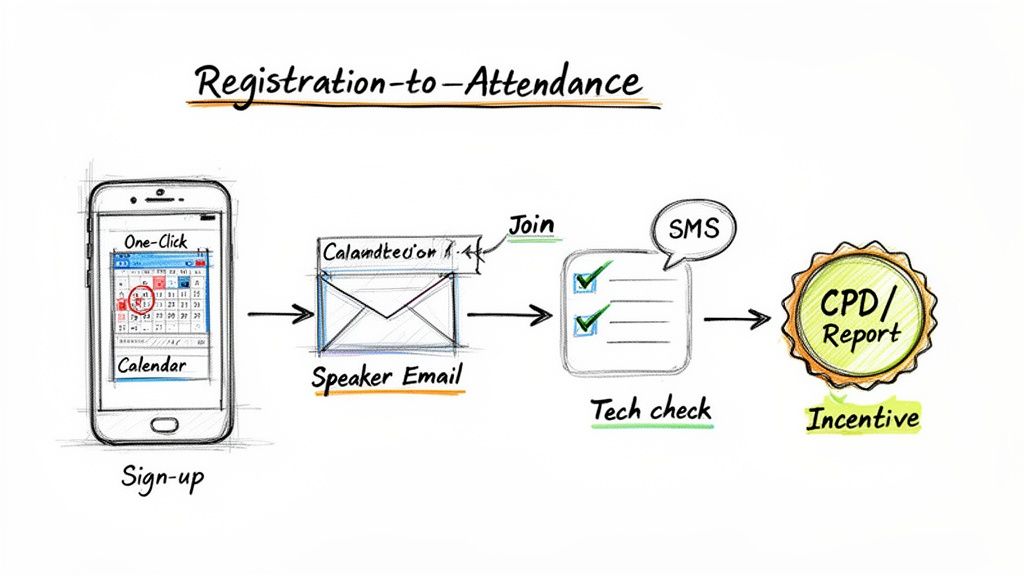
Start immediately after registration. The confirmation email should have a massive, can't-miss "add to calendar" link. This one simple step can boost attendance by 10-15% because it embeds your event directly into their schedule. Platforms like Cloud Present automate this, making it a seamless one-click action for Google Calendar, Outlook, and iCal.
From there, your sequence should unfold methodically:
- One Week Out: Send an email from the main speaker. This personal touch adds a ton of credibility. Even better, include a short, pre-recorded video clip teasing a key insight they'll share live.
- 24 Hours Before: This one is all about logistics. Re-state the start time, provide a clear joining link, and give a quick agenda recap. This is also when you should be doing a final tech check on your end.
- One Hour Before: A final, punchy reminder. An SMS notification here can be a game-changer, cutting through email clutter with open rates often topping 90%.
The best reminder sequences don't just remind; they re-sell the value of attending. Every message should be a micro-moment that reinforces why they registered in the first place, building genuine anticipation.
Using Incentives to Drive Live Attendance
While your content should be the main draw, a well-chosen incentive can be the final nudge someone needs to show up. We’re not talking about generic giveaways. These should be valuable resources that perfectly complement the webinar topic, and they should be exclusive to live attendees.
For B2B SaaS audiences, practical tools and data-driven insights are gold. Highlighting that attendees will receive an exclusive resource adds a tangible, professional benefit that’s tough to ignore.
Other high-value incentives we've seen work well include:
- Exclusive Resources: Offer a comprehensive checklist, a detailed industry report, or an editable template that is only available to those who show up live.
- Early Access: Give attendees first dibs on a new piece of research or a beta version of a tool before it’s released to the public.
- Expert Q&A: Really play up the live Q&A session. Frame it as an exclusive opportunity for attendees to get their specific questions answered by your experts.
When it comes to forecasting how these tactics will perform, data is your best friend. Refining your strategy and setting realistic targets becomes much easier when you can model the potential impact of different variables on your final attendance numbers.
Ensuring a Seamless Technical Experience
Nothing kills attendance momentum faster than tech problems. A registrant who struggles to join in the first two minutes is gone. They will give up and drop off.
To prevent this, your pre-event communications need to proactively tackle potential technical hurdles. In your final reminder email, include clear, simple instructions for joining. Detail any software requirements (though browser-based platforms like Cloud Present eliminate this issue entirely) and provide a link to a test page where they can check their connection and audio settings beforehand.
This small step dramatically reduces last-minute support queries and attendee frustration, ensuring a smooth start for everyone.
Why Smaller Webinars Actually Drive Higher Attendance
In the world of demand generation, the gut reaction is always to go bigger. More registrants, wider reach, larger numbers across the board. But when it comes to webinars, especially for B2B SaaS companies, that logic can backfire. It might sound strange, but the secret to boosting webinar attendance isn't casting a wider net—it's making the net smaller and far more precise.
Focusing on a tight, intimate audience can lead to dramatically higher attendance rates, much deeper engagement, and a healthier ROI. It’s a fundamental shift from just broadcasting a message to hosting a high-value, exclusive conversation.
The Power of Being Hyper-Relevant
When you try to create a webinar for everyone, you often end up creating it for no one in particular. A massive event designed to pull in 1,000+ registrants has to keep the content broad by default. This dilution of focus is exactly what causes the steep drop-off between registration and actual attendance.
On the other hand, a smaller, targeted webinar for under 100 people can be laser-focused on a very specific pain point that plagues a niche audience. That kind of hyper-relevance makes showing up feel non-negotiable.
For B2B SaaS teams, this means ditching the general-interest topics and embracing highly specialised workshops.
- Instead of: "An Introduction to SEO for SaaS"
- Try: "How to Build a Topic Cluster Strategy for Early-Stage B2B SaaS"
The second topic will absolutely get fewer registrants. But the people who do sign up are infinitely more likely to attend because the content speaks directly to the challenges they face every day.
The Data Tells the Same Story
This isn't just a hunch; the data backs it up. In the UK B2B space, running smaller, targeted webinars with fewer than 100 registrants can boost live attendance rates by a solid 5-10.3% over larger events. These intimate sessions often hit a 43% attendance rate, which is better than massive webinars (over 1,000 registrants) that average just 41%.
Think about it: a webinar for marketing leaders on new AI content creation tools. With fewer than 100 sign-ups, you can end up with a packed virtual room where 20-40% convert into qualified leads at around US$55-US$60 per lead. That’s a fraction of the cost of many other demand generation activities. You can dive deeper into UK webinar benchmarks to see how this strategy affects lead quality and cost.
When an invitation promises to solve a very specific, high-stakes problem for a select group, it’s no longer a generic marketing event. It becomes an exclusive strategic briefing. That feeling of exclusivity is a massive motivator for showing up live.
A Real-World Example of Niche Targeting
Let's imagine a marketing automation SaaS company. Instead of hosting a broad webinar on "Email Marketing Best Practices," they produce a 45-minute workshop titled "Building a 5-Step Lead Nurturing Sequence that Converts for E-commerce."
They target their promotion only to Marketing Managers at D2C companies using specific e-commerce platforms, securing 85 registrants. On the day, 45 people show up—a 53% attendance rate.
Because the audience is so uniform, the Q&A is incredibly sharp and valuable. The questions are specific, the challenges are shared, and the solutions are immediately applicable. The company doesn't walk away with hundreds of lukewarm leads; they leave with a dozen high-quality sales conversations, shortening their sales cycle and proving clear ROI.
This approach also makes your content production more efficient. By focusing on persona-specific topics, your team can create high-quality, targeted sessions more frequently, without the resource drain of a "blockbuster" event. With a partner like Cloud Present handling the production side, you can scale this high-impact strategy efficiently, turning your webinar programme into a predictable pipeline engine.
Maximising Your Webinar ROI After The Event
The webinar's value shouldn't evaporate the second the live session ends. For most B2B marketing teams, especially those stretched thin on resources, the real ROI is unlocked in the days and weeks that follow. This is your chance to turn a one-hour event into a demand generation engine that keeps working for you.
First things first: get that on-demand recording out immediately. Send it to everyone who registered, not just the people who showed up. A lot of professionals sign up fully intending to watch it later, and this simple follow-up can boost your total viewership by a massive 30-40%.
The Content Repurposing Flywheel
Think of a high-quality webinar as a goldmine of content. Instead of just ticking a box and moving on to the next project, the smartest content teams build a "repurposing flywheel" to maximise their investment and efficiency. We've seen teams spin a single, polished one-hour webinar into over 10 high-impact marketing assets.
This whole approach is about tackling the constant pressure for new content without burning out your team. It’s about working smarter, not harder, to nurture leads and cement your company as a thought leader.
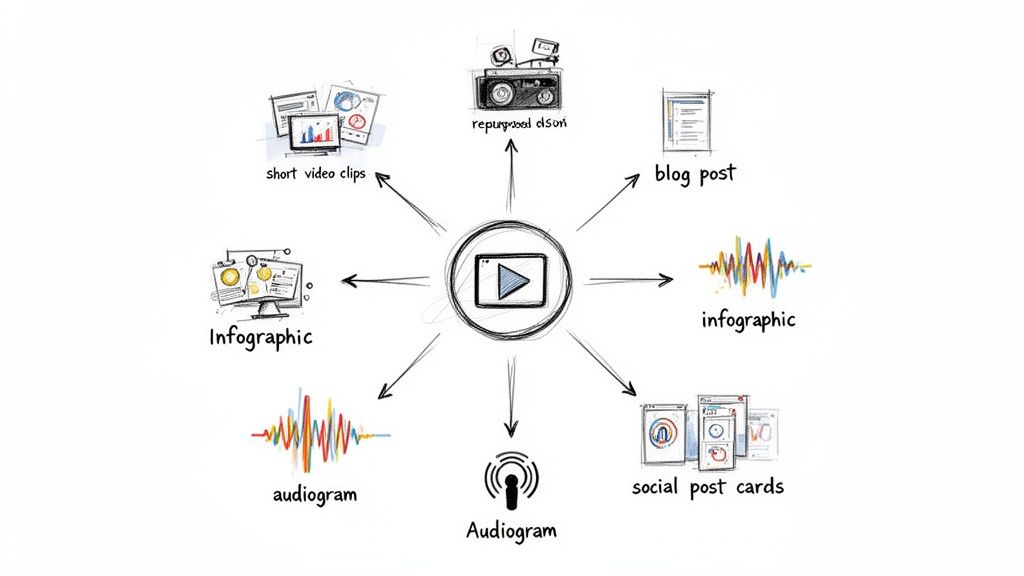
Treat your webinar as the 'pillar' asset in a larger campaign. The game is to atomise the core recording into bite-sized pieces you can drip out across different channels for weeks, keeping the conversation alive and well.
From One-Hour Event to a Full Campaign
Here’s a tangible plan for turning that recording into a multi-asset campaign that drives continuous engagement.
- Short Video Clips (3-5 assets): Snip out the best bits—key insights, surprising stats, or a compelling quote from a speaker—and turn them into 30-60 second clips. These are absolute gold for LinkedIn. Post one a week to keep the topic in people's feeds.
- Detailed Blog Post (1 asset): Write a comprehensive article that summarises the key takeaways. Crucially, embed the full on-demand recording and those short video clips right into the post. This gives people options for how they want to engage.
- Audiogram Snippets (2-3 assets): Take the most powerful audio segments and convert them into audiograms with your branding and captions. This makes your content accessible on platforms like LinkedIn where people often scroll with the sound off.
- Key Takeaways Infographic (1 asset): Visualise the most important data points or the core framework from the presentation into a clean, shareable infographic. It’s a fantastic, high-value asset for social media and your follow-up emails.
By systematically pushing these assets out, you're creating multiple new touchpoints for your audience. You’re not just reinforcing your company's expertise; you’re making sure you squeeze every drop of value from your production efforts. For a deeper dive, check out our guide on creating an effective post-webinar follow-up strategy.
Frequently Asked Questions
What's a good attendance rate for a B2B webinar?
In the B2B SaaS world, a healthy attendance rate usually lands somewhere between 35% and 45% of the people who signed up. This tells you your promotion hit the mark and the topic is genuinely interesting.
But that’s just a benchmark. If you're running a session on a super-specific, niche topic—say, a technical workshop for DevOps engineers—don't be surprised if that number jumps to 50% or even higher. The more targeted your content, the more committed your registrants are to showing up live.
How far ahead should I start promoting a webinar?
You'll want to give yourself a runway of about four to six weeks. I know it sounds like a lot, especially since most people sign up in the final week, but starting early is a non-negotiable for B2B marketers.
This longer timeframe lets you do more than just send out a few announcement emails. It gives you the space to build real momentum, lock in co-marketing partners, and create teaser content that gets people talking. Think of it less as a one-off announcement and more as a sustained conversation that builds anticipation over time.
Should I bother sending out an on-demand recording?
Absolutely. Not offering a recording is one of the biggest missed opportunities I see. You've got to send the replay link to everyone who registered, whether they attended or not.
Here’s why: many busy professionals register fully intending to watch the replay on their own schedule. By sending out that on-demand version, you can easily boost your total viewership by 30-40%. It extends the life of your content and makes sure your hard work reaches the widest possible audience—a simple step that pays huge dividends for your content ROI.
Ready to turn your webinars into high-performing, lead-generating assets? Cloud Present acts as your outsourced production studio, handling everything from planning and polishing to repurposing. Learn how we deliver broadcast-quality webinars that drive results.


