A Modern Playbook to Promote Your Webinar and Drive ROI
Discover how to promote your webinar with our proven playbook for B2B marketers. Learn actionable strategies to boost registration, engagement, and ROI.
To execute your webinar promotion with professional precision, you must establish a strategic foundation before a single campaign goes live. This is about defining clear business goals, articulating a compelling value proposition for your audience, and setting the right KPIs to measure success and prove ROI. This initial planning is what separates a forgettable online event from a powerful demand-generation engine.
Building Your Webinar Promotion Foundation
Too many B2B SaaS marketing teams jump straight into tactics. They begin writing email copy or designing social graphics without locking in the strategy first. This is a recipe for wasted budget, low registration numbers, and an underwhelming return on investment. Before you even consider sending an invite, you need to lay the groundwork. This ensures every promotional activity is targeted, purposeful, and measurable. We're not just selecting a topic; we're aligning a virtual event with tangible business outcomes.
For content teams and marketing professionals working with limited resources, this foundational work is an efficiency multiplier. It prevents the costly mistake of promoting the right message to the wrong people or, even worse, promoting the wrong message entirely.
Define Your Objectives and KPIs
First, you must answer the critical question: "What business goal will this webinar achieve?" It's easy to get caught up in vanity metrics like the total number of sign-ups. Avoid this. Instead, focus on goals that directly impact your sales pipeline and revenue.
Your objectives must be specific and measurable. Consider goals such as:
- Generate 75 marketing-qualified leads (MQLs) from a target list of enterprise accounts.
- Achieve a 30% attendee-to-demo request conversion rate.
- Source US$100,000 in sales pipeline within 90 days of the event.
Once you have these objectives locked in, you can establish the KPIs that will track your progress. These aren't just for a post-event report; they are the signposts for your promotional campaigns. Key KPIs should include Cost Per Registration (CPR), Landing Page Conversion Rate, MQL Conversion Rate, and, of course, Webinar-Sourced Revenue. Tracking these helps you optimise your spend and your efforts in real-time.
A webinar without clear, business-focused objectives is just a presentation. But a webinar tied to specific MQL or pipeline goals? That becomes a strategic investment, making it far easier to secure budget approval and demonstrate your team's value to leadership.
Craft a Laser-Focused Value Proposition
Your value proposition is the core of all your promotional messaging. It must instantly answer your ideal attendee's most critical question: "What's in it for me?" Get this wrong, and you'll see the impact in your low click-through rates and disappointing landing page conversions.
To build a compelling proposition, you need to articulate the tangible outcome or skill an attendee will walk away with. Vague promises won't suffice. For example, instead of a generic statement like "Learn about AI in marketing," a much stronger proposition would be, "Discover how to cut your content production time by 40% using three new AI tools." The difference is clear: it's specific, benefit-driven, and solves a real pain point for marketing teams facing pressure to increase content output. You can find more tips for laying this groundwork in our ultimate webinar planning checklist.
Develop a Detailed Attendee Persona
You cannot effectively promote your webinar without a crystal-clear picture of who you are trying to reach. A detailed attendee persona goes far beyond job titles and company size. It delves into the specifics of their daily challenges, their professional goals, and their online behaviour.
Ask yourself these kinds of questions:
- What are their biggest pain points that our webinar topic solves?
- Which LinkedIn groups are they active in? Which industry influencers do they follow?
- What language and tone will resonate with them?
- What is their primary motivation for attending a webinar—learning a new skill, staying ahead of industry trends, or actively evaluating solutions?
This persona becomes the blueprint for every creative and targeting decision. It will dictate the copy on your LinkedIn ads, the angle of your email subject lines, and the partners you choose to collaborate with. It is how you ensure every promotional dollar is spent reaching precisely the right people.
Your Multi-Channel Pre-Launch Promotion Blueprint
You’ve established the strategy. Now it’s time to build the promotional engine that drives registrations. An effective pre-launch campaign is not about blasting the same message everywhere. It is a coordinated effort—a series of thoughtful touchpoints across different channels that build genuine momentum.
For B2B SaaS content teams, this is where efficiency is realised. You are constantly under pressure to generate demand with limited time and budget. Instead of starting from scratch for every platform, you adapt your core message to fit the channel. This maintains consistency and makes your webinar unmissable.
This all begins with a solid foundation: clear objectives, a deep understanding of your audience, and the KPIs you’ll use to measure success.
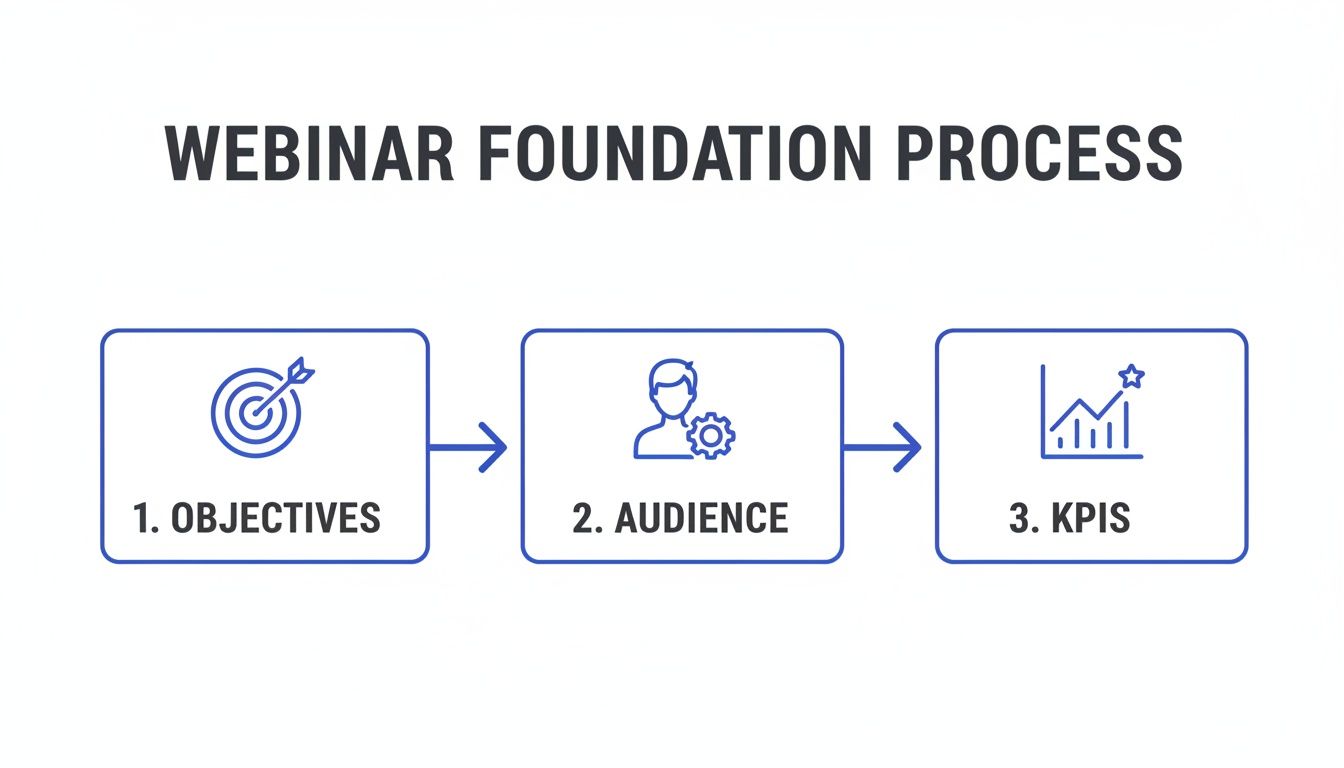
As you can see, a successful promotional plan is mapped out long before the first email is sent. Each step builds on the last, creating a targeted, measurable campaign.
Mastering Email Marketing for Webinar Registrations
Email remains one of the most reliable channels to promote your webinar, consistently delivering high-quality registrants. The key is to nurture interest with a strategic sequence, not just a single announcement.
Here’s a simple, proven structure:
- The Announcement (3-4 weeks out): This is your launch. Present a powerful value proposition, introduce your speakers, and be explicit about the key learning outcomes. Your goal is to build initial buzz and secure early registrations.
- The Value-Add Reminder (1 week out): It's time for a reminder. Re-engage non-openers by changing the angle. Highlight a surprising statistic that will be covered or share a compelling quote from a speaker. This keeps your event top of mind.
- The 'Last Chance' Push (24-48 hours out): This is where you create urgency. Use subject lines like "Last chance to register" or "Our webinar is tomorrow". This final email often drives a significant spike in sign-ups, accounting for 20-30% of total registrations in many campaigns.
Throughout the sequence, make your call-to-action (CTA) prominent and clear. Use bold, action-oriented buttons like "Save My Spot" to drive traffic to your landing page.
Leveraging LinkedIn for Organic and Paid Reach
For any B2B SaaS company, LinkedIn is non-negotiable. It is the primary professional network where your ideal customers are active. Your approach here should be two-pronged: organic conversation and hyper-targeted paid advertising.
On the organic side, do not simply post a registration link. Start a conversation. Ask a provocative question related to your webinar’s topic to stimulate discussion in the comments. Be sure to tag your speakers and their companies to leverage their networks—a single share from an influential speaker can easily double your organic reach.
Your speakers are your most valuable promotional assets. Make it exceptionally easy for them to contribute by providing a "promo pack". Include pre-written posts, custom graphics, and a unique tracking link. When it's effortless, they will share.
When it comes to paid promotion, LinkedIn’s targeting capabilities are unparalleled. You can get incredibly granular, targeting by job title, industry, company size, and specific skills. For a webinar aimed at marketing managers in fintech, a starting budget of US$500-US$1,000 for a two-week campaign can deliver a steady flow of qualified leads. Always test your creative—pit a short video clip from your speaker against a static graphic and analyse which drives the lowest cost per registration.
Forging Strategic Partnerships to Expand Your Audience
Why do all the promotional heavy lifting yourself? Partnering with complementary, non-competing brands is one of the most efficient ways to get your webinar in front of a fresh, relevant audience. You essentially double your promotional power without increasing your budget.
Look for companies that serve the same customer profile but solve a different problem. For instance, if your webinar is about content analytics, a partnership with a project management tool is a logical fit. Both products are part of the marketing team's toolkit. To execute this, you’ll need a solid plan for coordinating your efforts. You can learn more about crafting an effective multi-channel content strategy to keep everything aligned.
Once you’ve found the right partner, propose a simple co-marketing agreement:
- Co-branded materials: Create a shared landing page and promotional assets featuring both logos.
- Cross-promotion: Both parties agree to promote the webinar to their respective email lists and social channels.
- Shared speaking slot: Feature an expert from the partner company as a guest speaker to add value and credibility.
This is not just about driving registrations; it's about building authority through association. A modern multi-channel marketing strategy will show you how to fully integrate these tactics. By combining the power of email, LinkedIn, and strategic partnerships, you create a layered promotional campaign that all but guarantees your webinar will be a success.
Optimising Your Landing Page for Maximum Registrations
Every one of your promotional channels, from your email sequences to your paid LinkedIn campaigns, is designed to funnel traffic to one critical destination: your registration page. If this page is slow, confusing, or uninspiring, you will lose high-value prospects, effectively sabotaging your promotional budget and effort. Every element must be meticulously designed to convert a curious visitor into a confirmed attendee.
For busy B2B content teams, a high-converting landing page is the ultimate efficiency tool. It ensures the traffic you work so hard to generate translates into measurable results like MQLs and sales pipeline. This isn't just about aesthetics; it's about creating a frictionless journey from interest to registration.
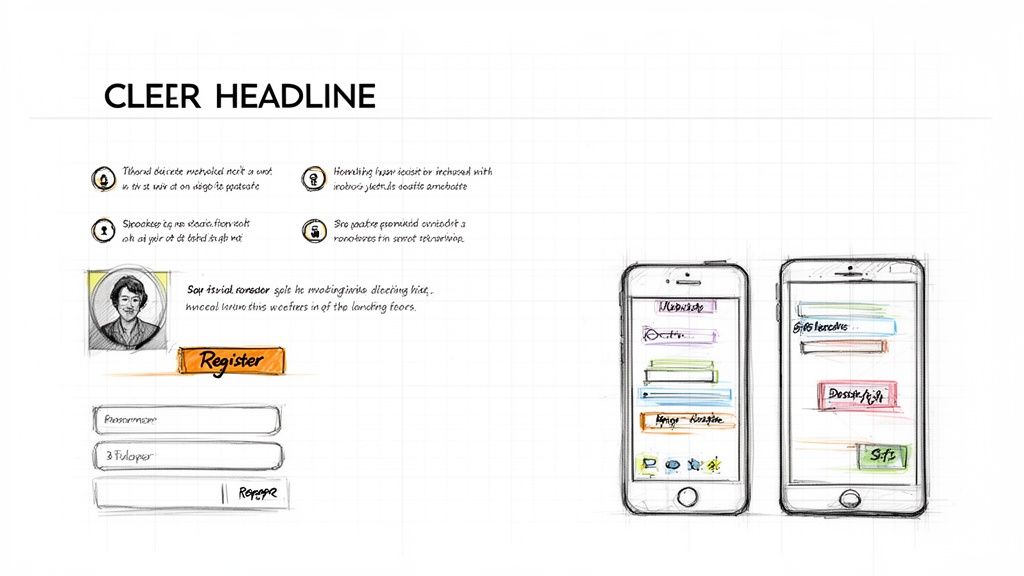
Anatomy of a High-Converting Page
Your landing page must quickly and convincingly answer the visitor's "what's in it for me?" question. They need to grasp the value proposition within seconds, or they will leave.
A successful page combines several key components that work in harmony:
- A Benefit-Led Headline: Do not just state the webinar title. Instead of "Webinar on AI Tools," try "How to Cut Content Production Time by 40% with 3 AI Tools." The difference is clear.
- Compelling Copy: Use clear, scannable bullet points to list the specific, tangible takeaways attendees will gain. Always focus on the outcomes they will achieve, not just the features you will discuss.
- Professional Speaker Bios: Feature your speakers prominently with high-quality headshots and brief bios. This is not vanity; it is about establishing their authority and giving attendees a reason to trust the content.
- Clean, Uncluttered Design: Utilise generous white space, a clear visual hierarchy, and on-brand imagery. All elements should guide the user's eye directly to the call-to-action.
To ensure your registration page is performing optimally, it is vital to apply key landing page design best practices.
The Form Field Optimisation Challenge
This is a classic marketer's dilemma: how much information should you request? More fields provide your sales team with richer lead data, but every additional field creates friction and can increase form abandonment. It’s a balancing act. In fact, one study found that reducing form fields from 11 to just four can boost conversions by an incredible 120%.
The solution is to find a strategic middle ground. Start with the absolute essentials:
- First Name
- Last Name
- Work Email
- Company Name
If your sales team requires more data, such as Job Title or Company Size, investigate using progressive profiling tools. These technologies gather this information over time, across multiple touchpoints. This approach keeps the initial barrier to entry extremely low, which is crucial for maximising registration numbers. For a deeper dive, check out our guide on webinar landing page best practices.
Technical Essentials and A/B Testing
Even with brilliant copy and a streamlined form, poor technical performance will kill your conversion rates. Page speed is non-negotiable; a mere one-second delay in load time can reduce conversions by 7%. Your page must also be fully responsive, providing a seamless experience on mobile devices where a significant portion of your audience will likely first encounter your promotion.
In the competitive UK B2B landscape, webinars deliver an impressive average 213% ROI with a cost-per-lead as low as £58. This statistic underscores why savvy UK marketers are turning to webinars to stretch their budgets further while filling sales pipelines with qualified prospects. Learn more about the impact of webinar marketing in the UK.
Finally, stop guessing and start testing. Simple A/B tests can lead to significant increases in your registration rate. The key is to test one variable at a time to get clear, unambiguous results.
Here are a few high-impact elements to begin testing:
- Headline: Pit a question-based headline against a statement-based one.
- Call-to-Action (CTA) Button Copy: Compare a standard "Register Now" against a more benefit-driven phrase like "Save My Spot."
- Hero Image: Test a graphic featuring your speakers against a more abstract, conceptual image related to the topic.
Mastering the Launch Week and Post-Event Follow-Up
The final few days before your webinar are a critical period. It’s about converting last-minute, on-the-fence registrants into live attendees and transforming your promotional work into a fully engaged virtual audience. For busy B2B SaaS teams, this "final push" is paramount. Live attendance almost always translates to higher engagement and a more direct path through the sales funnel.
However, once the event concludes, the real work begins. A sophisticated post-event strategy is what distinguishes a one-off presentation from a content asset that generates demand for months. This requires a smart, segmented approach to ensure every individual—whether they attended or not—receives the right message to guide them to the next step. It’s about converting initial interest into a tangible business opportunity.
The Final Push to Boost Live Attendance
The 48 hours leading up to your webinar are your last, best chance to combat the no-show rate, which can easily reach 40-50% for B2B events. This is no time for generic reminders. It’s time to amplify the excitement and create a sense of FOMO (fear of missing out).
One effective tactic is to create simple countdown graphics or short video snippets for LinkedIn, ensuring you tag your speakers. A quick post that says, "Tomorrow! Join our expert panel to learn three actionable tactics for reducing churn. Are you ready?" achieves two things: it builds social proof and keeps your event top-of-mind in a crowded feed.
Simultaneously, your email campaign must shift into its final phase:
- 24-Hour Reminder: This email is not just a reminder; it's a final value proposition. Frame it as the last chance to gain specific insights. For example, "Don't miss out on the framework that helped our clients boost MQLs by 25%."
- 1-Hour "Going Live" Alert: This email should be short and direct. A simple "We're starting in one hour – Join us here" is all you need. It's a functional nudge that catches people at their desks.
These final communications are what convert a registrant into an active, engaged attendee, directly impacting the quality of leads you hand over to sales.
Smart Segmentation for Post-Webinar Follow-Up
Sending a single, generic "thanks for attending" email to everyone is a significant missed opportunity. To properly nurture these leads, you must segment your audience based on their engagement with the event. At a minimum, divide your list into two fundamental groups: attendees and no-shows.
Your follow-up is not just a polite gesture; it’s a critical sales enablement function. A well-segmented and timely follow-up can increase lead conversion rates by over 15%, ensuring the investment in your webinar translates directly to the pipeline.
For attendees, the goal is to continue the conversation. Your first email, which should arrive in their inbox within a few hours of the event ending, must include:
- A link to the on-demand recording.
- A downloadable copy of the slide deck.
- Links to any articles, tools, or resources mentioned during the session.
For no-shows, the objective is entirely different. Your "sorry we missed you" email should convey that you still value their interest. Provide them with the on-demand recording and frame it as an exclusive opportunity to catch up on what they missed. This simple, targeted action keeps them within your marketing funnel.
Nurturing Leads for a Smooth Sales Handoff
The primary purpose of running a webinar is to generate qualified leads that convert into customers. This requires a structured nurturing sequence and a clear handoff process to your sales team.
Your segmented follow-up emails are just the beginning. The subsequent communication should be designed to move prospects further down the funnel.
Post-Webinar Follow-Up Communication Matrix
To maximise engagement and nurture leads effectively, you need a plan. Do not just send random emails; segment your communication based on your audience and your desired next action. This matrix provides a simple but powerful framework for structuring your follow-up.
| Audience Segment | Primary Objective | Recommended Content | Timing |
|---|---|---|---|
| Engaged Attendees | Accelerate sales conversation | Case studies related to webinar topic, demo invitations | 2-3 days post |
| Passive Attendees | Re-engage and educate | Related blog posts, short video clips from the webinar | 3-5 days post |
| No-Shows | Provide value, gauge interest | On-demand recording, a single key takeaway infographic | 1-2 days post |
| All Registrants | Long-term nurture | Add to monthly newsletter, invite to next relevant event | 1-2 weeks post |
This structured approach ensures every interaction has a purpose.
For highly engaged attendees—those who asked questions or were active in polls—a personalised email from a sales development representative (SDR) is highly effective. This outreach creates a direct bridge from the educational content of the webinar to a sales-focused conversation. It ensures the US$50,000 or more in potential pipeline you just generated does not fall through the cracks.
This systematic approach transforms your webinar from a single event into a reliable, evergreen demand generation engine.
Turning Your Webinar Into a Content Goldmine
A high-quality webinar does not end when the live session concludes. Especially for resource-constrained B2B SaaS marketing teams, treating a one-hour webinar as a one-off event is a monumental waste of potential.
Instead, you should view it as the raw material for weeks, or even months, of high-value content that can fuel your entire marketing engine. This approach addresses the persistent ‘what do we post today?’ problem and dramatically increases the ROI on your initial production investment.
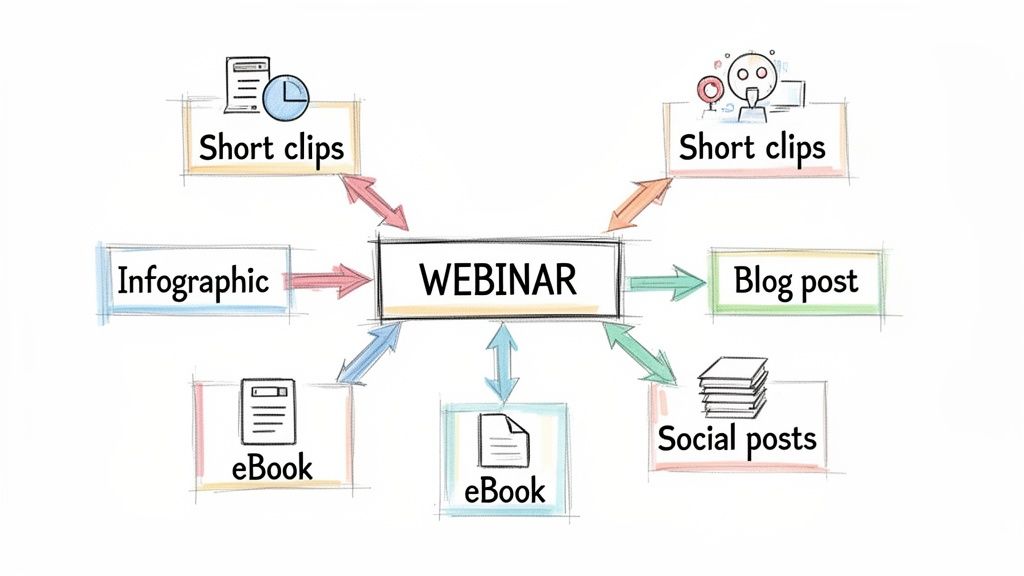
The key is to think like a content strategist from the outset. Your webinar isn't just a presentation; it's a content ecosystem in waiting. Every key talking point, surprising statistic, and insightful audience question is a potential asset. By systematically deconstructing the event, you can create a library of content that serves different channels and buyer stages, from top-of-funnel awareness to bottom-of-funnel decision-making.
From Recording to Revenue Engine
The first step is to obtain a clean, polished recording and an accurate transcript. This is your source material. At Cloud Present, we manage this entire production process, delivering broadcast-quality edits and transcripts within days, so your team can focus on the strategic work of repurposing. Once you have these core assets, the content repurposing begins.
Here’s a practical framework for turning that single recording into a multi-format content campaign:
- Create Snackable Video Clips: Isolate the most impactful 1-2 minute segments from your webinar. These could be a speaker’s powerful opening statement, a surprising data point, or the answer to a common audience question. Add branded overlays and captions, then distribute them on LinkedIn. These clips are perfect for capturing attention and driving traffic back to the full on-demand recording.
- Design Data-Driven Infographics: Extract the most compelling statistics and key takeaways. A good webinar is packed with data; a single infographic can visualise 3-5 of these points in a highly shareable format. Post it on your blog and social channels, and include it in your post-event nurture sequence to reinforce the value delivered.
- Write In-Depth Blog Posts: Use the webinar transcript to create several detailed blog posts. Each major sub-topic covered in the webinar can become its own article. This not only provides valuable, SEO-friendly content for your website but also establishes deeper authority on the subject.
This approach is gaining significant traction. UK marketing professionals are increasingly embracing webinars as a core strategy, with 28% currently using them and planning to ramp up efforts in 2025. This enthusiasm reflects a broader shift towards virtual formats that deliver measurable results, especially for B2B audiences in professional services. You can learn more about the rise of digital marketing in the UK.
A single webinar can generate over 10 distinct pieces of repurposed content. This isn't just about efficiency gains; it's about surrounding your target audience with valuable insights across multiple touchpoints, reinforcing your message and accelerating their journey through the funnel.
Fuelling the Funnel with Repurposed Assets
Each piece of repurposed content has a specific role. Do not just create them; deploy them strategically to align with different stages of the buyer’s journey. This ensures you are not only visible but also relevant at every step.
A well-organised distribution plan might look like this:
| Marketing Funnel Stage | Repurposed Asset | Primary Distribution Channel | Key Metric |
|---|---|---|---|
| Top of Funnel (Awareness) | Short video clips & infographics | LinkedIn, Twitter | Impressions, Engagement Rate |
| Middle of Funnel (Consideration) | Detailed blog posts, on-demand recording | Organic Search, Email Nurturing | Time on Page, On-Demand Views |
| Bottom of Funnel (Decision) | Gated eBook or comprehensive guide | Landing Pages, Paid Retargeting | Lead Conversions, Demo Requests |
For example, use your short video clips to attract new audiences on LinkedIn (top of funnel). Those who engage can then be retargeted with ads that lead to a blog post expanding on that clip's topic (middle of funnel). Finally, the blog post can feature a call-to-action to download a comprehensive eBook—created from the full webinar transcript—in exchange for their contact details (bottom of funnel).
This systematic approach transforms a fleeting live event into a perpetual demand generation asset. It ensures that the effort put into one webinar continues to deliver qualified leads and tangible ROI long after the broadcast ends, solving the relentless need for consistent, high-quality content.
Your Top Webinar Promotion Questions, Answered
When you're immersed in the details of planning a webinar, a few key questions inevitably arise. How early is too early to start promotion? How do you maximise live attendance? And what’s the most effective way to prove it was a worthwhile investment?
Let's break down some of the most common queries from B2B marketing professionals, with actionable advice to help you refine your strategy.
What is the Ideal Promotional Timeline?
The optimal window is to begin promotion three to four weeks before the live date. This provides sufficient runway to build momentum without causing audience fatigue.
Consider it a phased approach. Your initial announcement email can go out around the four-week mark. From there, maintain a steady drumbeat of promotion across social media and partner channels.
Then, in the final week, execute the main push. This is when you increase the urgency with reminder emails and social media countdowns to drive home that "last chance" feeling and mitigate no-show rates.
How Can We Increase Live Attendance?
Maximising live attendance is the primary goal. It’s where genuine engagement occurs and where you can qualify leads in real time. Standard reminder emails are essential, but the real secret is to tease something exclusive that people can only get by attending the live session.
This is not just about saying "be there." It's about providing a tangible reason. This could be a free template, a special Q&A with an industry expert, or a limited-time offer on your product. Highlighting this exclusivity in your final 24-hour reminders creates a powerful sense of FOMO that is surprisingly effective at converting registrants into attendees.
I've seen this firsthand. While the average B2B webinar attendance rate hovers around 40-50%, offering a truly valuable, live-only incentive can push that figure closer to 60%. That represents a significant increase in the number of engaged leads from a single event.
What is the Best Way to Measure Promotional ROI?
If you are only tracking registration numbers, you are missing the bigger picture. To gain a true understanding of your return on investment, you must track the entire journey, from the first promotional click all the way to closed business.
Here are the metrics that truly matter:
- Cost Per MQL: This is your baseline. Divide your total promotional spend by the number of marketing-qualified leads generated. It tells you the exact cost to acquire a quality lead.
- Pipeline Contribution: This is where the ROI becomes clear. Use your CRM to track how many attendees requested a demo and what the total sales pipeline value is. For example, if you spend US$5,000 on a webinar that generates US$100,000 in pipeline, that's a 20x return. That is a number you can report to your leadership team.
- Lead-to-Customer Conversion Rate: The ultimate test of success. Monitor how many webinar-sourced leads convert into paying customers over time. This metric tells the full story of your campaign's impact.
Ready to turn your webinars into a professional demand generation engine? As a strategic partner, Cloud Present acts as your outsourced production studio. We handle everything from broadcast-quality recording to the strategic repurposing of your content, ensuring it continues to deliver value long after the live event is over.


