A Modern Multi-Channel Content Strategy for B2B SaaS Marketers
Unlock the power of a multi channel content strategy. Learn to transform one webinar into 10+ assets, driving ROI and generating leads for your B2B firm.
A multi-channel content strategy is about working smarter, not harder. For B2B SaaS marketing teams battling limited resources, it means creating one high-value webinar and then repurposing it to fuel demand generation across all your key channels. That single, professionally produced session can be methodically atomised into blog posts, social media clips, email nurture sequences, and more. It’s the key to maximising your return on investment (ROI) and maintaining a consistent content output without burning out your team.
Why Your B2B SaaS Marketing Needs a Multi-Channel Content Strategy
The pressure on B2B SaaS marketing teams is immense. You're expected to generate a consistent pipeline of qualified leads, often with a tight budget and the constant need to prove ROI. A multi-channel content strategy isn't just a ‘nice-to-have’—it’s a strategic necessity to solve the pain points of inconsistent output and resource constraints. It's time to get off the content creation hamster wheel and build a scalable system that delivers measurable results.
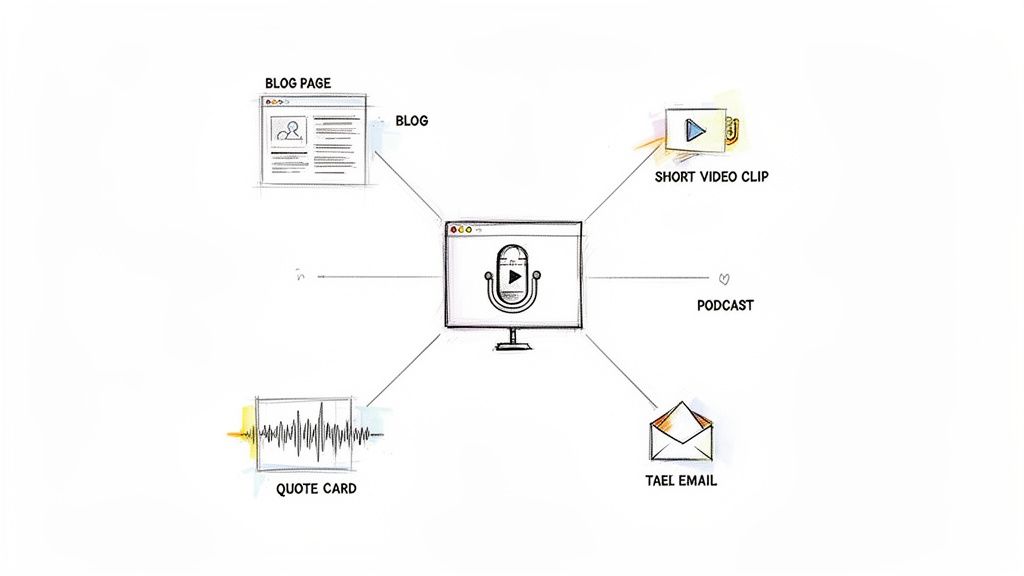
The solution is to build a sustainable content engine that ends production bottlenecks while amplifying your company's thought leadership. The central concept is content atomisation: the art of taking one powerhouse asset, like a webinar, and spinning it into more than ten distinct pieces of high-performing content.
From One Webinar to an Entire Demand Generation Campaign
Picture this: you produce a single, broadcast-quality webinar with an in-house subject matter expert. Instead of being a one-off event, it becomes the strategic core of your marketing for the next quarter. That one recording can be cleverly repurposed into:
- Lead Generation Assets: A gated, on-demand version of the webinar to capture high-intent leads actively researching solutions like yours.
- SEO-Driving Content: A detailed summary blog post and a full transcript to attract valuable organic traffic from search engines.
- Social Media Engagement: Short, impactful video clips and compelling quote graphics to dominate your LinkedIn feed for weeks.
- Nurture Sequences: Targeted email campaigns that leverage webinar insights to guide prospects through your sales funnel.
This approach directly addresses the pain points of stretched resources and the need for consistent content. You achieve maximum value from every minute your experts invest. Data shows that companies with strong multi-channel strategies see engagement rates over 300% higher than those with single-channel approaches. This translates directly to efficiency and pipeline growth.
By building your strategy around a central, repurposable asset, you shift from a content treadmill to a content ecosystem. Every piece works together to reinforce your message, establish authority, and drive measurable business outcomes.
Ultimately, it all comes down to efficiency and impact. To truly make a multi-channel strategy sing, it’s vital to understand how to boost video engagement in your content strategy and ensure every asset pulls its weight. As we’ll see, the B2B buyer has changed, and a video-first marketing approach is no longer optional.
Building Your Webinar Content Engine
Before you can execute a powerful multi-channel content strategy, you need a high-value "pillar" asset to build upon. This is where a broadcast-quality, pre-recorded webinar comes in.
Don’t think of it as a one-off event. Think of it as the raw material for an entire demand generation campaign—it's your central content engine.
However, creating a webinar that is designed for repurposing requires a different mindset than just hitting 'record' on a live session. Every element, from topic selection to narrative structure, must be intentional to maximise efficiency gains later on.
Choosing Topics That Address High-Value Customer Pain Points
The best webinar content addresses the most pressing challenges your ideal customers face. Generic, top-of-funnel topics won't generate the high-intent MQLs you need. Your topic must be specific enough to attract a qualified audience but broad enough to have a shelf life of at least six months.
Implementation Step: Collaborate with your sales and customer success teams. Ask them: "What are the top three questions you get on every demo call?" or "What is the biggest implementation hurdle our new customers face?" These questions are a goldmine for webinar topics.
For example, a SaaS company in the project management space could skip "An Introduction to Agile" and create something far more actionable, like "How to Cut Project Delivery Times by 20% with Automated Resource Allocation." This specificity signals immediate value and attracts prospects with a genuine problem to solve.
A great webinar topic answers a question that keeps your ideal customer profile (ICP) awake at night. By solving a specific, urgent problem, you create content that not only educates but also generates immediate demand for your solution.
This planning stage is critical. B2B buyers consume an average of three to five pieces of content before engaging with sales. A sharp, well-chosen webinar topic ensures every one of the 10+ assets you create from it will resonate perfectly with your target audience.
Structuring the Narrative for Efficient Repurposing
A common mistake is treating a webinar as one long, monolithic presentation. To repurpose effectively, you must think in chapters. Plan your narrative in distinct, logical segments, each tackling a specific sub-topic.
This modular approach makes post-production significantly more efficient. A 60-minute webinar could be structured like this:
- Introduction (5 mins): Hook the audience by outlining the core problem and the high stakes involved.
- Chapter 1 (15 mins): Deep dive into the primary challenge, supported by data.
- Chapter 2 (15 mins): Present your unique framework or solution.
- Chapter 3 (15 mins): Walk through a practical case study or implementation example.
- Conclusion (10 mins): Summarise key takeaways and provide a clear call-to-action.
Each chapter can be effortlessly extracted to become a standalone short-form video for LinkedIn, a dedicated section in a blog post, or the focus of a nurture email. Pre-planning your segments in this way can reduce editing time by up to 40% and ensures each micro-asset makes sense on its own.
Ensuring Professional Quality Standards
For a B2B SaaS brand, production quality is a direct reflection of your product's credibility. Poor audio, distracting backgrounds, or amateur visuals will undermine even the most insightful content. The good news is that professional-grade results no longer require a physical studio.
Modern browser-based recording platforms, like the one we provide at Cloud Present, enable your subject matter experts to record from anywhere while capturing crystal-clear 4K video and audio. This is a game-changer for efficiency. We can turn around a fully edited, branded, and polished webinar in just 3-5 business days.
Implementation Steps for Professional Quality:
- Invest in Good Microphones: Send your speakers a quality USB microphone (costing around US$100). Audio quality is more important than video quality.
- Control the Environment: Advise speakers to record in a quiet, well-lit room with a simple, uncluttered background.
- Use a Professional Platform: Use a dedicated recording platform that captures separate audio and video tracks for each speaker, giving you maximum flexibility in post-production.
By standardising this process, you create a repeatable system for high-quality content production. This focus on planning is the foundation of a successful B2B webinar strategy that delivers both quality and a tangible return on investment.
Your Webinar Repurposing Workflow
You have a polished, broadcast-quality webinar ready to go. Now what? It’s time to stop thinking of it as a single event and start seeing it as the heart of a multi-channel content campaign. This isn’t about just posting a few clips to social media. It's about a methodical, repeatable workflow that can turn one 60-minute session into a full-funnel demand generation machine.
For any B2B SaaS marketing team, this solves a huge problem: how to produce a steady stream of high-quality, expert-led content without burning out your product and engineering teams. By planning for repurposing from the start, you maximise the value of your experts' time.
The process starts long before you hit ‘record’. It begins with thoughtful topic selection and structuring, which are the building blocks for everything that follows.
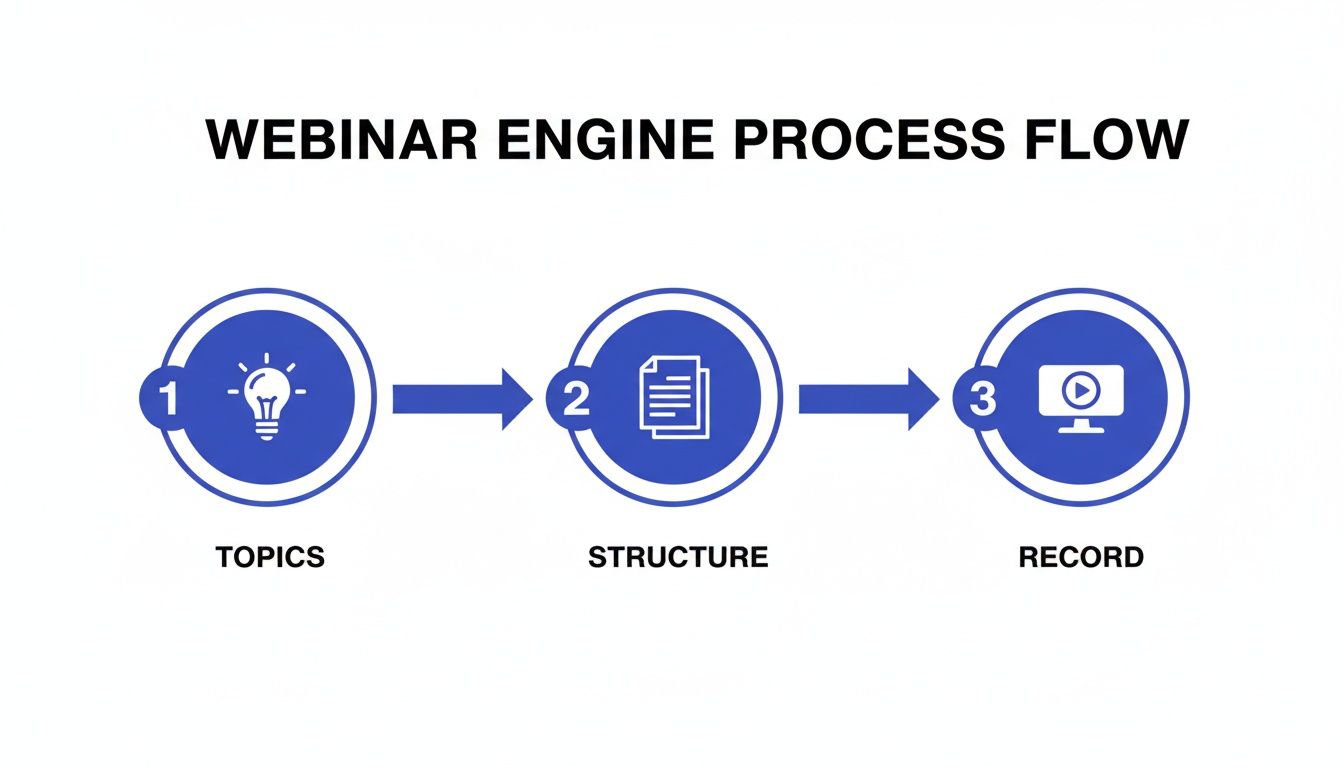
With a solid foundation, the real magic begins.
The Anatomy of a High-Impact Repurposing Plan
A smart workflow can easily spin your webinar into more than 10 distinct assets, each with a specific job to do in your marketing funnel. Let's get practical.
Imagine your SaaS company just produced a webinar titled, "How to Cut Project Delivery Times by 20%." Here’s how you atomise that single asset into a campaign:
The Gated On-Demand Recording: This is your primary lead magnet. Host the full, polished recording on a dedicated landing page behind a simple form. This asset is for high-intent prospects actively seeking a solution. Your main KPI here is Marketing Qualified Leads (MQLs), and you should aim for a Cost Per Lead under US$150.
The Full Downloadable Transcript (PDF): Don't overlook the power of text. A full transcript is an SEO goldmine, allowing search engines to index every word. It also caters to audiences who prefer to read or skim, making your content more accessible.
The SEO-Optimised Summary Blog Post: This becomes the public-facing anchor for your campaign. Write a sharp, 1,200-word article summarising the webinar's core arguments. Implementation Tip: Embed 2-3 of the most compelling video clips directly into the post. This increases page dwell time—a positive signal to search engines—and drives top-of-funnel organic traffic.
By transforming a single webinar into a suite of targeted assets, you’re not just reusing content—you’re creating multiple entry points into your sales funnel. Each piece caters to a different audience preference and consumption habit, ensuring your expert insights reach the widest possible audience.
This isn’t just theory; the numbers back it up. B2B companies with strong multi-channel strategies see 9.5% year-over-year revenue growth compared to just 3.4% for those with weak strategies. This growth is a direct result of efficient, scalable content repurposing.
Expanding Your Reach with Micro-Content
The webinar recording and blog post are your foundational "pillar" assets. But it's the micro-content that drives daily engagement and pulls people back to them.
This is where planning your webinar in distinct chapters really pays off.
Short-Form Video Clips (3-4 per webinar): Extract punchy 60-90 second segments from each chapter. These are perfect for LinkedIn, where they can grab attention in the feed. Implementation Tip: Always add branded title cards and subtitles, as 85% of social video is watched with the sound off. End each clip with a clear call-to-action, such as "Watch the full webinar to learn more."
Audiogram for Podcast Feeds (1 per webinar): Take the audio from your most insightful 5-10 minute segment and create an audiogram—a simple waveform video. You can drop this into your company podcast feed or share it on social, tapping into the growing audience who prefer audio content.
Shareable Quote Graphics (5-6 per webinar): Pull the most impactful one-liners from your expert and turn them into sharp, visually appealing quote graphics. These are incredibly shareable and work wonders for reinforcing your company's thought leadership. Use your brand colours and add your expert’s headshot to build their personal brand.
Nurturing Leads with Targeted Communication
Finally, all this content becomes the fuel for your lead nurture engine. Don't just send a link to the recording and hope for the best.
Build a simple, effective three-part email sequence to guide new leads:
- Email 1 (Immediate): Delivers the on-demand webinar link instantly upon form submission.
- Email 2 (2 Days Later): Follows up with the summary blog post, highlighting a key takeaway from the session.
- Email 3 (4 Days Later): Shares one of the short video clips and asks a direct question to spark a conversation, like, "What was your biggest challenge with project delivery last quarter?"
To help you visualise how all these pieces fit together, here’s a simple channel map.
Webinar Repurposing Channel Map
This table breaks down how each repurposed asset from your webinar can be strategically deployed across different channels, each with its own goal and success metric. It’s a practical roadmap for turning one recording into a coordinated campaign.
| Repurposed Asset | Primary Channel(s) | Strategic Goal | Key Metric (KPI) |
|---|---|---|---|
| Gated On-Demand Recording | Landing Page, Email | Lead Generation | MQLs, Cost-per-Lead |
| SEO Summary Blog Post | Company Blog, Organic Search | Organic Traffic, Awareness | Organic Rankings, Dwell Time |
| Short-Form Video Clips | LinkedIn, X (Twitter), YouTube Shorts | Social Engagement, Traffic | Views, Click-Through Rate (CTR) |
| Full Transcript (PDF) | Blog Post, Resource Centre | SEO, Accessibility | Organic Traffic, Downloads |
| Quote Graphics | LinkedIn, Instagram, X (Twitter) | Brand Awareness, Thought Leadership | Shares, Impressions |
| Audiogram (Podcast Snippet) | Podcast Platforms, Social Media | Audience Reach, Engagement | Listens, Subscriber Growth |
| Email Nurture Sequence | Email Marketing Platform | Lead Nurturing, Sales Pipeline | Open Rate, Reply Rate |
Using this map ensures every piece of content has a purpose and that you're measuring what matters. This entire ecosystem, all flowing from a single recording, is how you truly maximise the return on your content efforts.
If you want to dig even deeper into the specifics, check out our guide on how to turn one webinar into ten marketing assets. It offers an even more detailed roadmap for execution.
Matching Your Content to the Right Channels
You've invested significant time and resources into creating a brilliant, expert-led piece of content. But even the best webinar recording will fall flat if you just throw it at every channel hoping something sticks. A smart multi-channel content strategy is about matching the right asset to the right platform, in the right format.
Think of it this way: you wouldn't wear a three-piece suit to the gym. In the same way, a dense, technical video clip that performs brilliantly on LinkedIn will be ignored on Instagram. It’s about respecting the context of each platform and user expectations. This is how you go from just being on multiple channels to actually engaging your target audience on them.
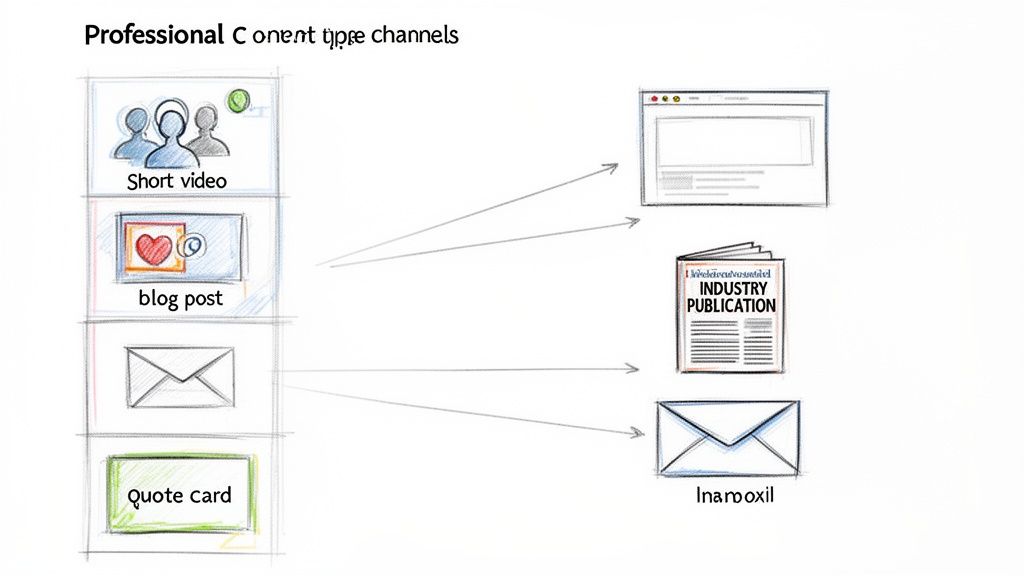
Getting this alignment right is critical. While 75% of B2B buyers prefer video, many marketing teams struggle with effective distribution. This gap is a massive opportunity for efficiency gains, especially when you remember that engaged buyers spend significantly more. For SaaS firms, this highlights the need to repurpose high-value assets like webinars across every touchpoint a prospect might use. You can dig into more of these UK B2B sales statistics and trends to get a clearer picture.
Tailoring Assets for Core B2B SaaS Platforms
For most B2B SaaS companies, a few key platforms do most of the heavy lifting. Let's break down how to adapt your repurposed webinar assets for each one, turning a single recording into a coordinated, authority-building campaign.
LinkedIn – Your Professional Stage: This is the home of B2B thought leadership. Short-form video clips (60-90 seconds) that tackle a specific technical point or offer a strong opinion perform incredibly well. Implementation Tip: Always add subtitles and a branded frame. The goal is to spark conversation and drive traffic back to your pillar content—the full webinar or the summary blog post.
Your Corporate Blog – The SEO Hub: Think of your blog as the home base for the entire campaign, built to capture organic search traffic. This is where your detailed, 1,200+ word summary post should live. Structure it with clear headings, embed relevant video clips from the webinar, and link prominently to the gated on-demand recording. This asset is a long-term workhorse, building your domain authority and attracting prospects as they research the exact problems you solve.
Targeted Email – The Nurture Engine: Email gives you a direct line to prospects who have already shown interest. Use insights from the webinar to power a multi-part nurture sequence. You can share the summary blog, a punchy quote graphic, or a specific video clip that addresses a common customer objection. Keep the tone helpful and educational. You're guiding them towards a demo, not just sending a sales pitch.
Maintaining Quality and Consistency
A multi-channel strategy requires a system to maintain brand consistency and professional quality across all assets. This is where a pre-recorded, repurposed model shines.
A pre-recorded format gives your marketing team final say before anything goes live. This transforms brand review from a potential bottleneck into a streamlined quality check, ensuring every asset—from a LinkedIn clip to an email—is accurate, approved, and on-brand.
This control also allows for strategic scheduling. You can align the rollout of your repurposed content with product launches, industry events, or specific campaign goals. Imagine scheduling a series of short video clips about a new feature to post in the weeks leading up to its release. That’s how you maximise relevance and impact.
This level of control ensures your brand’s authority is upheld at every touchpoint. By carefully tailoring each asset and scheduling its release, you build a cohesive multi-channel content strategy that doesn't just generate noise—it generates trust, authority, and high-quality leads. With a platform like Cloud Present, this entire workflow becomes a managed service, allowing your experts to focus on insights while we handle the production and strategic distribution.
Measuring Your Multi-Channel Content ROI
Let's be direct. Proving the value of your multi-channel content strategy is non-negotiable. Your leadership team doesn't care about likes and shares. They care about revenue, pipeline, and customer acquisition cost. To secure budget and a strategic seat at the table, you must draw a clear line from content activities to business outcomes.
This means moving beyond vanity metrics and focusing on what truly drives the business forward: pipeline influence, cost per MQL, and content-assisted conversions. This is how you shift the conversation from "content is a cost centre" to "content is a revenue driver."
From Metrics to Money: Calculating Real ROI
Let's get practical and put some real numbers to your efforts.
Imagine you spent US$5,000 on a LinkedIn campaign to promote the assets repurposed from your webinar. That campaign generated 50 downloads of your gated content, resulting in 10 Marketing Qualified Leads (MQLs).
Here’s how the calculation breaks down:
- Cost per Download: US$5,000 / 50 downloads = US$100 per download.
- Cost per MQL: US$5,000 / 10 MQLs = US$500 per MQL.
Now, let's connect this to revenue. Assume your sales team converts MQLs to customers at a rate of 20%, and your average customer lifetime value (CLV) is US$25,000.
From those 10 MQLs, you can project 2 new customers (10 MQLs x 20% conversion rate). The total revenue influenced by this single campaign is US$50,000 (2 customers x US$25,000 CLV).
The final ROI calculation is beautifully simple:
ROI = ([US$50,000 Revenue - US$5,000 Campaign Cost] / US$5,000 Campaign Cost) x 100 = 900%
This is the kind of data that doesn't just justify your budget—it gets it increased. Once your strategy is running, it's crucial to understand what’s working. If you want to dive deeper, you can learn more about how to measure social media ROI to fine-tune your efforts.
Building Your Content Performance Dashboard
You don't need a complex business intelligence tool to start. A simple, shared dashboard can provide a clear, at-a-glance view of how your multi-channel content is performing against business goals. Your dashboard should connect top-of-funnel activity with bottom-of-funnel results.
Key Metrics for Your Dashboard:
- Cost Per Asset (CPA): Take the total production cost of your pillar asset (the webinar) and divide it by the number of repurposed assets you created (e.g., 10+). This metric alone demonstrates incredible efficiency.
- Content-Assisted Conversions: Use your marketing automation platform to track how many leads consumed a piece of your campaign content before converting into an MQL or customer.
- Pipeline Influence: Tag every contact in your CRM who engages with your webinar campaign. You can then report on the total value of sales opportunities that include these tagged contacts.
- Lead-to-MQL Conversion Rate: Closely monitor the percentage of leads from your gated content that meet your sales-ready criteria. This is a powerful indicator of audience quality.
By focusing on these metrics, you directly tie your content creation to the sales pipeline, making its value crystal clear.
The Efficiency Gains of Repurposing
The ROI of a multi-channel content strategy isn't just about the revenue it generates; it's also about the significant efficiency gains. By atomising one high-value webinar, you dramatically lower your cost per asset and multiply the lifetime value of that initial investment.
Consider the alternative: creating 10+ unique pieces of content from scratch. This would require coordinating with subject matter experts, designers, and writers for each asset—a logistical and financial nightmare for lean SaaS teams.
A repurposing model delivers measurable efficiency gains:
- Reduced Production Costs: You invest once in a high-quality recording, then use lean processes to create derivative assets. A video clip costs a fraction of a new recording.
- Increased Content Velocity: Your team can produce a higher volume of quality content in less time, ensuring a consistent, authoritative presence across all channels.
- Maximised Expert Time: You ask your experts for one hour of their time and turn it into a quarter’s worth of marketing material. This is a powerful internal selling point to gain buy-in.
Platforms like Cloud Present are built to manage this entire workflow, from initial recording to final performance dashboard. We act as your strategic partner, handling production and analytics so you can focus on demonstrating clear, measurable ROI.
Your Top Multi-Channel Strategy Questions, Answered
As you prepare to roll out a multi-channel content strategy, a few practical questions always arise. We’ve heard them all from B2B SaaS marketing teams, so we’ve gathered the most common ones here to provide clear, actionable answers.
Think of this as your final implementation checklist, reinforcing the core ideas so you can manage everything from gaining leadership buy-in to executing the daily workflow without overwhelm.
How Much Content Can I Really Get from One Webinar?
This is usually the first question leaders ask, and the answer highlights the efficiency of this model. From a single, well-planned 60-minute webinar, you can easily generate over 10 distinct marketing assets.
This isn’t just theory; it’s a tangible output. A standard campaign could include:
- The full, gated on-demand recording for lead capture.
- An SEO-friendly summary blog post to drive organic traffic.
- 3-4 short video clips, optimised for LinkedIn.
- An audiogram snippet for social sharing or your podcast feed.
- A set of quote graphics for building brand authority.
- The full transcript for accessibility and maximum SEO value.
- A multi-part email nurture sequence to welcome new leads.
The key is to plan for this from the outset. If you structure your webinar in chapters, the repurposing process becomes remarkably smooth and efficient.
How Do I Get Our Subject Matter Experts on Board?
Your internal experts are your most valuable content asset, but they are also your busiest colleagues. Gaining their buy-in is critical. The best approach is to frame this around efficiency and impact. You aren’t asking for more of their time; you’re promising to maximise the value of the time they do give you.
Position the webinar as a high-leverage activity. Instead of requesting ten different content contributions over the next quarter, you’re asking for one focused hour to record a session. From there, your marketing team handles all the heavy lifting, turning that single effort into a full-blown campaign that showcases their expertise for months.
Implementation Step: Show them the plan. Lay out exactly how their one-hour contribution will fuel demand generation and cement their thought leadership across multiple channels. This transforms the request from "another marketing task" into a strategic opportunity they will be eager to support.
How Do I Start with a Tiny Team and Budget?
Limited resources should not be a barrier. The entire point of this model is its scalability. If you are a small team with a tight budget, don’t try to do everything at once. Focus on the highest-impact assets first. Prove the concept, secure early wins, and then expand.
Start with a core "power trio" of repurposed content:
- The Main Event: Produce one high-quality, pre-recorded webinar.
- The SEO Engine: Write a detailed summary blog post to capture search traffic.
- The Social Hook: Edit two or three punchy video clips for LinkedIn to drive engagement.
This trio provides a solid foundation for lead generation (the gated webinar), long-term traffic (the blog), and social buzz (the video clips). Once you start tracking the results from this initial push, you’ll have a powerful business case to secure more budget and scale your multi-channel strategy over time.
Ready to turn your company's expertise into a powerful content engine without overwhelming your team? Cloud Present acts as your outsourced webinar studio and strategic partner, handling everything from broadcast-quality recording to multi-channel repurposing. Discover how we help B2B SaaS firms create high-impact assets that drive demand by visiting https://www.cloudpresent.co.


