A Modern Webinar Marketing Strategy for B2B SaaS Growth
Discover a modern webinar marketing strategy for B2B SaaS. This guide covers production, promotion, repurposing, and metrics to drive leads and ROI.
Let’s be honest: for too long, webinars have been a "one-and-done" headache for B2B marketing teams. You pour weeks into prepping a single live event, push like crazy to get people to show up, and then the recording goes to die in a forgotten corner of your website. It’s a stressful, inefficient model that completely misses the point.
This is why so many webinar programmes fail to deliver a consistent, measurable return on investment. It's a key pain point for teams with limited resources who need to deliver a consistent content output and drive demand generation.
A modern webinar marketing strategy isn't about hosting a single live event at all. It's about building a scalable content engine. This is how you solve that persistent B2B challenge: generating a steady stream of high-quality content with a team that's already stretched thin.
Rethinking Your Webinar Marketing Strategy
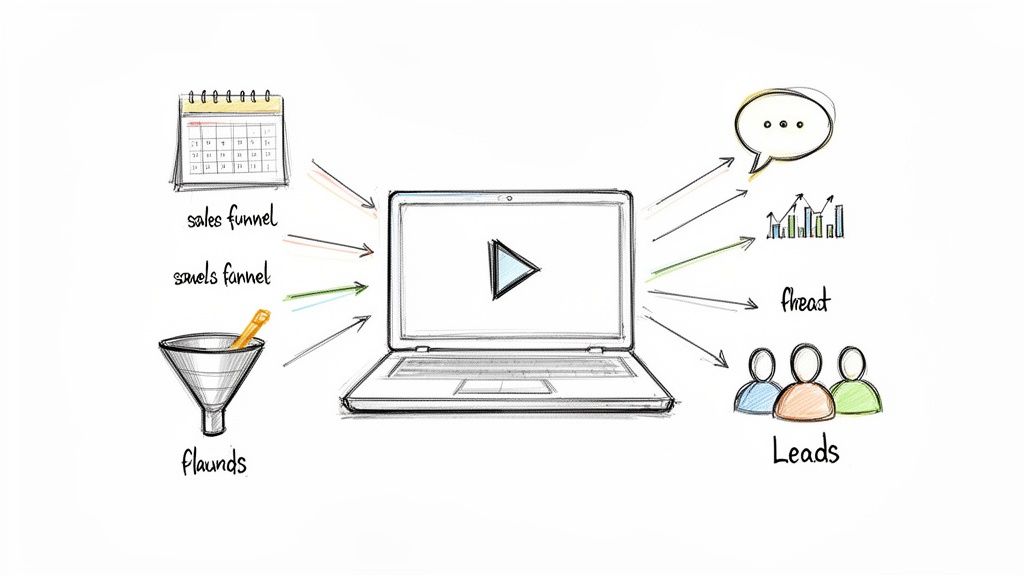
The reality is, a single, well-executed webinar holds immense potential that goes far beyond its initial broadcast. The big shift for B2B SaaS teams is moving your focus from a live-only scramble to a pre-recorded, broadcast-quality production.
This strategic pivot unlocks a world of efficiency gains and control. The new model centres on smart content repurposing—turning every session into a long-term asset that keeps generating demand long after the "live" day has passed.
The Business Case for a Modern Approach
The financial argument for getting your webinar strategy right is impossible to ignore. Webinars are a powerhouse for lead generation in the B2B world, with some studies showing an impressive webinar ROI effectiveness. This efficiency directly addresses a huge pain point for B2B and SaaS teams: the constant pressure to fill the sales pipeline with high-intent leads without an ever-expanding budget.
For B2B SaaS companies, a well-executed virtual event strategy can deliver a cost-per-lead that dramatically outperforms other channels. To put that into perspective, here’s how webinars stack up.
Cost-Per-Lead Comparison for B2B SaaS Channels
This table illustrates the significant cost-efficiency of a modern webinar strategy compared to other popular B2B lead generation channels, highlighting the clear financial benefits and ROI potential.
| Channel | Average Cost-Per-Lead (USD) | Typical Use Case |
|---|---|---|
| Webinars | $72 | High-intent, educational lead generation. |
| LinkedIn Ads | $425 | Targeted B2B professional outreach. |
| Trade Shows | $850 | In-person networking and brand presence. |
| Google Ads (B2B) | $150-$300 | Capturing active search intent. |
| Content Syndication | $100-$200 | Top-of-funnel lead volume. |
The numbers speak for themselves. When it comes to cost-effective demand generation, a well-oiled webinar machine is in a league of its own.
From One-Off Event to Content Engine
The strategic shift is simple but profound. Stop seeing the webinar as the final product. Instead, treat it as the raw material for a dozen other marketing assets. This model prioritises professional quality standards and thoughtful distribution over the chaos of a live-only event.
Here’s what this modern approach actually lets you do:
- Create content at scale. You can slice a single one-hour recording into blog posts, social media clips, infographics, and even podcast episodes. Suddenly, the "what should we post this week?" problem disappears, addressing the need for consistent content output.
- Achieve broadcast-quality standards. Pre-recording means no more awkward technical glitches. It allows for polished editing, branded overlays, and a professional finish that reflects your firm’s expertise. This is where a strategic partner like Cloud Present can manage the heavy lifting.
- Secure more expert involvement. Your subject matter experts are busy. Asking them to record on their own schedule, without the pressure of a specific live broadcast time, dramatically increases their willingness to contribute their knowledge.
By treating each webinar as the start of a content lifecycle—not the end—you build a sustainable system for establishing thought leadership, nurturing prospects, and driving measurable business growth. It’s about working smarter, not harder, to hit your demand generation goals.
Building Your Strategic Webinar Blueprint
A high-impact webinar doesn’t start the moment you hit ‘record’. It starts with a solid plan. For B2B SaaS marketing professionals and content teams, this blueprint is the bedrock of a virtual event that doesn’t just inform but actually converts. It’s about creating high-quality, valuable content without draining your team's limited resources.
First things first: you have to move beyond generic topics. Your entire webinar marketing strategy hinges on solving a specific, urgent pain point for your ideal customer. Forget broad industry trends and zero in on the practical, day-to-day challenges your clients are wrestling with.
For instance, instead of a vague title like "The Future of AI in SaaS," get granular. A much more compelling topic is "A Practical Guide to Integrating AI-Powered Churn Prediction with Your Existing CRM." See the difference? That level of specificity immediately signals value and pulls in a self-qualified, high-intent audience.
Defining Your Objectives and KPIs
Before you build a single slide, you need to define what success looks like in hard numbers. Fuzzy goals like “increase brand awareness” just won’t cut it. You need objectives tied directly to business outcomes. This gives your content team a clear target and helps you prove the programme’s value to leadership.
Good objectives are specific and quantifiable. Here are a few practical examples that resonate with B2B SaaS goals:
- Marketing Qualified Leads (MQLs): Generate 75 new MQLs with job titles matching our ideal customer profile (e.g., 'Head of Operations' or 'IT Director').
- Pipeline Contribution: Influence US$150,000 in new sales pipeline within 90 days of the webinar.
- Product Adoption: Drive a 15% increase in feature adoption for our new analytics module among existing customers who attend.
- Sales Demo Requests: Secure 20 qualified demo requests from the post-webinar follow-up sequence.
Setting these KPIs upfront transforms your webinar from just another marketing task into a strategic demand-generation engine. It’s the data you’ll use to calculate ROI and justify future investment in your virtual event strategy.
Structuring Content for Maximum Engagement
With your topic and objectives locked in, the next piece of the puzzle is content structure. A common mistake is creating what is essentially a thinly veiled sales pitch. But the data is clear: over 70% of B2B professionals tune into webinars to learn tips and best practices. Your content has to deliver genuine educational value, first and foremost.
Here’s a proven implementation step-by-step structure for a 45-minute B2B webinar that works:
- Introduction (5 minutes): Briefly introduce the speaker and state the specific problem you're going to solve. Set clear expectations for what the audience will walk away with.
- The Core Problem (10 minutes): Dive deep into the pain point. Use data-driven insights, anecdotes, and real-world scenarios to build empathy and show you genuinely understand their world.
- The Solution Framework (20 minutes): This is the heart of your webinar. Present your actionable framework, methodology, or checklist. Give them practical steps they can apply immediately.
- Subtle Product Tie-in (5 minutes): Now you can briefly show how your SaaS product simplifies or automates the framework you just taught. This isn't a full demo; it's a natural bridge from the educational content to your solution.
- Q&A and Call-to-Action (5 minutes): Open the floor for questions and present a clear, compelling call-to-action, such as booking a personalised demo or downloading a related guide.
The Case for Pre-Recording
The final strategic decision in your blueprint is the format: live or pre-recorded? Live events can feel electric with immediate interaction, but the risks are real—technical glitches, speaker nerves, last-minute scheduling conflicts. For B2B SaaS teams focused on delivering professional quality with maximum efficiency, pre-recording is almost always the superior choice.
A pre-recorded format de-risks the entire webinar production. It allows your subject matter experts to record on their own schedule, ensures polished editing with branded overlays, and guarantees a broadcast-quality experience for your audience, every single time.
This approach also transforms the "live" day into a much more controlled and engaging event. Your presenters can focus entirely on interacting with the audience in the chat and Q&A. With a strategic partner like Cloud Present handling the production, your team can deliver flawless, high-impact virtual events without the usual stress and heavy lifting.
Driving Attendance with High-Quality Production and Promotion
Great content is a fantastic start, but it’s only half the battle. A winning webinar marketing strategy hinges on two things: nailing a broadcast-quality production and running a promotional plan that consistently brings in the right people. This is where your great idea becomes a tangible, valuable asset.
The quality of your production is a direct reflection of your brand. In the B2B SaaS world, credibility is everything, and grainy video with crackling audio just won't cut it. Your audience is giving you their valuable time; a polished, professional presentation shows you respect that.
Mastering Production Quality
You don't need a Hollywood budget to look professional, but you do need to pay attention to the details. It’s about controlling what you can to ensure your subject matter experts shine. While you can partner with a production service, it's smart to get the fundamentals right internally. You can discover more about professional webinar production services in our detailed guide.
At a minimum, focus on these technical essentials for your presenters:
- Crisp Audio: This is completely non-negotiable. A decent external USB microphone, which will only set you back between US$50 and US$150, is a far better investment than relying on a tinny laptop mic. Clean audio keeps your audience focused on your message.
- Stable Video: Ensure presenters use a reliable webcam, ideally one that shoots in 1080p. Good lighting is just as crucial; a simple ring light can eliminate shadows and instantly elevate the professional look.
- Professional Background: A clean, uncluttered, and branded background instils confidence. This could be a tidy office, a branded virtual background, or a simple, neutral wall. The main goal is to remove distractions.
By standardising this simple tech stack for all your speakers, you create a consistent, high-quality experience across every virtual event. Getting this right before you hit record ensures every asset—from the live event to the short clips you repurpose later—reinforces your firm's authority.
Building a Multi-Channel Promotion Plan
Once your production quality is locked in, shift your focus to promotion. A scattergun approach is a waste of resources and won't attract your ideal prospects. You need a structured, multi-channel plan that builds momentum and pulls in registrations from the right audience, ideally kicking off two weeks before the event.
Timing is critical. For B2B audiences, mid-week is prime time. Data shows that Wednesday webinars can hit 48% attendance, with the Tuesday-Thursday window accounting for 76% of all successful events. Benchmarks also show an average registration-to-attendance rate of 57%, with engagement lasting an impressive 51 minutes for well-produced content. You can discover more insights about UK digital marketing statistics to help fine-tune your timing.
Here’s a practical implementation schedule:
Two Weeks Out (T-14 Days)
- Initial Email Blast: Announce the webinar to your full marketing list, focusing on the core problem you will solve.
- Organic Social Posts: Post on LinkedIn and other relevant platforms using a sharp, branded event graphic.
- Partner Outreach: If you’re co-hosting, provide guest speakers with a promo kit including email copy, social graphics, and tracking links.
One Week Out (T-7 Days)
- Second Email Blast: Nudge non-registrants with a compelling speaker quote or a surprising statistic to create urgency.
- Engaging Social Assets: Post short video teasers (30-60 seconds) where the speaker gives a sneak peek. Speaker quote cards also work well.
- Paid Social Campaign: Launch a targeted LinkedIn Ads campaign, focusing on specific job titles, industries, and company sizes.
The Week Of (T-3 to T-0 Days)
- Final Email Reminders: Send a "last chance to register" email two days before, followed by a final reminder on the morning of the broadcast.
- Countdown Social Posts: Use countdown stickers in social media stories to build anticipation.
- Personal Outreach: Involve your sales team. A direct, personal invitation to key prospects and high-value accounts can be incredibly effective.
By orchestrating this promotional rhythm, you create multiple touchpoints that cut through the noise and capture the attention of busy professionals. It’s how you ensure your fantastic content gets the audience it deserves.
Turning One Webinar Into a Content Goldmine
Think the live broadcast is the finish line? That’s the costliest mistake in a modern webinar marketing strategy. For B2B SaaS content teams already stretched thin, the real ROI kicks in after the webinar ends. Smart content repurposing is how you turn a single one-hour event into a month's worth of marketing assets.
This solves a massive pain point for most marketing teams: the struggle to maintain a consistent content output. It also meets your audience where they are. Data shows that around 45% of all webinar attendees watch on-demand. By building a simple workflow to slice and dice your recording, you’re not just getting more ROI—you’re delivering value on their terms.
Your Post-Webinar Repurposing Playbook
Stop seeing your recording as just one video file. It’s a goldmine of raw material. The goal is to atomise the main event into smaller, targeted assets, each built for a specific channel and stage of the buyer's journey. This is how you maximise the return on your initial time investment, driving efficiency gains.
Here’s a practical workflow to turn one webinar into at least ten other pieces of content:
The On-Demand Evergreen Asset: Get the full, polished recording onto a dedicated landing page. Gate it behind a form to keep capturing high-intent leads long after the live date.
The Pillar Blog Post: Use the webinar transcript (from a tool like Otter.ai or your webinar platform) to create a meaty, SEO-friendly blog post. Aim for 1,500+ words and embed the on-demand video and key slides.
Bite-Sized Social Video Clips: Go through the recording and pull out three to five of the most potent moments—a surprising statistic, a key insight, or a great Q&A answer. Edit these down into 30-90 second vertical video clips for LinkedIn, adding captions for silent scrollers.
Content repurposing isn't just about efficiency. It’s about meeting your audience on their terms. A busy director might not have 60 minutes for a full webinar, but they'll watch a 60-second clip on LinkedIn that solves an immediate problem. That clip is what pulls them deeper into your world.
Creating Assets for Every Learning Style
A smart virtual event strategy knows that people consume information differently. Your repurposing plan must cater to all learning styles to maximise reach.
The flow is simple: you produce the core webinar, promote it, and then repurpose the recording to drive engagement across different channels.
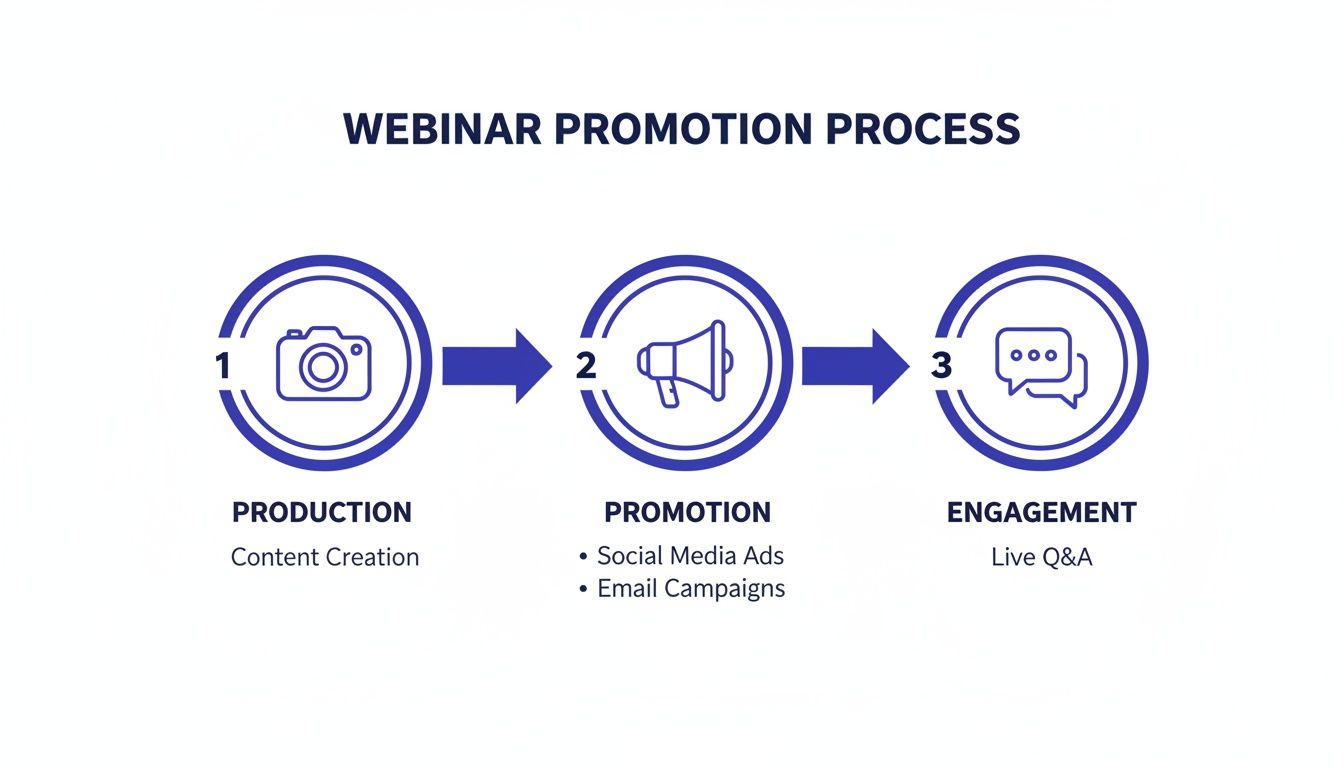
This approach turns a single piece of content into a steady drumbeat of value across multiple platforms.
Here are more practical examples of assets you can create:
- Infographics or Carousels: Distil the webinar’s key framework or data into a sharp-looking infographic or a LinkedIn carousel. These are highly shareable and brilliant for top-of-funnel awareness.
- Audio-Only Podcast Episode: Strip the audio from the recording, add a simple intro and outro, and you have a podcast episode ready for professionals who listen to content on their commute.
- Key Takeaways PDF/Checklist: Create a clean, one-page PDF summarising the most actionable steps. This is a perfect content upgrade for your blog post or nurture sequence.
- Email Nurture Sequence: Pull out five key insights and turn them into a five-day email drip campaign for registrants. Each email can link back to a different repurposed asset, reinforcing the core message.
This multi-format approach does more than just extend the life of your content. It builds a stronger, more cohesive brand presence and is a core piece of any effective multi-channel content strategy.
The table below provides clear implementation steps, mapping each repurposed asset to a channel and funnel stage.
Webinar Repurposing Workflow and Funnel Impact
| Original Asset | Repurposed Asset | Target Channel | Funnel Stage |
|---|---|---|---|
| Full Webinar Recording | On-Demand Webinar | Website/Landing Page | Middle/Bottom |
| Full Webinar Recording | Pillar Blog Post (1,500+ words) | Blog / SEO | Top/Middle |
| Key Webinar Moments | Short Video Clips (30-90s) | LinkedIn, X, Instagram | Top |
| Key Webinar Data/Framework | Infographic / Carousel | LinkedIn, Pinterest | Top |
| Full Webinar Audio | Podcast Episode | Spotify, Apple Podcasts | Top/Middle |
| Actionable Advice | PDF Checklist/Cheat Sheet | Email, Blog (Content Upgrade) | Middle |
| Key Webinar Quotes | Quote Graphics | LinkedIn, X, Instagram | Top |
| Q&A Session | FAQ Blog Post / Social Posts | Blog, Social Media | Middle |
| Webinar Slides | SlideShare Presentation | SlideShare, LinkedIn | Middle |
| Key Webinar Insights | 5-Day Email Nurture Sequence | Email Marketing | Middle/Bottom |
| Guest Expertise | Guest-Authored Blog Post | Blog / Partner Channels | Top/Middle |
By following this workflow, you ensure that the effort put into a single virtual event continues to generate leads, build authority, and engage your audience for weeks—or even months—to come. As your strategic partner, Cloud Present bakes this entire process into our service, handling the webinar production and asset creation to free up your team for high-value strategic work.
Measuring Webinar Performance and Proving ROI
For any B2B SaaS marketing team, proving your worth is non-negotiable. A winning webinar strategy doesn’t stop when the content is created; it demands a clear demonstration of its impact on the bottom line. This means moving past surface-level stats like registration numbers and digging into the key performance indicators that prove ROI to leadership.
Your mission is to tell a clear, data-driven story about how your virtual events generate revenue. The good news? Webinars already have a fantastic track record. A solid 78% of marketers report they help slash their overall cost-per-lead. The average cost-per-lead (CPL) for a webinar is just US$72, a bargain compared to many other B2B channels.
Key Metrics That Prove Business Value
To truly measure success, you must connect the dots between your webinar activity and actual pipeline and revenue. This is impossible without a tight integration between your webinar platform and your CRM, whether that's HubSpot or Salesforce. That connection lets you follow an attendee’s journey from a new lead to a closed-won deal.
Here are the critical metrics your B2B content team should have on its dashboard:
- Lead Quality Score: How many attendees fit your Ideal Customer Profile (ICP)? A high percentage of registrants with the right job titles or from target accounts indicates your promotion is hitting the mark.
- Pipeline Contribution: This is the ultimate metric for proving ROI. Measure the total value of sales opportunities (in US Dollars) that include at least one person who attended your webinar.
- Cost-Per-MQL: Calculate this by dividing your total webinar production and promotion costs by the number of Marketing Qualified Leads (MQLs) it generated. A low CPL is concrete proof of your programme's efficiency gains.
- Sales Cycle Velocity: Do leads who engage with your webinars move through the sales funnel faster? Run the analysis. A shorter sales cycle is a huge efficiency win for the entire business.
A Framework for Full-Funnel Analysis
To improve, you must know where you're falling short. Analysing performance at every stage of the attendee journey lets you find weak spots and make targeted fixes to boost overall ROI. While tracking webinar performance is crucial, it's also part of a bigger picture. To get a broader perspective on your marketing impact, it's helpful to learn how to measure social media ROI as well.
Start by breaking down your analysis into three distinct phases:
Pre-Event Analysis
- Landing Page Conversion Rate: What percentage of visitors to your registration page actually sign up? If the rate is below 25%, it may indicate weak copy, a clunky form, or a topic that isn't resonating.
- Registration Source: Where are your best leads coming from? Dig into whether email, social media, or a partner promotion is driving the highest-quality sign-ups.
Live & On-Demand Engagement
- Attendance Rate: What percentage of registrants showed up live? The industry benchmark sits around 57%, so see how you stack up.
- Audience Retention: Where did you lose people? Pinpoint the exact moments viewership dropped off to identify less engaging parts of your presentation.
- On-Demand View Duration: For the 45% of viewers who watch on-demand, how long are they sticking around? This metric shows the evergreen value of your content.
Post-Event Business Impact
- Demo or Consultation Requests: How many attendees took the next logical step and booked a meeting with your sales team? This is a powerful signal of buying intent.
- Content Download Rate: If you offered supplementary resources, track how many people engaged with them. This shows active interest and gives your sales team a perfect conversation starter.
By meticulously tracking these KPIs, you transform your webinar programme from a simple content-producing function into a predictable, revenue-generating engine. This is how you secure buy-in from leadership and justify continued investment in your webinar marketing strategy.
Cloud Present integrates seamlessly with your existing tech stack, giving you a unified dashboard to monitor these crucial metrics. Learn more about how to get deeper insights from your events by exploring our guide on leveraging powerful webinar analytics.
Got Questions About Your Webinar Strategy?
Even the most buttoned-up marketing teams run into the same questions when they're trying to nail their webinar marketing strategy. Getting these fundamentals right is the difference between a virtual event that drives real business and one that just eats up your afternoon.
Let's tackle some of the most common questions we hear from B2B SaaS professionals.
How Long Should a B2B Webinar Be?
For a sharp B2B audience, the sweet spot is 45 to 60 minutes. This provides enough time for a substantial 35-45 minute presentation, followed by a solid 10-15 minutes for live Q&A. Anything longer risks testing your audience's patience.
We consistently see audience engagement start to dip after the 50-minute mark. If you have a complex topic that requires more time, a much better virtual event strategy is to break it down into a series of 20-minute on-demand videos. They're far more digestible, and you'll see your completion rates shoot up.
What Are the Most Critical Success Metrics?
Registrations and attendance numbers are fine, but they're vanity metrics. To prove the ROI of your webinars to the C-suite, you must connect your efforts directly to revenue.
Here are the specific metrics to focus on:
- Audience Engagement: Look past the view count. How long did people stick around (average view duration)? Did they participate in polls or download resources? These are signals of genuine interest.
- Lead Quality: Who attended? Dig into the job titles. What percentage of attendees match your ideal customer profile? And most importantly, how many requested a demo after the event?
- Pipeline Contribution: This is the ultimate metric for proving ROI. When you connect your webinar platform to your CRM, you can track the entire journey. How many attendees turned into MQLs, then SQLs, and ultimately, closed-won deals? Attributing influenced revenue is the clearest way to prove your impact.
What Is the Best Way to Promote a Webinar?
Posting once on LinkedIn and hoping for the best is not a strategy. To attract high-quality professionals who are in-market for your solution, you need a coordinated, multi-channel plan that kicks off at least two weeks before the live date.
Start with your own email list; it’s almost always your best source of high-intent leads. Next, activate your company and speaker LinkedIn profiles with a mix of text posts, punchy quote graphics, and short video teasers.
To cast a wider net, targeted paid ads on LinkedIn are incredibly effective. You can zero in on the exact job titles, company sizes, and industries that matter to your business. Another killer tactic is partnering with a complementary tech company for a co-hosted webinar. It’s a brilliant way to get in front of a brand new, pre-qualified audience.
Here's the key: Every single piece of promotional copy needs to speak directly to a specific pain point. This is how you attract people who aren't just curious, but are actively looking for the solution you're about to present.
Should We Gate Our On-Demand Webinar Recording?
Ah, the classic gate-versus-ungate debate. There’s no single right answer here—it all comes down to the primary goal of that specific piece of content.
If your number one goal is lead generation, then yes, gate the recording behind a form. The webinar becomes a lead-gen asset that works for you 24/7.
But if your main objective is brand awareness and thought leadership, leaving it ungated can massively boost views and shares. It positions you as an expert who gives value freely, building trust and authority.
Often, a hybrid approach works best. You could leave the full recording ungated for the first week to build social proof, then gate it for evergreen lead capture. An even smarter play? Leave the main video recording open, but gate the high-value assets created from it—like the PDF guide, checklist, or presentation slides. This gives people immediate value while still giving you a chance to capture their details.
Ready to transform your webinars into a predictable demand generation engine without overwhelming your team? As your strategic partner, Cloud Present acts as your outsourced webinar production studio, handling everything from professional recording and editing to creating 10+ repurposed assets from a single session. This is how you meet professional quality standards and achieve significant efficiency gains.
Discover how we help B2B firms deliver broadcast-quality virtual events at Cloud Present.


