Using Webinars for Marketing to Drive B2B SaaS Growth
Discover how using webinars for marketing can generate high-quality leads and maximize ROI. Our guide provides actionable strategies for B2B professionals.
For B2B SaaS marketing professionals, proving return on investment isn't just a metric; it's the entire game. In competitive markets where trust and expertise are paramount, generating a consistent pipeline of high-quality leads is a constant challenge for resource-strapped content teams. This is where using webinars for marketing shifts from being another tactic to a strategic growth engine.
A well-executed webinar cuts through the noise. It’s not just another PDF download or a generic email. It’s a direct line to your ideal customer profile, a platform to demonstrate genuine product expertise, and an efficient way to address their most pressing technical and business questions at scale.
The Unmatched ROI of Webinars in B2B Marketing
Let’s be honest: many SaaS marketing teams are wrestling with tight budgets while facing immense pressure to produce a relentless stream of high-value content. The core pain point is turning limited resources into a reliable pipeline of sales-qualified leads (SQLs), month after month.
This is exactly where a smart webinar strategy shines. It’s a remarkably efficient investment that solves several demand generation problems at once. You get to showcase your platform’s unique value, connect directly with target accounts, and build trust in a way that static content simply can’t.
Driving Down Lead Costs with Efficiency Gains
When you look at the numbers, the business case becomes crystal clear. Webinars consistently outperform many traditional B2B channels on cost-efficiency. According to a benchmark report from ON24, B2B webinars deliver an impressive average 213% ROI, with the cost to acquire a lead dropping as low as US$65.
That figure becomes even more powerful when you place it next to the alternatives. Acquiring a lead from LinkedIn Ads can cost around US$380, and the price tag for a single lead from a trade show often hits US$760. Suddenly, webinars look less like an expense and more like a savvy financial decision. You can dive deeper into the data by exploring the full webinar benchmarks report.
This chart puts the cost advantage into perspective for any SaaS marketer.
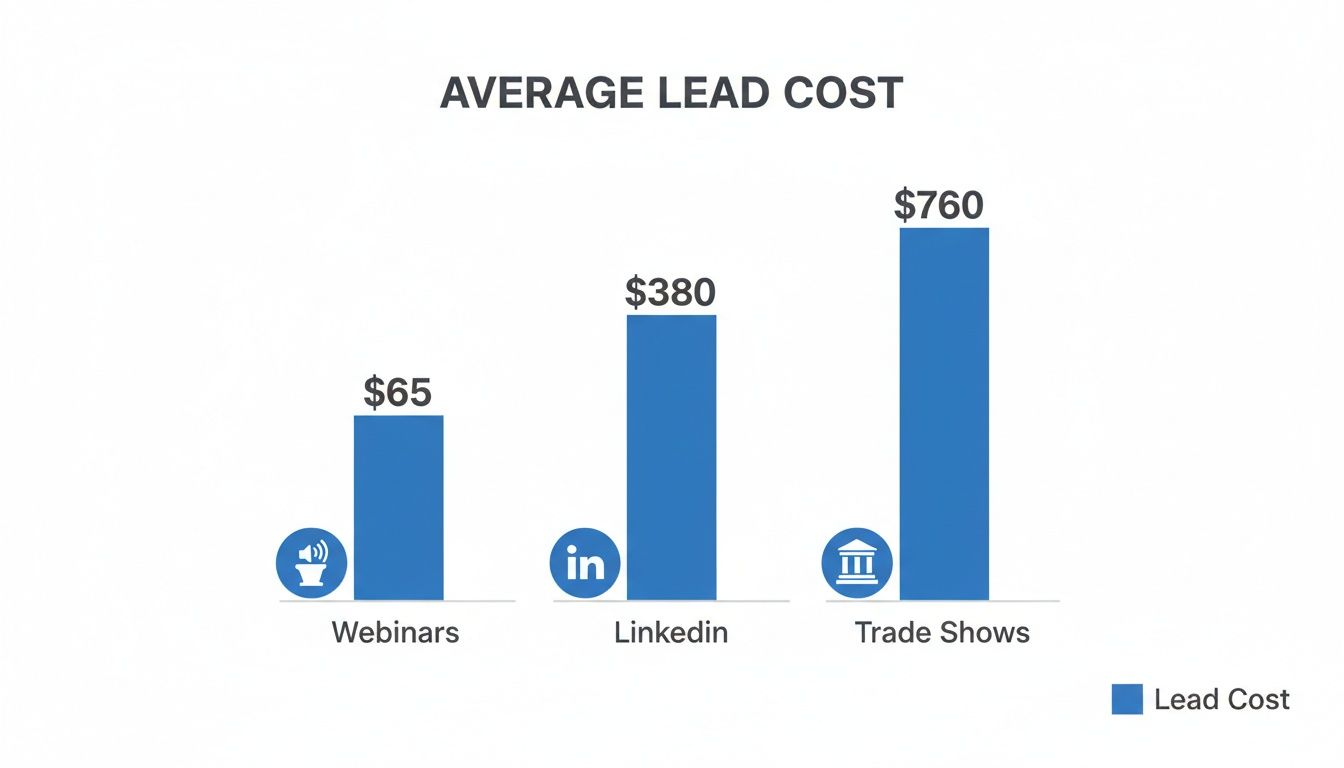
As you can see, the cost to bring in a lead through a webinar is a fraction of what firms typically spend on social ads or in-person events.
Practical Example: For a scale-up SaaS company with a finite marketing budget, running one high-value webinar each quarter is far more sustainable than sponsoring a single trade show booth. The webinar not only generates leads for less, but it also creates a library of repurposable content that can fuel the marketing engine for months, solving the consistent content output challenge.
Webinar Cost Per Lead vs Alternative B2B Channels
To make this comparison even clearer, here’s a simple table breaking down the numbers. It highlights just how efficient webinars are for demand generation in a B2B SaaS context.
| Marketing Channel | Average Cost Per Lead (USD) | Typical Use Case |
|---|---|---|
| Webinars | $65 | In-depth education, demonstrating expertise, mid-funnel lead nurturing |
| LinkedIn Ads | $380 | Top-of-funnel awareness, targeting specific job titles and industries |
| Trade Shows | $760 | High-touch networking, major announcements, brand presence |
This financial efficiency is a game-changer for lean marketing teams. It frees up budget to be reallocated to other strategic initiatives, maximising the impact of every dollar spent. By turning a single 60-minute event into a reliable source of qualified leads and reusable content, webinars solve the relentless demand for high-value marketing output.
This is where a strategic partner like Cloud Present provides more than just a service. By managing the entire production process, we ensure your company can consistently deliver polished, high-ROI virtual events without burning out your internal team.
Building Your High-Impact B2B Webinar Strategy
A great webinar doesn’t just happen. It’s born from a solid virtual event strategy that ties directly into your core business goals, turning what could be a one-off event into a repeatable, measurable part of your marketing engine. Without that foundation, you’re just creating content that might be interesting, but won't move the needle on demand generation.
Implementation Step 1: Define Your Primary Objective. What does success actually look like? Are you trying to generate a specific number of sales-qualified leads (SQLs)? Is the aim to boost client retention by 15% with high-value educational content? Or perhaps you want to establish your company as the go-to authority on a complex new industry trend.
Each of these goals demands a totally different approach to your content, promotion, and measurement. Nailing down this "North Star" ensures every decision serves a real business purpose.
Aligning Content with Audience Pain Points
With your goal locked in, it’s all about the audience. For B2B SaaS, a generic, one-size-fits-all approach is a recipe for failure. You need to get into the heads of your ideal customers and understand the specific pressures they're under. A marketing manager at a mid-sized tech company has completely different pain points than a compliance officer at a financial institution.
Your webinar topic must hit a nerve. A title like ‘E-commerce Growth Strategies’ is too vague. But what about something like, ‘How Our Client Cut Customer Churn by 25% with Automated In-App Onboarding’? Now you’re talking. It speaks directly to a real SaaS problem and promises a tangible outcome. That’s what gets the right people to register.
Actionable Insight: A great webinar acts as a bridge. On one side, you have your audience with a specific, urgent problem. On the other, you have your platform’s solution. Your webinar content is the structure that connects the two, demonstrating your value in a practical, non-salesy way.
Of course, coming up with compelling topics is key. Exploring fresh webinar content ideas ensures your topic isn’t just relevant, but also interesting enough to cut through the noise of a crowded inbox.
Choosing the Right Webinar Format for Your Goal
Don’t treat your webinar’s format as an afterthought; it’s a strategic choice. The structure you pick should be the best possible vehicle for delivering your message and hitting that primary objective. Different formats serve different purposes, and getting this right has a massive impact on engagement and ROI.
Here are a few proven formats and when to use them:
- The Expert Panel Discussion: Your go-to for building thought leadership. Get three or four industry experts together (including one from your company) to unpack a trending topic. It builds massive credibility and attracts a broad, high-level audience—perfect for top-of-funnel brand awareness.
- The Product Deep-Dive or Case Study: Ideal for nurturing leads in the middle of your funnel. This format goes way beyond a feature list. It shows exactly how your service solves a real-world client problem, letting prospects see themselves in the success story.
- The Best Practices or 'How-To' Workshop: A fantastic play for client retention and education. If you're in a technical SaaS space, timely workshops on new features or advanced use cases are pure gold. It positions your company as a trusted advisor and gives customers a compelling reason to stick around.
By meticulously defining your goals, homing in on a specific audience pain point, and picking the perfect format, you're not just hosting an event—you're executing a strategic plan. This disciplined approach ensures your efforts in using webinars for marketing lead to measurable business results, not just vanity metrics. With a strategic partner like Cloud Present managing the production, your team can focus entirely on what they do best: delivering high-impact content.
Mastering Production for Professional Grade Webinars
For B2B SaaS companies, your authority is everything. A DIY webinar with shoddy audio, a distracting background, and technical glitches doesn't just look amateurish—it actively erodes the trust you’ve worked so hard to build. Getting your webinar production right isn't about chasing perfection. It's about ensuring the quality of your presentation mirrors the professional quality of your software and expertise.
This means moving beyond just hitting 'record'. A proper, structured production workflow is key. The goal is to create a seamless, professional experience that keeps your audience glued to your message, not distracted by a frozen screen or a crackling microphone.
Pre-Production: Your Blueprint for Success
The groundwork for a polished webinar is laid long before you go live. A solid pre-production phase is your best defence against day-of disasters and sets your speakers up for success—which is absolutely vital when you're working with busy subject matter experts who don't have time for technical headaches.
Your pre-production checklist should include:
- Speaker Briefing and Rehearsals: Never skip this. A full technical run-through a few days before the event helps speakers get comfortable with the platform and flow. More importantly, it's your chance to spot and fix issues with lighting, audio, or dodgy internet connections.
- Engaging Slide Deck Creation: Think of your slides as visual aids, not a script. Keep text minimal and lean on high-quality graphics and clear data visualisations. A good rule of thumb is one core idea per slide. This prevents cognitive overload for your audience.
- Achieving Broadcast-Quality Audio and Video: This is non-negotiable. Insist that speakers use an external USB microphone and a high-definition webcam. Good lighting, facing the speaker, is just as crucial to avoid that grainy, unprofessional look. This investment is often under US$200 but the impact on brand perception is immense.
The Strategic Advantage of Pre-Recording
Live webinars have their place, but the pre-recorded or 'simulive' format offers powerful efficiency gains. This is especially true for B2B SaaS teams who have high quality standards but are stretched thin on resources. Pre-recording neatly separates the pressure of performance from the stress of technical execution, leading to a much smoother, more reliable final product.
Here’s a glimpse of what a professionally managed virtual event looks like on a platform built for serious B2B engagement.
This dashboard view shows how the right strategic partner gives you a central hub for managing recordings, assets, and analytics, bringing a sense of calm and order to the entire production process.
This approach delivers key benefits:
Actionable Insight: Pre-recording transforms a high-stakes live event into a controlled studio production. It boosts speaker confidence, eliminates the risk of live technical failures, and—most critically for companies in regulated industries—allows for thorough compliance and legal reviews before a single prospect sees it. This directly addresses the pain point of limited resources by ensuring a high-quality output every time.
This controlled environment is where you see real efficiency gains. Speakers can easily re-record a section if they stumble, ensuring their delivery is sharp and concise. From there, editors can polish the final cut, adding branded intros, lower-third graphics, and slick transitions. The end result? A broadcast-quality asset that truly reflects the professionalism of your brand. For a deeper dive, our guide on webinar production services has more practical advice.
Selecting Your Production Toolkit
Choosing the right technology is fundamental. Your webinar platform is the stage, and its features directly impact the quality and engagement you can deliver. When looking at production tools, it’s worth weighing the pros and cons of all-in-one solutions versus dedicated platforms, like in this comparison of a Webinar in Teachable vs. dedicated webinar software.
For B2B marketing, a dedicated platform needs to do more than just stream video. You should be looking for features that support a truly professional workflow, such as:
- High-Definition Local Recording: This is a game-changer. It captures pristine audio and video directly from each speaker's computer, completely bypassing any internet lag or quality drops.
- Branding and Customisation: The ability to add your company’s logo, brand colours, and custom backgrounds reinforces your brand identity from start to finish.
- Integrated Engagement Tools: Features like polls, Q&A modules, and calls-to-action shouldn't be an afterthought. They need to be built-in and intuitive for your speakers to manage.
Ultimately, mastering production is about control and efficiency. By adopting a structured workflow, embracing the power of pre-recording, and choosing the right tools, you ensure every webinar you produce enhances your brand's authority and delivers a measurable return.
Turning One Webinar Into a Content Goldmine
For busy B2B SaaS content teams, the content treadmill never stops. The pressure to consistently produce high-quality assets is immense, especially with limited time and resources. This is where webinars can feel like a double-edged sword: you pour a huge amount of effort into a single live event, only for its impact to fade once it’s over.
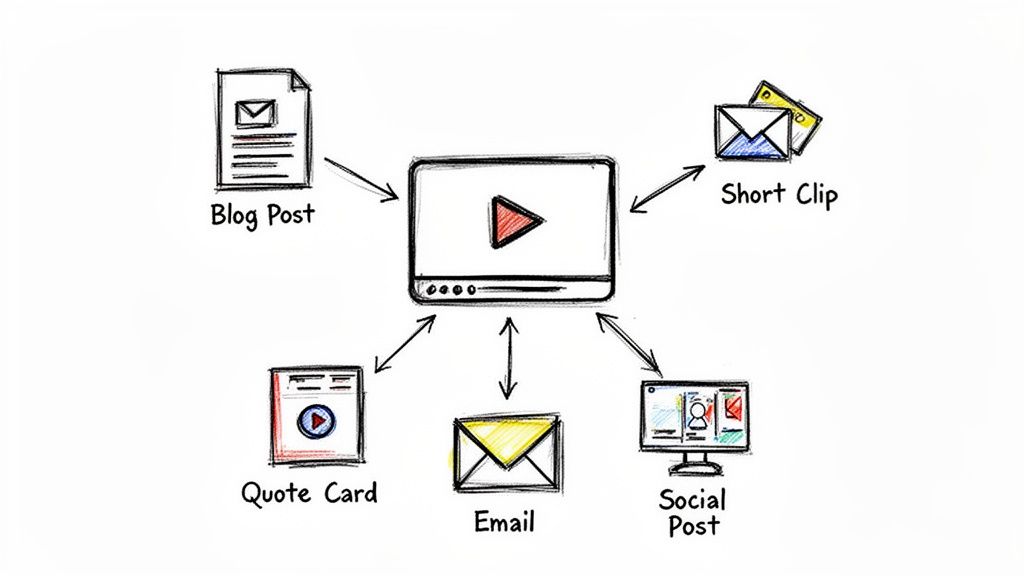
But what if you stopped thinking of a webinar as a one-off event and started seeing it as the raw material for a dozen other pieces of content? This is the power of content repurposing—a strategy where you deconstruct a one-hour session into a whole suite of marketing assets. It’s the secret to maximising your ROI and making your core message work for you for weeks, or even months, addressing the pain point of needing consistent content output.
Every question from the Q&A, every expert insight, and every key statistic is a seed for something new. By breaking it down systematically, you can fuel your entire marketing engine with minimal extra work.
Deconstructing Your Webinar Recording
The process starts the moment your live event ends. The goal is to dissect the recording and pinpoint the most valuable, high-impact moments that can stand on their own. It’s like a chef taking one prime cut of beef and creating multiple distinct dishes from it. Nothing goes to waste.
Implementation Step 1: Get an accurate transcript. This text-based version of your webinar is the foundation for almost everything that comes next, allowing you to easily mine for content gold.
Here’s a practical look at how that single one-hour recording can be broken down:
- The Full On-Demand Recording: This is the most obvious starting point. Gate the full recording behind a form on a dedicated landing page to keep generating leads long after the live event.
- A High-Value Blog Post: Use the transcript to create a comprehensive blog post that summarises the webinar's key themes and insights. An SEO-optimised article like this can attract organic traffic for months to come.
- Short Video Clips for Social Media: Find three to five "Aha!" moments—a surprising statistic, a powerful quote, or a crucial piece of advice. Edit these into punchy 30-60 second clips with captions, perfect for grabbing attention and driving engagement on LinkedIn.
Actionable Insight: Repurposing isn't just about efficiency; it's about meeting your audience where they are. Some prospects will happily watch a 60-minute deep-dive, while others will only ever engage with a 45-second video clip on their feed. Repurposing lets you cater to both.
Creating a Library of Micro-Assets
Beyond the core assets like the blog and video clips, you can create a whole library of micro-content to fill your social calendar and nurture leads. This is where you see the real efficiency gains.
The aim is to create a diverse range of assets that appeal to different learning styles and work across different platforms. This ensures your message has the broadest possible reach. Our in-depth guide offers even more strategies for effective webinar content repurposing, showing you how to turn one session into a real content machine.
Here are a few more assets you can create from a single webinar:
- Quote Graphics: Pull the most impactful quotes from your speakers and turn them into sharp, visually appealing graphics for social media. These are highly shareable and reinforce your company's expertise.
- Infographic: Was your webinar heavy on data? Consolidate the key statistics and findings into a professional infographic. It’s an excellent format for making complex information digestible at a glance.
- Email Nurture Sequence: Use the webinar's main talking points to build a three-part email series for attendees and no-shows. Each email can focus on a different key takeaway, driving them back to the full recording or a related call-to-action.
- Podcast Episode: The audio from your webinar can be easily stripped out and repackaged as a podcast episode. This lets you reach an entirely new audience that prefers to consume content on the go.
This strategic approach transforms a single marketing activity into a sustainable content engine. With a strategic partner like Cloud Present, this entire repurposing workflow can be handled for you, turning your webinar into a reliable source of demand without draining your team’s precious resources.
Driving Attendance and Measuring Business Impact
You can create the most ground-breaking webinar imaginable, but it’s a wasted effort if no one shows up. A perfectly produced event with an empty virtual room is just a dress rehearsal. To ensure your event is well-attended by the right people, you need a multi-channel promotion playbook that cuts through the noise and drives registrations.
Simply sending one email blast and posting on social media a couple of times won't get the job done. A successful promotion strategy is a sustained campaign, and we've found the sweet spot is starting two to three weeks before the event. This gives you plenty of runway to build momentum without your audience tuning you out.
Crafting a Multi-Channel Promotion Playbook
Effective webinar promotion isn’t about shouting from every rooftop; it's about precision. The goal is to reach your ideal customer profile across multiple touchpoints, reinforcing the value of your event at every turn.
A smart promotional strategy layers several key channels, making sure they work in harmony. This approach ensures your message connects with prospects wherever they spend their time online.
Here’s a practical, multi-channel approach that works:
- Targeted Email Campaigns: This is still the heavyweight champion for webinar registrations. A simple but effective approach is a three-part email sequence: an initial announcement, a mid-campaign reminder that teases a key speaker insight, and a "last chance" nudge 24 hours before you go live.
- Paid Social Promotion: Use platforms like LinkedIn to get laser-focused, targeting specific job titles, industries, and company sizes. Don't just post a link; promote short video clips of your speakers or compelling quote graphics to stop the scroll and drive clicks to your registration page.
- Leveraging Partner Co-Marketing: Teaming up with a complementary tech company or an industry influencer can be a game-changer for your reach. Data shows this tactic can lead to registration rates up to 300% higher than going it alone, because it comes with a powerful third-party endorsement.
Actionable Insight: Make it incredibly easy for your target audience to discover, register for, and remember your webinar. Every single promotional asset should clearly answer the question, "What's in it for me?" by focusing on the tangible problems your webinar promises to solve.
For a more detailed breakdown, our guide to effective webinar promotion strategies gives you a complete checklist and timeline you can put into action straight away.
Measuring What Truly Matters: Pipeline and ROI
Once the webinar ends, the real work begins. Sure, registration and attendance numbers are handy for gauging interest, but the C-suite wants to see tangible business impact. This means moving past vanity metrics and directly connecting your webinar efforts to pipeline and revenue.
Implementation Step: CRM Integration. By syncing your webinar platform with your CRM, you can automatically track which attendees become marketing-qualified leads (MQLs), which of those convert into sales opportunities, and—most importantly—which opportunities close.
Here are the key performance indicators (KPIs) you should build your dashboard around:
| Metric | What It Measures | Why It Matters for ROI |
|---|---|---|
| Lead-to-Opportunity Conversion Rate | The percentage of webinar attendees who become active sales opportunities. | This is your first real indicator of lead quality and sales alignment. An average B2B rate is around 10-15%. |
| Pipeline Influence (in USD) | The total value of sales opportunities that engaged with the webinar. | It demonstrates the webinar's direct contribution to the sales pipeline. |
| Sales Velocity | The time it takes for a webinar-generated lead to move through the sales cycle. | Shorter cycles suggest higher-quality, better-educated leads. |
| Revenue Attribution | The amount of closed-won revenue directly linked to webinar attendees. | This is the ultimate metric, proving the webinar's financial return. |
By tracking these metrics, you build a powerful business case, proving that using webinars for marketing isn’t just a content play—it’s a direct driver of business growth. A strategic partner like Cloud Present provides the integrated analytics to make this tracking seamless, turning your webinar data into a clear story of performance and ROI.
Navigating Webinar Compliance in Regulated Industries
If you’re using webinars in finance, law, or consulting, compliance isn’t just another box to tick on a checklist. It’s the entire foundation of your strategy. One small misstep can shatter client trust and attract the kind of regulatory attention no firm wants, making a proactive approach absolutely essential.
Think of it this way: your virtual event strategy needs to be built on a framework that manages risk from the very beginning, not as an afterthought.
This starts with tackling critical areas like data privacy head-on. Under regulations like GDPR, the way you collect, store, and process attendee information is under a microscope. Getting explicit consent for marketing communications during registration is completely non-negotiable, and your webinar platform had better be built to handle these requirements securely.
Building a Compliance-Ready Workflow
The content of your webinar carries its own set of risks. When you’re discussing financial instruments or legal precedents, every single statement has to be precise and thoroughly vetted. An off-the-cuff remark during a live Q&A could easily be misconstrued as official advice, creating a massive liability.
This is exactly where a meticulously planned workflow becomes your greatest defence.
A pre-recorded webinar format offers a powerful solution to this challenge. It creates a crucial window for internal review, giving your legal and compliance teams the chance to scrutinise the presentation and transcript before it ever sees the light of day. This controlled process guarantees accuracy and takes the risk of unscripted errors right off the table.
Actionable Insight: For regulated firms, the ability to pre-vet content isn't a luxury; it's a core component of risk management. It transforms the webinar from a high-stakes live performance into a polished, pre-approved asset that confidently represents the firm’s expertise.
Key Considerations for Regulated Industries
To make sure your webinar programme is both defensible and professional, you need to bake these best practices into your production process. Each step is designed to protect your firm while still allowing you to deliver authoritative and engaging content.
- Accurate Record-Keeping: If your webinars offer Continuing Legal Education (CLE) or Continuing Professional Education (CPE) credits, precise tracking is mandatory. Your system must be able to reliably log attendance duration and engagement to generate auditable records that satisfy accreditation bodies.
- Vetted Transcripts: An accurate, time-stamped transcript is your official record. It provides a clear, unambiguous account of what was said, which is invaluable for resolving any disputes or responding to regulatory enquiries. Services that guarantee 99% accuracy are the industry standard for a reason.
- Secure On-Demand Access: When you gate your on-demand webinar to generate leads, make sure the platform provides secure access. This protects your intellectual property and keeps you in control of who views potentially sensitive content.
Working with a strategic partner like Cloud Present that gets these nuances is critical. We build compliance into our end-to-end production, delivering polished, pre-vetted webinars with accurate transcripts in days. This frees up your team to focus on sharing their expert insights, without the regulatory headache.
Your Top Webinar Questions, Answered
Even with a solid plan, a few practical questions always pop up when you're getting a webinar programme off the ground. Let's tackle some of the most common ones that marketing teams ask.
What’s the Ideal Length for a B2B Marketing Webinar?
The sweet spot for most B2B webinars is 45-60 minutes. This gives you enough runway for a meaty 30-40 minute presentation, leaving a crucial 10-15 minutes for a live Q&A session at the end. Data consistently shows that audience engagement starts to dip after the one-hour mark.
Of course, context is everything. If you're unpacking complex regulatory changes, you'll probably need the full hour to do it justice. But for a higher-level thought leadership piece? A tight 45 minutes often hits harder, delivering real value while respecting everyone's packed schedules.
How Far in Advance Should We Start Promoting Our Webinar?
Give yourself a 2-3 week promotional window. Kicking things off three weeks out builds initial buzz and gets your event on people's calendars. Don't panic if registrations are slow at first; the real surge almost always happens in the final week, with a big spike on the day of the event itself. Typically, 25-30% of registrations occur in the final 24 hours.
A good promotional rhythm looks something like this:
- An initial announcement email to your core list.
- A steady drumbeat of social media posts, maybe sharing speaker headshots or juicy tidbits.
- A mid-campaign reminder to catch anyone who missed the first wave.
- A final "last chance" push 24 hours out, and another on the morning of the webinar.
This multi-touch approach keeps your event top-of-mind without feeling like spam.
Should Our Webinars Be Live or Pre-Recorded?
For B2B SaaS and professional services firms, the "simulive" model is often the perfect solution. It gives you the best of both worlds. You pre-record the core presentation, which means you can polish it to a high shine, edit out any stumbles, and ensure the final product is broadcast-quality.
Actionable Insight: More importantly, it gives your compliance or legal team the chance to review every word before it goes public. You then stream the pre-recorded session at a scheduled time, and your experts are right there in the live chat, answering questions as they come in. It’s all the polish of a recorded session with all the engagement of a live event, delivering a professional quality standard while mitigating risk.
This simulive model is exactly what we specialise in at Cloud Present. We handle the entire production, so your company can focus on delivering authoritative, compliant content that builds trust. See how our end-to-end service can elevate your webinar strategy.


