A Growth Blueprint: Actionable Marketing for Consulting Firms
Discover a proven growth blueprint for marketing for consulting firms. Learn positioning, demand generation, and ROI strategies to drive client acquisition.
Effective marketing for a consulting firm isn’t about random acts of promotion. It's about building a structured, predictable engine for growth that turns your firm’s expertise into a steady stream of high-value clients. For B2B marketing teams, this means focusing on efficiency, ROI, and professional quality standards.
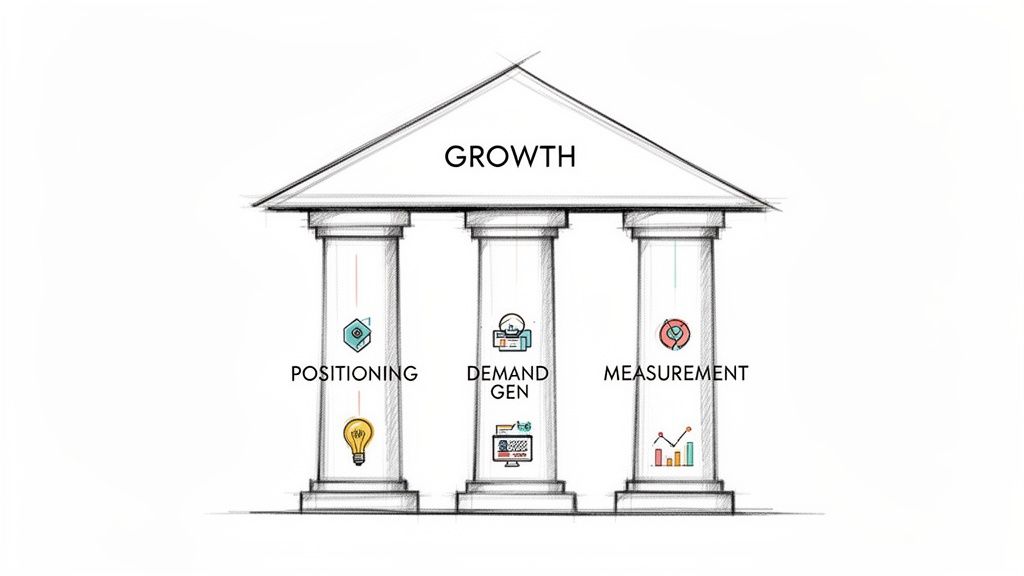
It all boils down to three core pillars: carving out a unique position in the market, creating a scalable system to generate demand, and meticulously measuring your return on investment. Get these right, and you're no longer just practising consulting; you're building a business.
Building Your Modern Consulting Marketing Framework
The consulting world is crowded. Relying on reputation and referrals is no longer enough. Today's marketing leaders in consulting face a trio of critical challenges: limited resources, the constant pressure for consistent content output, and the need to deliver a reliable flow of qualified leads for demand generation.
To win, you need a modern framework. This isn't about jumping on every new marketing trend. It’s about building an efficient, repeatable system that proves its value to the partners. Marketing shouldn’t be seen as a cost centre, but as a strategic contributor to the firm’s bottom line, driven by data-backed ROI.
The Three Pillars of Sustainable Growth
A truly successful marketing strategy rests on three interconnected pillars. Think of it like a stool – if one leg is wobbly, the whole thing becomes unstable.
Pillar 1: Differentiated Positioning: This is about answering one question with absolute clarity: Why is your firm the only logical choice for a specific client with a specific problem? This is your shield against commoditisation.
Pillar 2: Scalable Demand Generation: This is your growth engine. It’s where you create high-value content, like webinars, and then cleverly repurpose it across multiple channels. This solves the dreaded "content treadmill" problem and addresses the need for consistent output.
Pillar 3: Meticulous Measurement: Every marketing activity must be tied back to a business outcome. We're talking about focusing on metrics that matter, like pipeline contribution and client acquisition cost (CAC), not just vanity metrics like website traffic.
This blueprint gives you a clear roadmap to not only justify your budget but to demonstrate tangible, undeniable ROI. Just look at the UK management consulting industry – revenues nearly doubled to £20.4 billion by 2023 before a recent dip, highlighting both the massive opportunity and the market's volatility. A solid framework provides stability, no matter what the market is doing.
This table summarises how these pillars form a cohesive, actionable strategy.
The Modern Marketing Framework for Consulting Firms
| Pillar | Key Objective | Why It Matters for B2B Marketers |
|---|---|---|
| Differentiated Positioning | Stand out as the go-to expert for a specific niche. | Cuts through the noise, commands higher fees, and attracts ideal clients who are ready to buy. |
| Scalable Demand Generation | Build a consistent, repeatable system for generating leads. | Creates a predictable sales pipeline, reduces reliance on referrals, and fuels sustainable growth with resource efficiency. |
| Meticulous Measurement | Prove the direct financial impact of all marketing activities. | Secures budget, demonstrates marketing's value to leadership, and enables data-driven decisions that improve ROI. |
By building upon these foundations, marketing becomes a strategic driver, not just a support function.
Given that consulting is fundamentally a B2B service, a focused LinkedIn marketing strategy for B2B often serves as a powerful cornerstone within this framework, connecting directly with decision-makers where they are most active.
By focusing on a systematic approach that integrates positioning, content, and analytics, marketing teams can transform from support functions into strategic growth drivers for their firms. This shift is crucial for thriving in a competitive environment.
In the next sections, we'll dive deep into each of these pillars, breaking them down into practical, actionable steps you can start implementing right away.
Carving Out Your Defensible Market Position
In a market flooded with generalists, specialisation is your sharpest weapon. Great marketing for a consulting firm doesn’t start with a webinar or a blog post. It starts way before that, with a ruthlessly clear, defensible market position.
This isn't about a fluffy mission statement. It’s about nailing down precisely who you serve, the unique problem you solve for them, and why you’re the only logical choice.
Without that clarity, your marketing is just noise. You’re shouting into a crowded room, hoping someone pays attention. But with a sharp position? You’re speaking directly to your ideal client's biggest headache, making your message impossible to ignore.
Identifying Your Profitable Niche
First things first: you have to stop being the "jack of all trades." Real authority is built on deep, focused expertise. You need to figure out which path makes the most sense for your firm to truly stand apart.
It usually comes down to one of three routes:
- Industry Vertical: Do you live and breathe a specific sector like financial services, life sciences, or retail? Specialising here means you already speak the client’s language. You get their regulatory headaches and competitive pressures without needing a translator.
- Business Problem: Are you genuinely the best at solving one specific, painful challenge? Think supply chain optimisation, untangling legacy systems for digital transformation, or smoothing out post-merger integrations. This makes you the go-to specialist for a high-stakes problem, no matter what industry the client is in.
- Technological Expertise: Is your team on the bleeding edge of a particular technology, like implementing AI in risk management or building custom cloud architectures? This is a massive draw for clients looking for a distinct technical advantage over their competition.
Picking one primary focus doesn’t mean turning away all other work. It just means your marketing becomes laser-focused, pulling in the highest-value opportunities like a magnet.
A common trap is thinking a narrow focus means fewer opportunities. It’s the exact opposite. A sharp, defensible position attracts your ideal clients, dramatically reduces sales friction, and gives you the leverage to command premium fees for your specialised expertise.
Crafting Your Powerful Value Proposition
Once you’ve staked your claim in a niche, you need to articulate your value in a way that’s both compelling and unique. This means taking a good, hard look at your competitors. Do a gap analysis to find the "uncontested space"—what are your ideal clients crying out for that your rivals are either ignoring or doing a poor job of?
That gap is where your unique value proposition is born. It needs to be a clear, concise statement that instantly answers three questions for a potential client:
- Relevance: How do you solve my specific, urgent problem?
- Value: What tangible results can I actually expect from this?
- Differentiation: Why should I pick you over everyone else?
For example, a generic firm says, "We provide management consulting services." A firm with a killer value proposition says, "We help mid-market manufacturing firms slash supply chain costs by 15% in six months using our proprietary inventory forecasting model."
See the difference? It’s specific, it promises a measurable outcome, and it points to something unique. This is the kind of sharp messaging that becomes the bedrock of every webinar, blog post, and sales call, making sure all your marketing efforts hit their mark.
Building Your Demand Generation Engine
A strong market position is the foundation, but your demand generation engine is what builds the business. This is the system that turns your firm's expertise into a predictable, consistent flow of high-value leads. For B2B marketers, this is where strategy gets real, solving that relentless pressure to fill the pipeline while working with limited resources.
The secret isn’t just creating more content; it’s about creating smarter content. Webinars are the perfect centrepiece for this model. They let your experts share deep insights in a high-value format that can then be strategically repurposed, fuelling your entire marketing ecosystem from one powerful session. This is the key to efficiency and ROI.
Webinars as the Hub of Your Content Strategy
Think of a single, professionally produced webinar not as a one-off event, but as the raw material for a dozen other marketing assets. This "record once, publish everywhere" approach is the antidote to the content treadmill that burns out so many teams. It respects your consultants' valuable time while maximising the impact of their knowledge.
For example, a one-hour webinar on 'AI Governance for Financial Services' can be methodically deconstructed and repackaged, turning a single time investment into a long-term demand generation asset.
- Short-Form Video Clips: Cut 3-5 key moments (60-90 seconds each) to share on LinkedIn, targeting specific pain points or surprising insights. Add subtitles to maximise accessibility and engagement, as 85% of social media videos are watched with the sound off.
- In-Depth Blog Posts: Use the webinar transcript as the foundation for a detailed, SEO-optimised article to capture organic search traffic.
- Social Media Carousels: Visualise key statistics or frameworks from the presentation for engaging, shareable content on platforms like LinkedIn.
- Automated Email Nurture Sequences: Send a series of follow-up emails to everyone who registered, offering deeper dives into topics covered and guiding them towards a consultation. This can improve lead conversion rates by over 10%.
This process starts with your positioning. The flow from finding a niche to building a value proposition directly informs the topics for these high-impact webinars.
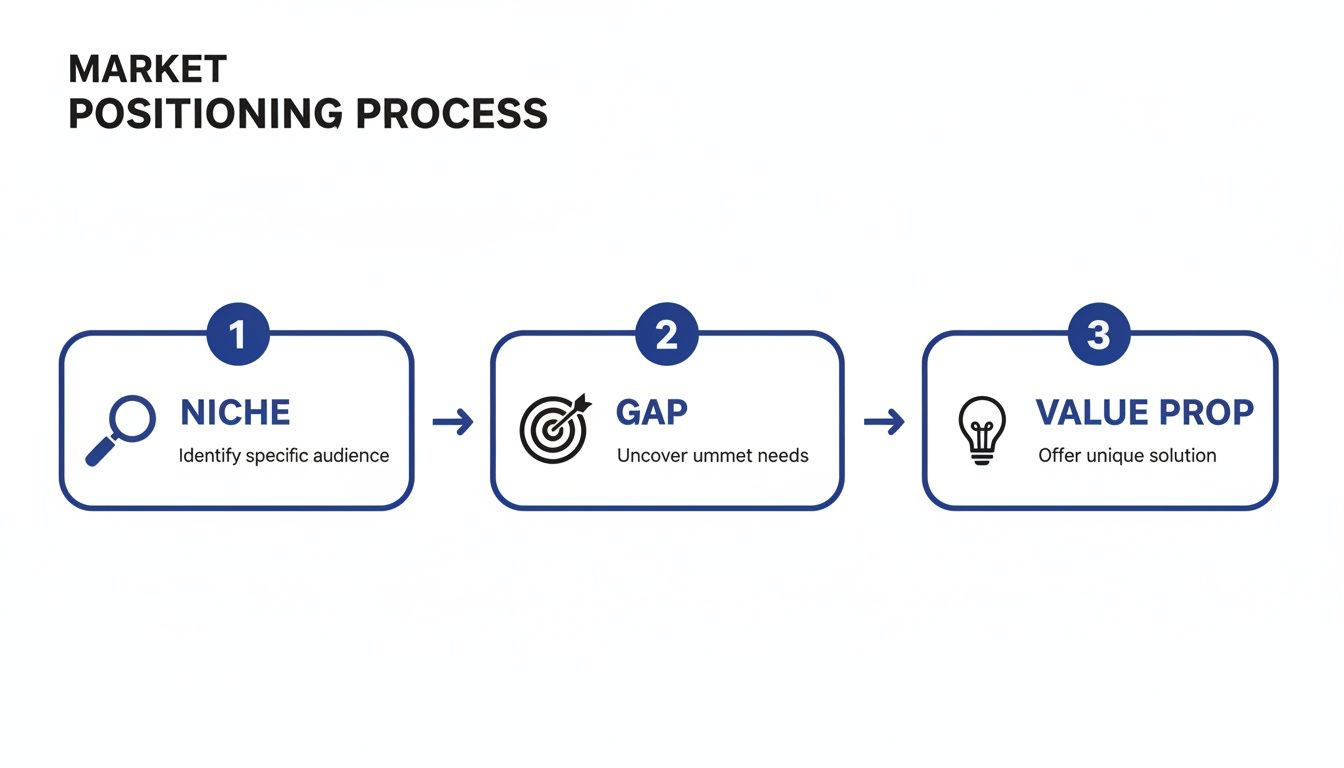
This helps establish your firm as the definitive authority in that space, attracting the right kinds of clients from the very first interaction.
Focusing on High-Impact Topics
The success of your virtual event strategy really boils down to choosing the right topics. In the UK, digital and IT strategy consulting is the largest revenue segment. A staggering 66% of UK consultants see AI as the top growth area, and large firms are planning to invest over US $6 million in it over the next two years.
The data sends a clear signal: webinars on AI ethics, cloud migration, or digital transformation aren't just relevant—they are essential demand generation engines. You can find more insights on the UK consulting market from the full research on IBISWorld.com.
By focusing on your clients' most urgent and expensive problems, you move beyond generic content and create indispensable resources. A high-quality webinar isn't just marketing; it's a consultative experience that demonstrates your value before a prospect ever signs a contract.
The Efficiency and ROI of a Repurposing Model
The real power here is in efficiency and measurable return. Limited resources are a constant pain point for marketing teams. By partnering with an end-to-end production service like Cloud Present, you can get over ten polished, on-brand assets from a single webinar recording, often with a 3-5 day turnaround.
This frees your experts to do what they do best—deliver world-class insights—instead of wrestling with production logistics. You get the quality of an in-house studio without the overhead, ensuring every piece of content reflects the professional standards of your firm.
By adopting this hub-and-spoke model, you build a scalable demand generation machine. For a comprehensive look at building out your lead generation activities, check out our guide on developing a B2B demand generation strategy. This system doesn't just create a steady stream of content; it gives you clear metrics to track performance, from lead acquisition cost per webinar to conversion rates from repurposed assets. It’s how you prove marketing’s direct contribution to the bottom line.
Putting Your Thought Leadership Plan Into Action
In consulting, your expertise isn't just a service—it's your product. Thought leadership is how you package that expertise and prove its value to the market. This isn't about abstract ideas; it's about building a concrete content plan so your team is never stuck wondering what to create next, solving the pain point of inconsistent content output.
A solid content plan maps specific themes to each stage of your client's journey. This makes sure you're delivering the right insight at the right moment, from high-level articles on emerging trends all the way to decision-stage case studies that prove you get results.
Build Your Strategy Around Content Pillars
To stop churning out random acts of content, you need to build your strategy around content pillars. Think of a pillar as a substantial, flagship piece of content on a core specialism of your firm—something like 'Supply Chain Resilience' or 'AI Governance in Financial Services'. This one big idea becomes the foundation for a whole ecosystem of related assets.
This approach gives you a consistent, high-value content pipeline. For instance, a single pillar can be the source for a foundational webinar, a detailed white paper, a series of tactical blog posts, a data-rich infographic, and a dozen short video clips for social media.
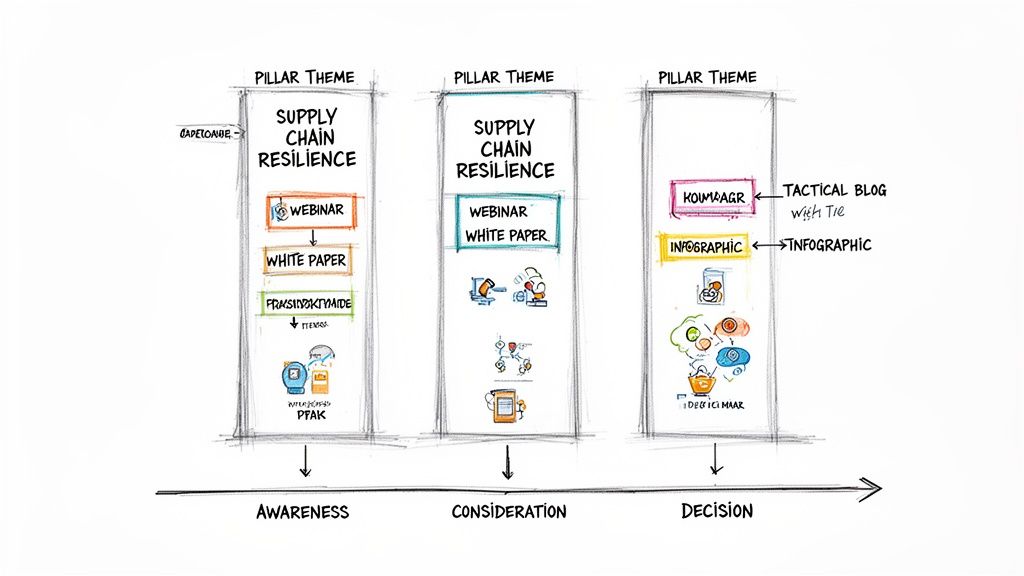
This methodical process makes your marketing for consulting firms both efficient and genuinely impactful, constantly reinforcing your niche expertise. It's no surprise that high-growth consulting firms keep content creation as their top marketing priority year after year. It's the engine that drives digital lead generation, which now accounts for around 40% of all leads for top-performing firms.
Map Your Content to the Client Journey
Your content pillars have to do more than just sit there; they need to guide prospects from their first flicker of awareness to a final decision. Every asset should serve a distinct purpose, building trust and demonstrating value at each step.
Here’s what a well-structured content ecosystem for a single pillar might look like:
- Awareness Stage: The prospect is just starting to realise they have a problem.
- Content: A high-level blog post ("5 Signs Your Supply Chain Is at Risk") or an infographic with key industry stats. These assets are designed to grab attention and introduce your firm's point of view.
- Consideration Stage: Now they're actively researching solutions.
- Content: A comprehensive webinar ("Building a Resilient Supply Chain for 2025 and Beyond") or a downloadable white paper that goes deep into your methodologies. This is where you establish serious credibility.
- Decision Stage: The prospect is sizing up potential providers.
- Content: A detailed case study showing how you achieved a 15% cost reduction for a similar company, or a short video testimonial from a happy client. This is the social proof they need to make a choice.
This approach ensures every piece of content has a clear job to do in nurturing leads through your pipeline. To get more out of each pillar, check out our complete guide to repurposing content.
The best thought leadership doesn't just tell people you're an expert; it shows them. When you structure your content around client pain points and guide them through their journey, your marketing transforms from a collection of random assets into a cohesive, lead-generating system.
From Plan to Professional Production
Putting this plan into motion requires more than just good ideas. It demands professional quality and efficient production to keep the momentum going. The fastest-growing consulting firms get this, which is why they are far more likely to outsource specialised skills like video production and graphic design.
This is where a strategic partner can be a game-changer. Instead of asking your already-swamped consultants to become part-time content creators, you can capture their expertise in a single, high-production-value webinar. From that one session, a partner like Cloud Present can spin out an entire ecosystem of on-brand assets, delivering broadcast-quality content in days, not weeks.
This frees up your team to focus on what they do best—delivering brilliant insights—while ensuring your firm’s thought leadership meets the high standards your clients expect.
Optimising Your Channels and Measuring True ROI
Creating exceptional content is only half the battle. If your brilliant insights never reach the right C-suite decision-makers, they might as well not exist. This is where a smart channel strategy comes in, shifting the focus from just creating content to making sure it actually performs.
The goal is to put your energy where senior executives are already paying attention. This means prioritising channels like LinkedIn, hyper-targeted email campaigns, and strategic partnerships with industry bodies over broader, less focused tactics. It's all about precision, not volume.
Moving Beyond Vanity Metrics
To really prove the value of your marketing, you have to look past surface-level metrics like likes, shares, or even website traffic. Firm partners and key stakeholders care about business outcomes, not how many people clicked a heart icon. Your reporting needs to speak their language.
This requires a relentless focus on metrics that draw a straight line from marketing activity to revenue:
- Marketing Qualified Leads (MQLs): The number of high-calibre leads generated from a specific campaign, like a webinar or a gated white paper.
- Pipeline Contribution: The total value of sales opportunities that marketing has sourced or influenced. This is the number you bring to budget meetings.
- Client Acquisition Cost (CAC): The total marketing and sales spend it takes to land a new client. The aim is to consistently drive this number down with efficient strategies like content repurposing.
When your dashboard shows a US $250 cost per lead from a webinar that generated five MQLs, you're demonstrating tangible value, not just activity. To make sure your video content reaches as many people as possible, understanding how to add subtitles to videos is a simple but powerful way to boost engagement and improve SEO.
A classic mistake is measuring LinkedIn success by public likes and comments. The real influence happens privately—in DMs, internal Slack channels, and forwarded emails. C-level executives often consume and evaluate content without ever engaging publicly. You have to account for this "dark social" activity by meticulously tracking lead source data.
Building a Performance Dashboard That Matters
A clear, concise dashboard is your best friend when it comes to defending your budget and proving your team’s impact. It should translate your marketing efforts into financial terms, making your ROI impossible to ignore. Start by tracking a few core KPIs that connect your content activities directly to business results.
This sample dashboard shows how to link your channels to concrete business objectives. It gives you the hard data needed to double down on what works and confidently cut what doesn’t.
Marketing Channel Performance Dashboard for Consulting
| Channel | Primary KPI | Secondary Metric | Target (Example) |
|---|---|---|---|
| Pillar Webinars | Cost per MQL | Attendee-to-Lead Rate | Under US $300 per MQL |
| Repurposed Video (LinkedIn) | MQLs Sourced | Link Clicks to Gated Asset | 5 MQLs per month |
| Targeted Email Nurture | Demo/Consultation Requests | Open Rate on Case Studies | 2 Demo Requests per Pillar |
| SEO (Pillar Blog Posts) | Organic Lead Conversions | Keyword Rankings for Pillar | 8 Organic Leads per quarter |
By tracking metrics like 'MQLs Sourced' from repurposed LinkedIn clips, you can clearly show how a single investment in a webinar continues to deliver value for months. This data-driven approach transforms marketing from a perceived cost centre into a documented, high-performance growth engine for your firm. It's the definitive way to prove your strategy isn't just busy—it's effective.
Your First 90 Days to Marketing Implementation
A brilliant strategy is only as good as its execution. Let's be honest, the biggest hurdle is often just getting started. This practical, 90-day plan is designed to break through that inertia, turning your marketing strategy from a document into a demand generation engine.
We'll break down the first three months into manageable sprints. The goal is simple: build momentum quickly and get measurable results. This roadmap prioritises foundational work first, ensuring your efforts are built on solid ground before you even think about scaling.
Days 1-30: Laying the Groundwork
The first month is all about meticulous planning and alignment. Don't rush this stage. Clarity here prevents costly rework and wasted effort later. Your focus is on setting up your first major marketing initiative—a pillar webinar—for a bullseye hit.
Your objectives for this period are straightforward:
- Nail Your Positioning: Revisit your defensible market position and unique value proposition. Get your entire marketing and business development team in a room (virtual or otherwise) and make sure everyone is crystal clear on the specific client pain points you solve better than anyone else.
- Plan Your Pillar Webinar: This isn't just about picking a subject. You need to identify a high-impact topic that tackles a critical, nagging challenge for your ideal client. Frame a compelling argument and outline the key takeaways that will cement your firm's authority.
- Define What Success Looks Like: How will you know if this worked? Establish clear KPIs from the very beginning. Think target registration numbers, marketing-qualified lead (MQL) goals, and cost-per-lead benchmarks. As a starting point, you might aim for a cost per MQL of under US $300.
Days 31-60: Execution and Activation
With your plan locked in, month two is all about action. This is where you bring your pillar webinar to life and kickstart the content repurposing workflow that will squeeze every drop of value out of it. Quality is non-negotiable here; these assets are a direct reflection of your firm's brand.
Key actions for this 30-day sprint:
- Produce and Launch the Webinar: Don't let your subject matter experts get bogged down by tech. Partner with a production specialist like Cloud Present to handle the technical side, ensuring a broadcast-quality recording. This frees up your experts to focus on what they do best: delivering outstanding content.
- Activate Your Content Workflow: The moment the webinar is done, commission the repurposed assets. This should be an immediate, well-oiled process. We're talking short video clips for LinkedIn, a detailed blog post expanding on the topic, and social media carousels, all delivered within a 3-5 day turnaround.
- Set Up Analytics Tracking: Implement the tracking dashboard you designed last month. You need to be able to accurately attribute leads and measure engagement across every single asset derived from the webinar.
The real game-changer is parallel processing. As soon as that webinar is recorded, the repurposing engine should fire up. This condenses what could be months of content creation into just a few days, keeping your channels fuelled with high-quality, consistent material.
Days 61-90: Analysis and Optimisation
The final 30 days are for learning and refining. Marketing for consulting firms is an iterative process, not a one-and-done campaign. This phase is crucial for ensuring your long-term success, as you'll use real data to make smart decisions for your next content pillar.
Focus your efforts here:
- Dig Into the Performance Data: Open up your dashboard. Did you hit your MQL target? Which repurposed assets drove the most engagement? Was it the short clips or the long-form blog? This data is gold.
- Refine Your Content Approach: Based on what the data tells you, adjust your strategy. If video clips on LinkedIn blew everything else out of the water, it’s a clear signal to double down on that format for your next pillar.
- Plan Your Next Pillar: With these fresh lessons learned, it's time to begin planning your next 90-day cycle. This creates a repeatable, scalable system for demand generation that gets smarter with every iteration.
For a deeper dive into turning events into a reliable sales pipeline, explore our detailed guide on the 90-day content distribution framework.
By treating this 90-day plan as a continuous cycle, you build a powerful marketing engine. If you need a partner to accelerate this roadmap, Cloud Present can act as your outsourced 'Head of Webinars,' ensuring a professional, high-ROI programme from day one.
Got Questions? We've Got Answers
When it comes to marketing a consulting firm, a few key questions always seem to pop up for marketing leaders. Let's tackle the big ones head-on with some straight-talking, practical advice on strategy, budget, and getting things done.
How Much Should a Consulting Firm Budget for Marketing?
You’ll hear the classic benchmark of 5-10% of revenue thrown around, but honestly, that’s an outdated way to think. Modern marketing isn’t about fixed percentages; it's about ROI.
Instead, build your budget around specific, tangible goals. For example, what would it be worth to generate a target number of Marketing Qualified Leads (MQLs) each quarter? Then, work backwards. If a pillar webinar and all its repurposed assets cost you US $8,000 to produce but bring in 40 high-quality leads, your cost per MQL is a very defensible US $200. This flips the conversation from "How much are we spending?" to "What return are we getting on our investment?"
What Is the Most Effective Marketing Channel for Consultants?
For any B2B consultancy, LinkedIn is where your senior decision-makers live. It's an absolute must. But don't fall into the trap of thinking one channel is a silver bullet. The best strategies are always integrated.
Think of it as a system. You use LinkedIn to share sharp, repurposed clips from your latest webinar. Those clips drive people back to your website to download the full, gated report. From there, your email marketing kicks in to nurture those new leads. All the while, your SEO efforts are making sure your deep-dive articles pop up when prospects are actively searching for solutions. It’s about creating a seamless path, not just shouting into the void on one platform.
How Can We Create Content if Our Consultants Are Too Busy?
This is the number one hurdle we see. And the solution isn't to demand more from your experts—it's to be smarter with the time they do give you. Stop asking them to write articles from a blank page. It’ll never happen.
Instead, book a single one-hour recording session for a pillar webinar. With a strategic partner like Cloud Present, you can hand off everything else – the professional production, the slick editing, and all the repurposing. That one-hour time investment from your expert can fuel months of top-tier content: short video clips for social, in-depth blog posts, and punchy email updates. It's a "record once, publish everywhere" model that respects your experts' calendars while keeping your content engine running on all cylinders.
Ready to turn your experts' time into a powerful demand generation engine? Cloud Present acts as your outsourced webinar studio, turning a single session into over ten high-impact marketing assets. Discover how we can help you build a scalable content strategy.


