What's the Average Webinar Conversion Rate? A B2B SaaS Guide
Discover the average webinar conversion rate benchmarks and practical strategies to boost your virtual event ROI.
Ask ten different B2B marketers for the "average webinar conversion rate" and you'll likely get ten different answers. That’s because it’s not just one number—it’s a story told through several key metrics across the entire event lifecycle.
For a B2B SaaS company, a strong starting point is aiming for a 20-40% landing page conversion rate (visitors who register) and a 30-60% attendance rate (registrants who attend live). Nailing these figures is the first step in transforming your webinar programme from a series of one-off events into a reliable engine for demand generation and pipeline growth.
Understanding Webinar Conversion Benchmarks
When you're running a lean B2B SaaS marketing team, every piece of content needs to pull its weight and demonstrate clear ROI. Webinars are an incredibly efficient tool for this, but only if you understand what success actually looks like. It’s not about one vanity metric; it’s about the entire journey a prospect takes, from discovery to qualified lead.
Think of it as a multi-stage funnel. It starts the moment someone lands on your registration page and only ends when an engaged attendee becomes a marketing qualified lead (MQL) for your sales team. Each stage is a make-or-break moment where you can either capture their interest or lose it for good.
This diagram breaks down the typical drop-off you can expect at each stage.
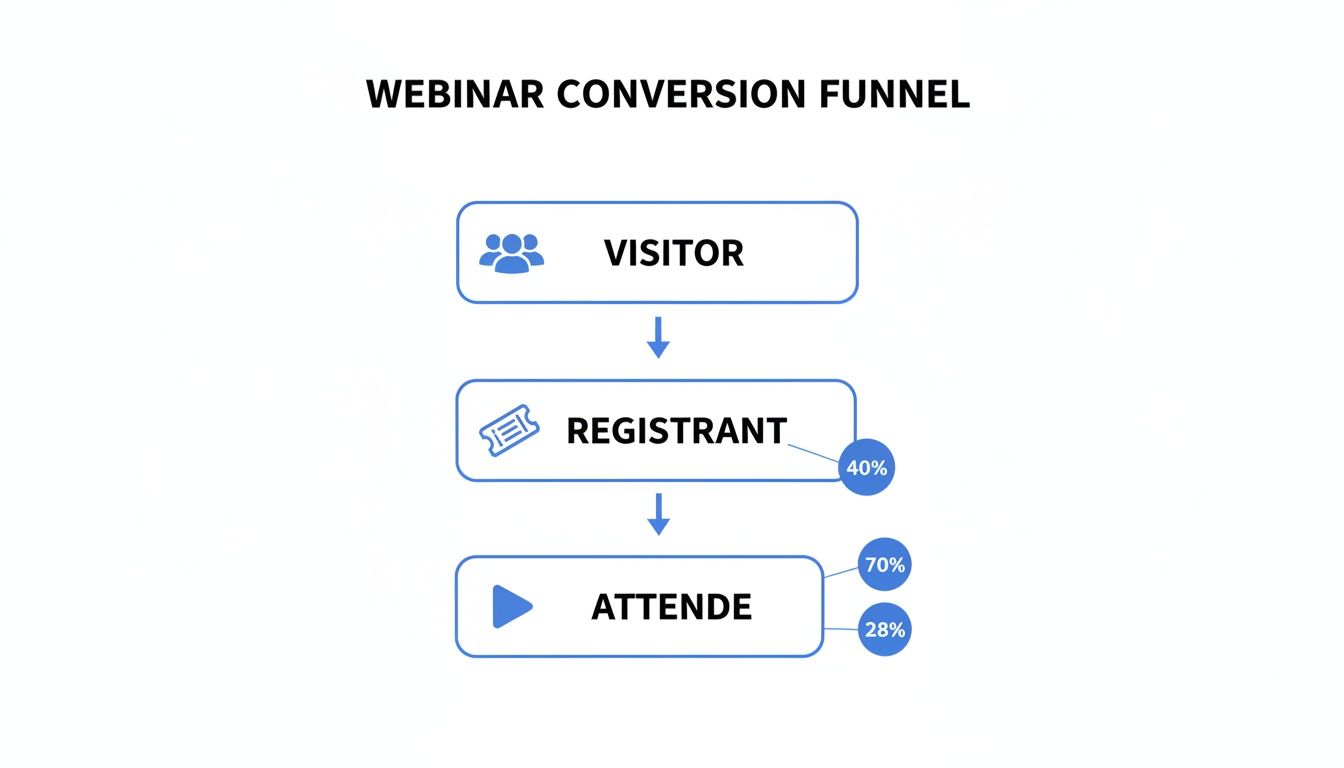
As you can see, a huge registration list doesn't mean much if you can’t get those people to tune in live and pay attention. The real value lies in converting engaged attendees into tangible pipeline.
Key Conversion Points in Professional Services
While the SaaS model is unique, we can draw valuable insights from adjacent B2B sectors like professional services. In regulated industries like law and finance, webinars are essential platforms for client education and thought leadership. The people signing up usually have a genuine need for the information, which means they're more committed from the get-go.
For instance, across the UK professional services sector, the average registration-to-attendance rate is an impressive 57%. This makes sense. When you're offering timely advice on complex regulatory changes or deep market analysis, professionals will make time to be there. For more details on this, you can explore the full report on webinar benchmarks.
To give you a clearer picture, here’s what success looks like at each stage for these high-value B2B audiences.
Key Webinar Conversion Benchmarks for UK Professional Services
This table outlines the crucial conversion points in a typical webinar funnel, with average rates tailored for UK legal, finance, and consulting firms. SaaS marketers can use these as a high-quality benchmark.
| Conversion Stage | What It Measures | Average UK Benchmark | Why It Matters for ROI |
|---|---|---|---|
| Landing Page Conversion | Percentage of visitors who register. | 20-30% | Shows if your topic, title, and copy are compelling enough to solve a key pain point. |
| Attendance Rate | Percentage of registrants who attend the live event. | 50-60% | Reflects the strength of your reminder campaigns and the perceived value of the live session. |
| Engagement Rate | Percentage of attendees who interact (e.g., polls, Q&A). | 35-50% | A strong indicator of content quality and audience intent, directly impacting lead quality. |
| Lead Conversion Rate | Percentage of attendees who become MQLs. | 15-25% | The bottom line. This ties your webinar directly to the sales pipeline and proves its commercial value. |
Tracking these specific metrics helps you move beyond guesswork. It lets you build a data-driven case for your webinar programme, pinpoint weaknesses in your funnel, and ultimately prove the financial impact of your work. At Cloud Present, we don’t just help firms produce broadcast-quality webinars; we help them measure the metrics that truly matter.
How to Calculate Your Webinar Conversion Rates
Knowing the industry benchmarks is a good starting point, but the real power comes from applying that thinking to your own numbers. Moving from vague averages to genuinely actionable insights means having a clear, repeatable way to measure what’s working. It's time to stop chasing vanity metrics and start calculating the figures that tie your webinar efforts directly to your bottom line.
The most effective way to do this is to break down your webinar funnel into its distinct stages. Each stage has a simple formula, and together, they tell a powerful story about your virtual event strategy, pinpointing exactly where it’s hitting the mark and where it’s falling short.
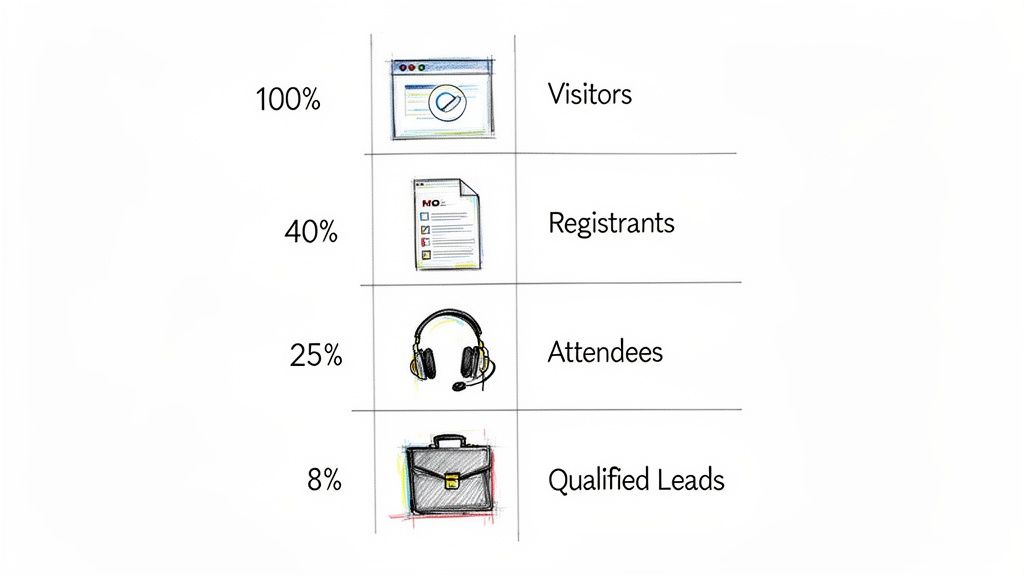
Core Conversion Formulas
Let's walk through a real-world B2B SaaS scenario. Imagine a fintech company hosts a webinar on "Scaling Payments Architecture for Growth." They drive 2,500 visitors to their landing page, which results in 625 registrants. On the day, 345 of those people actually attend the live session.
Here are the three critical calculations every B2B marketing team should have on their dashboard:
Landing Page Conversion Rate: This tells you how effective your topic, title, and promotional copy are. Are you attracting the right audience with a promise that’s compelling enough for them to share their contact details?
- Formula: (Total Registrants / Total Unique Visitors) x 100
- Example: (625 Registrants / 2,500 Visitors) x 100 = 25% Conversion Rate
Attendance Rate: This metric reflects how much your audience truly values the event and how well your reminder campaigns are working. A low attendance rate might signal a disconnect between what you promised and what your audience prioritises.
- Formula: (Total Live Attendees / Total Registrants) x 100
- Example: (345 Attendees / 625 Registrants) x 100 = 55.2% Attendance Rate
Lead Conversion Rate: This is the ultimate measure of ROI, connecting your webinar activity directly to your sales pipeline. It quantifies how many engaged viewers were inspired enough to take that next step, such as requesting a demo.
- Formula: (Marketing Qualified Leads / Total Attendees) x 100
- Example: If 55 attendees book a consultation (becoming MQLs): (55 MQLs / 345 Attendees) x 100 = 15.9% Lead Conversion Rate
These formulas give you a clear, data-driven narrative of your webinar's performance from start to finish. For a deeper look at optimising your sign-up process, our free Registration Analyser tool can offer some tailored insights.
Accounting for On-Demand Viewers
One of the most common mistakes marketing teams make is forgetting about the long-term value of their webinar. The live event is just the beginning. Busy professionals often register knowing they’ll be watching the recording on their own time. This is a critical efficiency gain for content teams facing constant pressure for new output.
It's crucial to track conversions from on-demand viewers separately. A webinar's true lead generation value unfolds over weeks, not hours. This evergreen content becomes a constant source of MQLs, significantly lowering your long-term Cost Per Lead (CPL).
To get the full picture of your ROI, you must track MQLs from the on-demand version for at least 30-60 days after the live event. Add these conversions to your live MQLs, and you’ll have a much more accurate view of the asset's total contribution to your pipeline. This complete view is essential for proving the financial impact of your webinar programme to stakeholders and justifying future investment.
What Really Moves the Needle on Your Conversion Rates
Getting a handle on your numbers is the first step. But the real gains come from understanding why those numbers are what they are. Your webinar conversion rate isn't the result of a single magic bullet; it's the sum of dozens of small, deliberate choices you make before, during, and after the event goes live. For busy B2B SaaS teams, knowing which levers to pull means maximum impact without burning through limited resources.
Think of it in three distinct phases. Each one is a chance to either hook a potential client or lose them, so getting the details right is critical. Small tweaks at each stage compound, leading to a significant jump in lead quality and overall ROI.
Pre-Webinar: The First Impression is Everything
Long before your speaker says a word, the fight for conversions has already started. This phase is all about building anticipation and removing friction. Your landing page, promotion strategy, and the sign-up process itself are what make or break your initial registration numbers.
A cluttered, demanding registration form is one of the biggest conversion killers. Every extra field is another reason for a busy professional to abandon the process. Ask yourself: is knowing their company size right now really more important than getting them registered? Probably not. A/B testing form length is a quick win.
For B2B firms targeting professional audiences in the UK, the data is clear: a smooth experience pays off. Recent benchmarks show webinar landing pages in this sector average a 22% conversion rate. Simple optimisations, like having a clear, benefit-driven call-to-action button, can lift registrant numbers by 28%. And, crucially, short registration forms with just two fields have been shown to convert 34% better than longer ones. For a deeper dive into the numbers, you can review detailed UK webinar benchmarks.
During the Webinar: Keeping Their Attention
Once you've got them in the virtual room, the game shifts to holding their attention. The quality of your content and the polish of your delivery are non-negotiable. If your presentation feels like a thinly veiled sales pitch, you'll see a high drop-off rate. But if you deliver genuine, tangible value that solves a real pain point, they'll stay engaged.
This is where interactive elements are so powerful. They turn passive viewing into an active experience.
- Interactive Polls: These aren't just for fun; they're real-time feedback loops. A well-timed poll can re-engage a distracted viewer and give your sales team invaluable data for follow-ups (e.g., "What's your biggest challenge with X?").
- Live Q&A Sessions: You absolutely must leave time for a Q&A. Research shows that 92% of webinar attendees want one, because it’s their chance to get answers tailored to their specific problems. This is a goldmine for understanding customer pain points.
- Speaker Delivery: An enthusiastic, professional presenter is often what separates a good webinar from a great one. A monotonous delivery will lose an audience, no matter how brilliant the content is.
- Call-to-Action (CTA) Timing: Deciding when to present your main call-to-action—whether it's "book a demo" or "download the report"—is a balancing act. Too early and it feels pushy. Too late and half your audience has already left. The sweet spot is usually right after you've delivered your most valuable insights, typically in the final 10-15 minutes.
The biggest mistake is treating a webinar like a lecture. It’s a conversation. Your goal isn't just to talk at people; it's to start a dialogue that naturally guides the most interested attendees toward the next logical step with your company.
Post-Webinar: Unlocking Long-Term Value
The job isn’t finished when the live stream ends. In fact, a huge chunk of your conversions will come from people watching the on-demand recording. Your post-webinar strategy is what turns a one-off event into a lasting asset that generates leads for months to come, maximising efficiency for your content team.
A prompt, segmented follow-up sequence is vital. Don't send the same email to everyone. Segment your audience based on behaviour—someone who attended live and asked a question is a far warmer lead than someone who registered but never showed up. Your messaging should reflect that.
And don't let your webinar content die. It should be the seed for a whole ecosystem of other assets. By repurposing the recording, you solve the constant headache of needing more content. A single, professionally produced webinar from a partner like Cloud Present can be sliced and diced into blog posts, social media clips, quote graphics, and newsletter snippets, ensuring you squeeze every drop of value from your initial investment.
Proven Strategies to Boost Your Webinar Conversions
Knowing your numbers is one thing. Actually improving them is where the real work begins. Moving the needle on your webinar conversion rate isn’t about finding a single magic trick; it’s about building a deliberate, multi-stage strategy that makes every touchpoint count. For B2B SaaS and professional services firms, this is how you build a repeatable system that turns webinars into genuine demand-generation assets.
Let’s walk through the playbook, with actionable implementation steps for each critical phase: driving registration, maximising engagement, and generating long-term ROI.
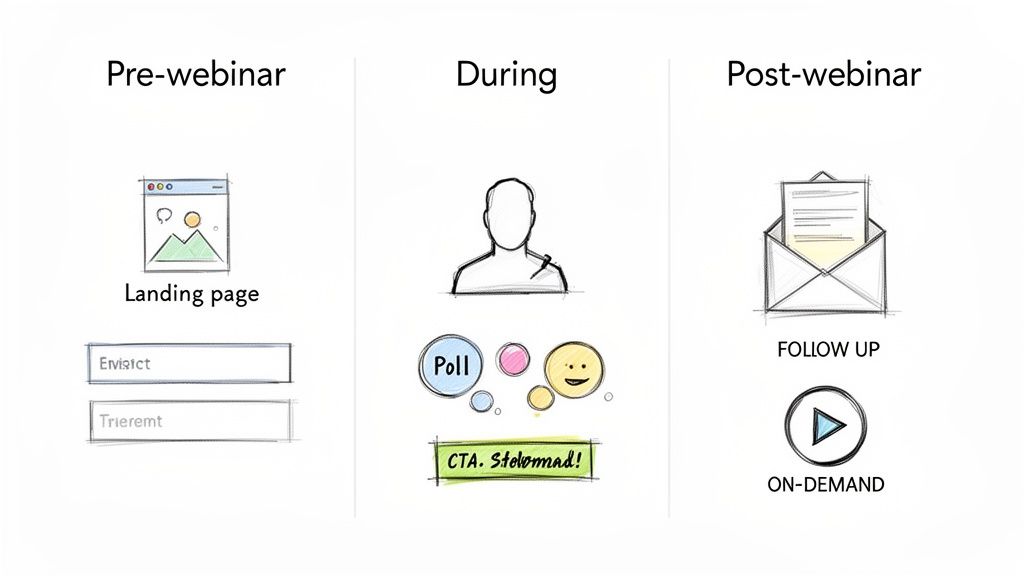
Pre-Webinar: Driving High-Quality Registrations
The battle for attendance is won long before you go live. Your promotion needs to cut through the noise, creating both awareness and a healthy dose of urgency.
An automated email sequence is your workhorse here. Start promoting at least two weeks out and send a minimum of three reminders to registrants. A simple three-part sequence—confirmation, one week out, and one day before—can lift attendance rates significantly.
But don't stop at email. Go where your ideal audience already is. For most B2B professionals, that means LinkedIn is your primary channel.
- Organic Posts: Share compelling tidbits from the upcoming session, tag your speakers, and use relevant hashtags. Post a short video clip of the speaker introducing the topic.
- Paid Ads: Get surgical. Run targeted campaigns aimed at specific job titles, industries, or even competitor audiences to attract high-intent registrants with a compelling cost-per-registration.
- Speaker Amplification: Your speakers have their own networks built on trust and authority. Provide them with pre-written posts and graphics to make it easy for them to promote the event.
While webinar-specific tactics are key, don't forget the fundamentals of event marketing. If you need more general ideas, you can explore various strategies to increase event attendance that apply here, too.
During the Webinar: Capturing and Maintaining Attention
Once attendees are in the virtual room, your focus must shift completely to engagement. A passive audience is an audience that won't convert. Your goal is to turn a one-way presentation into a two-way conversation.
Interactive elements are non-negotiable. They break up the monologue and give you real-time intelligence on your audience. Polls, for instance, are brilliant for re-engaging anyone who's started multitasking, while also giving your sales team valuable data for follow-up calls.
A live Q&A session is an absolute must. Research shows that 92% of webinar attendees want one. It's their chance to get personalised advice, and it's your chance to tackle specific pain points head-on and prove your expertise.
The placement of your main call-to-action (CTA) is also crucial. We see that B2B webinars targeting professional audiences achieve an average lead-to-customer conversion rate of 5-20%. The most successful ones present their core offer in the final 10 minutes. This timing is strategic; it capitalises on the peak value you've just delivered, making the next step feel like a natural, logical conclusion. For a deeper dive into audience participation, check out our guide on how to make webinars more interactive.
Post-Webinar: Maximising Long-Term ROI
The live event is just the beginning. A solid post-webinar strategy is what separates a decent event from a great lead-generation machine. This is where you focus on converting attendees and maximising the efficiency gains from your content.
Your first move should be a timely and segmented follow-up email.
- For Attendees: Within 24 hours, send the on-demand recording, a summary of key takeaways, and a clear CTA. Thank them for showing up and participating.
- For No-Shows: Send a "Sorry we missed you" email with a direct link to the recording. This simple action can recover a huge chunk of your potential audience and lead conversions.
- For Unregistered Leads: Use a short, punchy clip from the webinar in a future nurture campaign to draw interest to the on-demand version.
Now for the secret weapon for resource-strapped content teams: strategic repurposing. A single, professionally produced webinar can fuel your content calendar for weeks, solving the endless demand for fresh material.
- Blog Post: Write up a detailed summary of the key takeaways and embed the recording.
- Social Media Clips: Cut 1-2 minute video clips of the most impactful moments for LinkedIn.
- Quote Graphics: Turn powerful speaker statements into shareable images for social media.
- Audiogram: Create a short audio clip with animated captions for social feeds.
By partnering with a production expert like Cloud Present, you ensure that one webinar is transformed into over ten high-performing content assets. This creates a predictable pipeline and solves the persistent headache of constantly needing to produce more content.
Building a Dashboard to Track Webinar ROI
To prove your webinar programme is delivering value, you need to speak the language of the C-suite. That means moving past simple attendance figures and focusing on metrics that tie marketing activity directly to business growth. The best way to tell this compelling financial story? A dedicated ROI dashboard.
This isn't about collecting data for its own sake. It’s about building a clear narrative that shows the commercial impact of your virtual event strategy. Your dashboard should instantly answer the one question every CMO has: “What return are we getting on this investment?” By focusing on business-centric KPIs, you can justify your budget with confidence and frame webinars as a vital part of your demand generation strategy.
Selecting Your Core Dashboard Metrics
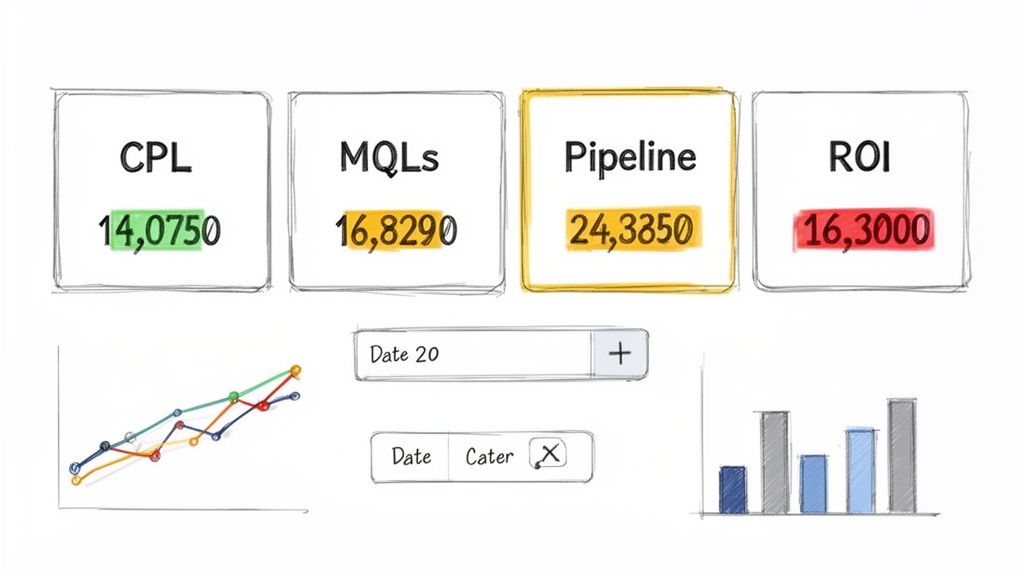
A great dashboard is simple and focused. It should tell a story at a glance, showing the journey from initial marketing spend all the way to pipeline generation. For a B2B SaaS company, there are three non-negotiable KPIs that must be front and centre.
These metrics are the backbone of your ROI argument. They draw a straight line from webinar activity to tangible business outcomes.
- Cost Per Lead (CPL): This is your ultimate efficiency metric. It tells you exactly what it costs to get one qualified lead through your webinar programme, making it easy to compare channel performance.
- Marketing Qualified Leads (MQLs) Generated: This number is your top-of-funnel contribution. It represents the total volume of high-intent prospects your webinar has handed over to the sales team.
- Pipeline Influence (US Dollars): This is your power metric for proving ROI. It puts a monetary value on the sales opportunities that your webinar either directly created or played a part in moving forward, linking your marketing efforts straight to potential revenue.
Designing Your Sample Dashboard
How you present your data is just as important as the data itself. A clean, logical layout helps you make a strong case without overwhelming senior stakeholders. Think of your dashboard as a one-page executive summary of your webinar programme's financial performance.
Here’s a practical structure that gets right to the point:
Webinar Performance Dashboard
| Metric | Definition | Formula/Source | Current Value |
|---|---|---|---|
| Total Investment | The all-in cost of the webinar, including platform fees, production, and promotion. | Sum of all expenses | $5,000 |
| Registrants | Total number of individuals who signed up for the webinar. | From registration platform | 625 |
| Attendees (Live + On-Demand) | Total unique viewers across the live event and the recording. | From webinar platform | 410 |
| MQLs Generated | Total attendees who took a conversion action (e.g., booked a demo). | From CRM tracking | 55 |
| Cost Per Lead (CPL) | The average cost to acquire one MQL from the webinar. | Total Investment / MQLs | $90.91 |
| Pipeline Influenced ($) | Total value of new sales opportunities involving webinar attendees. | From CRM reporting | $110,000 |
By consistently tracking these figures, you change the conversation from "how many people showed up?" to "how much pipeline did we generate?". This data-driven approach not only proves the value of your existing work but also builds a rock-solid case for future investment.
This clear framework ensures you are always ready to demonstrate the financial impact of your content. For a more detailed breakdown of what to measure, our guide on the 7-metric framework that proves marketing impact offers additional insights. With a strategic partner like Cloud Present, you not only get broadcast-quality production but also the analytics and support needed to build a dashboard that showcases undeniable ROI.
Turn Your Webinars into a Growth Engine
Knowing your average webinar conversion rate is just the first step. The real magic happens when you turn that data into a strategic advantage—building a reliable system that generates qualified leads and fuels predictable business growth. This is about shifting your mindset from hosting one-off events to building a genuine demand generation engine.
The process starts by defining what success looks like and tracking your performance at every stage of the funnel. From there, it’s all about making data-driven optimisations—like refining your landing page copy or improving your follow-up sequence—to consistently lift your results. It all comes together when you start measuring tangible ROI through a focused performance dashboard.
From Event to Asset
The smartest B2B SaaS marketing teams have realised that a webinar’s value doesn’t end when the live broadcast does. By strategically repurposing a single, professionally produced session, you can spin it out into a dozen high-performing pieces of content. This efficient approach not only solves the relentless pressure to create fresh material but also maximises the return on your initial time and budget.
A successful webinar programme isn't measured by how many events you host, but by how effectively each one contributes to your sales pipeline over its entire lifespan. It's about turning an hour-long presentation into a lasting lead-generation asset.
Making this leap requires a strategic partner who understands the entire virtual event lifecycle, from initial planning and polished production right through to analytics and content repurposing strategy. It frees up marketing leaders to focus on the big picture, knowing their virtual events meet professional quality standards and are engineered to deliver results.
If you're ready to build a scalable webinar programme that delivers measurable ROI, we should talk. Discover how Cloud Present can act as your strategic partner, turning every webinar into a powerful engine for business development.
Common Questions Answered
We get asked a lot about webinar conversion rates, especially from B2B SaaS marketing professionals and content teams. Here are some straightforward answers to the most common queries.
What’s a Good Webinar Conversion Rate for a B2B SaaS Company?
A ‘good’ rate isn’t a single number; it’s the complete story your funnel tells. For a B2B SaaS firm, a strong performance typically looks like this:
- Landing Page Conversion: Aim for 20-40% of visitors to register. This shows your topic is hitting a key pain point.
- Attendance Rate: Getting 30-60% of registrants to attend live is a solid result.
- Attendee-to-MQL Conversion: This is the most important step. Converting between 15-25% of your engaged attendees into marketing qualified leads (e.g., demo requests) is where you want to be.
Context is everything. A top-of-funnel thought leadership webinar might have a lower MQL rate but a larger audience, while a bottom-of-funnel, product-focused session will have a smaller, more qualified audience with a much higher conversion rate. Always measure performance against the specific goal of the webinar.
How Can We Get More People to Actually Attend Our Webinars?
To boost your live show-up rate, you need a smart, multi-channel reminder campaign. It's not about spamming people; it's about gently reminding them of the value they'll receive. Sending at least three well-timed reminder emails can lift attendance by up to 28%.
For another efficiency gain, add SMS reminders to the mix. For everyone who has opted in, this can add another 12-20% to your attendance figures. In every reminder, hammer home the unique value proposition. Are you sharing proprietary data? Offering an exclusive framework? Creating a sense of urgency and professional FOMO (Fear Of Missing Out) is key. We also consistently see the best attendance for B2B professionals when events are scheduled for midday on a Tuesday or Wednesday.
When your reminders focus on the value exchange—what attendees will concretely gain—you're no longer just marketing an event. You're offering an unmissable professional development opportunity, and that's what directly impacts your show-up rate.
Are Pre-Recorded Webinars as Good for Conversions?
Yes, and over their lifetime, they can often be more efficient and generate a higher ROI. A live event creates immediate buzz, but a professionally produced on-demand webinar gives time-poor professionals the flexibility they need. This means a much larger cumulative audience tunes in over the long haul.
You capture a steady stream of high-intent leads long after the initial broadcast. When measured over several months, a polished, pre-recorded asset can easily match or beat the conversion performance of a single live event. It becomes a cornerstone of your evergreen content strategy, working 24/7 to generate leads. This transforms a one-off marketing expense into a long-term, lead-generating asset with an ROI that just keeps climbing, providing a massive efficiency gain for your content team.
At Cloud Present, we help you turn your expertise into a polished, evergreen asset. We manage the entire production, delivering broadcast-quality webinars that generate leads for months, so you can focus on your strategy.


