What Is On Demand Video and How Can It Grow Your SaaS Business?
Discover what is on demand video and learn how B2B SaaS brands use it to turn a single webinar into a powerful, evergreen lead generation engine.

On-demand video is your strategy for turning fleeting expertise into a permanent content library that generates high-quality leads, 24/7. Think of it less like a live broadcast and more like creating a Netflix for your business insights.
For B2B SaaS marketers and content teams facing limited resources and relentless demand generation targets, this shift is transformative. It turns a one-off webinar into a powerful, evergreen asset that educates your audience, builds brand authority, and fuels a consistent content pipeline. It’s about moving beyond the single event to build a scalable engine for long-term growth and measurable ROI.
From Live Event to Lead Generation Engine
At its core, on-demand video is pre-recorded content a viewer can play at their leisure. For SaaS companies, this typically means taking a high-value live webinar—like a product demo, a customer success story, or an industry trends analysis—and making it available after the live event wraps up.
But a truly effective strategy is about more than just hitting ‘upload’ on a raw recording.
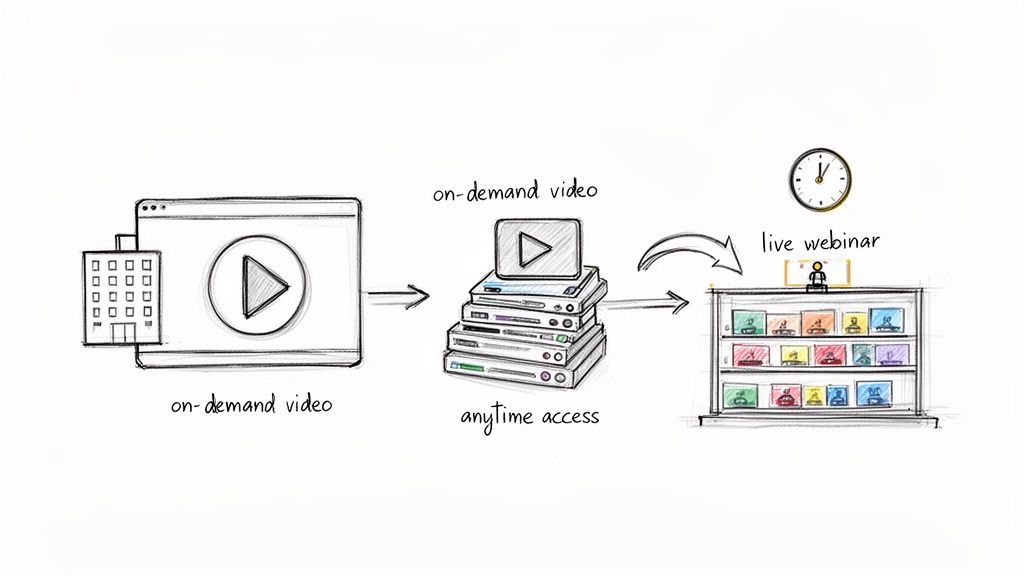
It’s about intentionally producing a polished, evergreen asset designed to be watched on its own. This change in approach is a game-changer for teams stretched thin by the constant demand for new content. Instead of pouring all your energy into one live broadcast, you’re creating a durable resource that delivers a continuous return on that initial effort.
We're just seeing B2B behaviour mirror what's been happening in the consumer world for years. In the UK, the on-demand media market hit US$14.34 billion and is expected to climb to US$19.35 billion by 2030. This boom is all about one thing: people want to consume content on their own terms. That preference doesn't disappear when they log on for work. You can find out more about the UK's growing on-demand market to see the trend in detail.
Live vs On-Demand: Key Differences for SaaS Marketing Strategy
Understanding the distinction between live and on-demand formats is crucial for building a virtual event strategy that drives measurable results. Live webinars are brilliant for creating urgency and real-time interaction, but on-demand videos deliver scalability and lasting value. One creates a temporary buzz; the other builds a permanent library.
For instance, a live Q&A with an industry expert is fantastic for immediate engagement. But an on-demand version of that same session, professionally edited for clarity and indexed by topic, becomes a go-to educational tool for new prospects months or even years down the line. It keeps capturing leads long after the live buzz has faded, contributing directly to your demand generation goals.
By transforming your live events into on-demand assets, you stop trading time for impact. You build a system where one hour of a subject matter expert's time can generate leads, educate clients, and build brand authority for years to come.
To make this crystal clear, the table below breaks down the practical differences. It should help you decide where to allocate your team's valuable time and budget to get the best possible return.
Live Webinar vs On Demand Video At a Glance
| Feature | Live Webinar | On Demand Video |
|---|---|---|
| Audience Engagement | Real-time interaction (Q&A, polls) but limited to a specific time slot. | Asynchronous viewing, allowing for deeper content consumption on the viewer's schedule. |
| Lead Generation | High urgency for registration, but captures leads only before the event. | Continuous, long-term lead capture through gated content, attracting high-intent prospects over time. |
| Scalability & Reach | Limited by time zones and attendee availability. | Global reach, accessible to anyone, anywhere, at any time, overcoming scheduling conflicts. |
| Content Longevity | Value diminishes rapidly after the event ends. | Becomes an evergreen asset that provides continuous value and measurable ROI for months or years. |
| Production Quality | Subject to live technical issues; less control over the final presentation. | Polished and professionally edited, ensuring a flawless, high-quality viewing experience that reflects your brand. |
Ultimately, it’s not about choosing one over the other. The most effective strategies use live events to create momentum and then leverage on-demand versions to sustain it, ensuring every piece of content delivers maximum ROI long into the future.
Shifting From Live Events To Evergreen Assets
Smart SaaS marketers are making a crucial shift in how they think about webinars. They're no longer just hitting 'record' on a live event; they’re intentionally producing evergreen assets from day one. This pivot—from a single, fleeting moment to a lasting library of content—is how you unlock scalable growth and get off the content hamster wheel for good.
The business case is simple. A live webinar is great, but its impact is limited to whoever can show up at that exact time. An on-demand video, on the other hand, works for you 24/7. It smashes through timezone barriers, reaches a global audience, and keeps fuelling your demand generation engine long after you’ve switched off your camera.
This isn't a new idea; it's just mirroring how people already consume media. Just look at the UK, where Subscription Video-on-Demand (SVoD) adoption in households exploded by 240% in less than ten years, jumping from 20% to 68% of homes. People expect content on their own terms. For SaaS companies, this is a clear sign: turn your webinars into assets prospects can binge-watch on their schedule, just like they do with Netflix. You can explore more data on UK streaming habits to see just how powerful this consumer shift really is.
Elevating Quality and Control
One of the biggest wins of a pre-recorded, on-demand approach is the immediate jump in professional quality. When you record in a controlled environment, you ditch all the risks of live events—flaky internet, awkward interruptions, and speaker jitters. This lets your subject matter experts relax and deliver their best, most polished performance without the pressure of a live audience.
And that control goes way beyond the speaker. Post-production is where the real magic happens. It lets you:
Edit for Impact: Snip out awkward pauses and tighten up key points. A rambling 60-minute webinar can often become a powerful 30-minute asset without losing an ounce of value. This efficiency gain is critical for busy marketing teams.
Strengthen Branding: Seamlessly weave in professional graphics, branded overlays, and clear calls-to-action that create a cohesive and high-quality brand experience.
Ensure Compliance: For firms in regulated industries like fintech, this step is non-negotiable. Post-production provides a crucial opportunity to review every claim and ensure full compliance before publication.
This entire process transforms a simple recording into a broadcast-quality asset. It reinforces your brand’s authority and professionalism, solving the all-too-common pain point of creating high-calibre content when you’re already stretched thin.
Shifting to an on-demand production model isn't just about being more efficient; it's about raising the standard. You're trading the unpredictability of live broadcasting for the certainty of a polished, professional asset that truly reflects the quality of your brand.
Building Your Content Library for Long-Term ROI
Every on-demand video you create is another brick in a valuable library of content. Think of a fintech company creating a series on market analysis. The live event might grab some immediate attention, but the on-demand library becomes an indispensable resource for new prospects researching market trends months down the line.
It's the same for a martech firm offering webinars on marketing automation. Each on-demand session adds to a knowledge base that signals deep expertise and attracts high-intent leads who are actively searching for specific solutions. Suddenly, your marketing isn't just a series of disconnected campaigns; it’s a cohesive, long-term growth strategy.
To squeeze every drop of value from your videos, you must implement smart content repurposing strategies. This is how you can chop up a single webinar into dozens of smaller assets, stretching its ROI even further and feeding your content calendar for weeks.
By treating each video as a long-term investment, you're building an engine that consistently educates your audience and captures high-quality leads. And with a partner like Cloud Present handling the production, your team can focus on the big picture while we deliver the polished assets that get it done.
Your On-Demand Video Production Playbook
So, you've wrapped up a great live event. What's next? If you're just dumping the raw recording online, you're missing a massive opportunity. Turning that file into a polished, on-demand asset isn't about hitting 'upload' and hoping for the best. It's about having a repeatable playbook that guarantees quality and makes sure every minute of your content works hard for your business.
Let's break down the process into four actionable stages. Think of it as your production line for creating high-value content that consistently meets professional quality standards. Following a comprehensive video production workflow guide is the difference between an asset that generates leads for months and a recording that just gathers digital dust.
This flow chart maps out the journey from a one-off live event to a piece of evergreen content that keeps delivering.
It’s a simple but powerful shift in thinking: your webinar isn't just an event, it's the raw material for a long-lasting marketing asset.
Stage 1: Strategic Planning
Before anyone hits record, you need a plan. This is where you define what success looks like and map out the video's entire journey, from creation to promotion. Skipping this stage results in content that doesn't drive action.
Here’s what to nail down first:
Define Your Audience and Goals: Who are you talking to? What do you want them to do after watching? Are you chasing broad awareness (views and shares) or qualified leads (demo requests and consultations)? A fintech firm explaining new regulations has very different goals from a software company demoing a new feature.
Outline the Core Content: A solid outline is your script's backbone. It keeps your speakers on point, ensuring they deliver punchy, valuable information without rambling.
Plan for Distribution: Where will this video live? Will it be gated content on a landing page, an embedded video in a blog post, or part of an email nurture sequence? Figure this out now to maximise impact later.
Stage 2: High-Fidelity Content Capture
The quality of your raw recording sets the ceiling for your final product. Grainy video and muffled audio scream amateur, instantly damaging your credibility. For SaaS companies, using a dedicated platform to capture high-fidelity recordings isn't a luxury—it's essential for maintaining professional standards.
Focus on getting the best source material possible:
Pristine Audio: Ditch the built-in laptop mic. A simple US$100 USB microphone can make a world of difference. Bad audio is the number one reason people click away.
Stable, High-Resolution Video: Ensure speakers have a solid internet connection and a decent webcam. Even better, use a platform like Cloud Present that records locally on each person's computer. This completely sidesteps any issues with choppy video caused by a poor Wi-Fi signal.
A Controlled Environment: A clean, well-lit background makes your brand look professional. A cluttered home office does not. Simple advice on lighting and backdrop goes a long way.
Stage 3: Professional Post-Production
This is where the magic happens. Post-production turns a simple recording into a strategic asset. It's not just about trimming the beginning and end; it's about editing for pace, adding your brand's touch, and ensuring everything is compliant. This is often where time-strapped internal teams hit a wall.
Post-production is your quality control checkpoint. It transforms a functional recording into an engaging, on-brand experience that builds trust and drives action. It’s the difference between an amateur video and a professional broadcast.
Here are the non-negotiables:
Edit for Clarity and Pace: Cut out the filler words ("umms" and "ahhs"), awkward pauses, and any off-topic tangents. A rambling 45-minute live event can often be sharpened into a powerful 25-minute on-demand video.
Add Brand Elements: This is your chance to make it look and feel like your content. Add intro and outro graphics, lower-third titles for speakers, and smooth, branded transitions.
Insert Calls-to-Action (CTAs): Don't leave your viewers hanging. Add clear graphics or verbal cues telling them what to do next, whether it's downloading a whitepaper or booking a call.
Ensure Compliance: This is absolutely critical for regulated industries like fintech. Post-production is your final check to add necessary disclaimers and ensure the content meets all legal and regulatory standards before it goes live.
Stage 4: Hosting and Distribution
Your video is polished and ready to go, but its journey isn't over. Where you host it and how you promote it will ultimately decide its impact.
Choose a hosting platform that gives you real analytics—not just view counts, but deep engagement metrics like audience retention and CTA clicks. This data is gold. It tells you exactly what’s resonating with your audience and what isn't.
Once it's hosted, it's time to execute the distribution plan you made back in stage one. The insights you gather here will feed straight into your next production cycle, helping you get smarter with every video you create and even explore content repurposing services to get more mileage out of every recording.
Turning One Webinar Into a Content Campaign
Think your on-demand webinar is a single asset? Think again. It’s the raw material for an entire marketing campaign. For any content team trying to hit ambitious demand-gen targets with limited resources, this is where you get the biggest bang for your buck. The secret is to stop seeing the webinar as the final product and start treating it as the centrepiece of a content ecosystem.
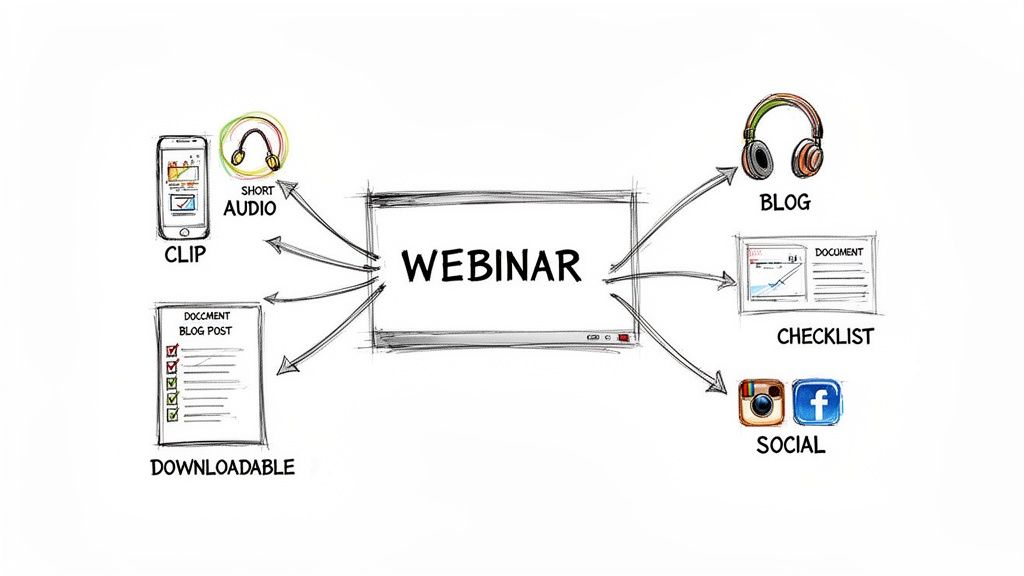
Strategic repurposing is how you squeeze every drop of value from your initial effort. It’s about transforming one hour of content into a dozen different assets that fuel every stage of your marketing funnel. This efficiency gain addresses the key pain point of needing a consistent content output without a huge budget.
The appetite for this kind of flexible content is huge. In the UK, video streaming revenues hit US$13,987.9 million and are forecast to explode to US$45,586.9 million by 2030. While live streaming is big, on-demand video is where the fastest growth is happening. This trend is a perfect mirror for how B2B firms can strategically gate or time-release on-demand webinars for maximum impact, just like the major streaming platforms. You can find out more about the UK video streaming market and see how this growth supports a VOD-first strategy.
A Practical Blueprint for Repurposing
Let's get practical. Here’s a simple framework for breaking your on-demand webinar down into smaller, targeted assets. Each piece should have a clear goal, a specific distribution channel, and a metric you can actually measure.
Short Video Clips for Social Media: Pull out 3-4 powerful, 60-second soundbites. These are gold for LinkedIn—perfect for grabbing attention, sparking conversation, and pointing people back to the full on-demand video. KPI: Engagement rate and click-through rate (CTR) to your landing page.
Audio Snippets for a Podcast: Strip the audio, polish it up with a professional intro and outro, and you've got a new podcast episode. This is a great way to build brand awareness and catch your audience while they’re commuting or at the gym. KPI: Downloads and listener retention.
Detailed SEO Blog Post: Use the webinar transcript as the foundation for a comprehensive, keyword-rich blog post. This is a long-term play, designed to capture organic search traffic and establish your authority for months to come. KPI: Organic traffic and keyword rankings.
Downloadable Checklist or Guide: Condense the key takeaways into a handy, one-page checklist or a gated PDF guide. This is a classic lead generation tactic that gives people real value in exchange for their contact details. KPI: Lead conversion rate.
This multi-channel approach means you meet your audience where they are, catering to different habits and dramatically boosting the reach of your original message. For a deeper dive, check out our guide on how to unlock the hidden revenue in your webinar archive.
A single webinar is an investment. Repurposing it into multiple assets is how you collect the dividends. You move from a one-off event to a continuous campaign that generates leads and builds authority long after the live session ends.
Mapping Repurposed Assets to Funnel KPIs
To prove the real ROI of your efforts, you have to connect each repurposed asset to a specific funnel stage and a business metric that matters. This isn’t just about making more content; it’s about creating content that does a specific job. The table below gives you a clear framework for mapping your assets to measurable outcomes.
Webinar Repurposing ROI Framework
| Repurposed Asset | Funnel Stage | Primary KPI | Distribution Channel |
|---|---|---|---|
| Short Video Clips | Top of Funnel (Awareness) | Video Views & Engagement Rate | LinkedIn, X (Twitter) |
| Podcast Episode | Top of Funnel (Awareness) | Downloads & Subscribers | Spotify, Apple Podcasts |
| SEO Blog Post | Middle of Funnel (Consideration) | Organic Traffic & Time on Page | Company Blog, Search Engines |
| Downloadable Checklist | Middle of Funnel (Lead Gen) | Form Conversion Rate | Landing Page, Email Campaign |
| Full On-Demand Webinar | Bottom of Funnel (Decision) | MQLs & Demo Requests | Gated Landing Page |
By taking this structured approach, you turn on-demand video from a simple content format into a powerful, data-driven engine for growth. It gives you a clear way to demonstrate the massive ROI from your initial investment and justifies putting more resources into a high-quality production strategy.
Measuring Your On-Demand Video Success
Putting a great on-demand video out there is one thing, but proving its business impact is the real challenge. It's easy to get caught up in vanity metrics like view counts, but those numbers don't tell the whole story. To justify your content budget, you must connect your video performance directly to business growth.
A smart on-demand video strategy isn't about chasing eyeballs; it's about attracting the right eyeballs and guiding them from casual viewer to qualified lead. That means tracking specific metrics across the entire journey, from first click to sales conversation.
Top of Funnel: Are You Capturing Attention?
At the start of the journey, you need to know if your content is compelling enough to make people stop scrolling. These metrics act as a vital health check on your titles, thumbnails, and promotional copy.
Here’s what to monitor:
Play Rate: Of all the people who landed on your page, what percentage actually hit the play button? A low number here (below 30%) could mean your intro copy or thumbnail isn't compelling enough.
Video Views by Source: While it can be a vanity metric, total views give you a baseline for your content's reach. Break this down by source—social media, email, organic search—to see which channels are driving the most valuable traffic.
Middle of Funnel: Are You Maintaining Engagement?
This is where the rubber meets the road. Are viewers sticking around, or are they bouncing after the first 30 seconds? These metrics reveal how engaging your content really is, because an audience that isn't paying attention will never convert.
Focus on these two key indicators:
Audience Retention Rate: This graph shows you exactly where people drop off. A steep decline in the first few minutes is a huge red flag that your opening is weak. For a standard 20-minute B2B webinar, you should be aiming for a retention rate above 60% to know you've got something that resonates.
Click-Through Rate (CTR) on CTAs: If you’ve embedded a link to a guide or a "Book a Demo" button in your video, this is gold. A CTR of 2-5% on in-video CTAs is a strong indicator that your content is inspiring people to take the next step.
A great on-demand video isn't just something people watch; it’s a tool that gets them to act. Retention and CTA clicks tell you if people are engaged enough to do something meaningful.
Bottom of Funnel: Did It Drive Business Growth?
Ultimately, this is what the C-suite wants to see. These are the metrics that tie your video strategy directly to the sales pipeline and justify future investment.
The most critical numbers are:
Lead Conversion Rate: If your video is gated, what percentage of viewers fill out the form? A healthy conversion rate for high-value content is typically between 15-20%. This tells you exactly how effective your content is at generating new prospects.
Pipeline Influence: This is the killer metric. Using your CRM, you can track how many leads who watched your video eventually turned into a real sales opportunity. Even if the video was just one touchpoint, attributing a piece of a new deal to it is powerful proof of its value. For a deeper dive, check out our guide that explains how to measure webinar ROI using a 7-metric framework.
By tracking performance across this entire funnel, you can stop talking about views and start talking about revenue. This is how you build a rock-solid case that your on-demand videos aren't just a "nice-to-have" but an essential part of your demand generation engine. At Cloud Present, our performance dashboards are built to give you this exact clarity, so you can focus on what really matters.
Finding The Right On-Demand Video Partner
Making the jump to an on-demand video model is a strategic decision. It’s about shifting your mindset from running one-off events to building a scalable, lead-generating content engine. But this is exactly where many marketing teams hit a wall. The roadblocks are almost always the same: not enough time, tight budgets, and the constant pressure to create high-quality content that actually moves the needle.
This is where bringing in a strategic partner can change the game entirely. While your internal team holds all the subject matter expertise, an outsourced production studio brings the specialised skills, dedicated gear, and smooth workflows needed to turn that knowledge into polished, professional video. They handle the technical headaches so your team can stay focused on what they do best—crafting a message that resonates.
Think of Them as Your Dedicated Head of Webinars
The right partner isn't just a supplier; they're your dedicated 'Head of Webinars'. Their job is to own the entire production process, from the moment you hit 'stop recording' to final delivery and beyond. This immediately solves a massive pain point for marketing leaders who simply don't have the bandwidth to manage complex video projects on top of everything else.
A true partner does far more than just basic editing. They should provide:
Broadcast-Quality Production: Using high-fidelity recording and professional post-production techniques to make sure every video looks and sounds as good as your brand deserves.
Rapid, Reliable Turnaround: Delivering polished on-demand webinars in just 3-5 business days – a speed that’s nearly impossible for a stretched internal team to hit consistently.
Strategic Repurposing: Proactively looking for ways to slice and dice each webinar into a full content campaign, squeezing every last drop of value from your investment.
Choosing a partner isn't about outsourcing a task; it's about insourcing expertise. It's finding a specialist who can execute your on-demand video strategy faster, more efficiently, and to a higher standard than you could manage alone, freeing up your team to focus on strategy and growth.
For marketing leaders measured on pipeline and revenue, the efficiency gains are huge. Instead of your team spending weeks wrestling with editing software or coordinating schedules, you get a reliable flow of high-impact content that keeps your demand generation efforts humming. This consistent output helps you build a valuable library of assets that educates prospects and genuinely speeds up the sales cycle.
At Cloud Present, we bridge that gap between your team's expertise and the broadcast-quality assets you need to stand out. We become an extension of your marketing team, solving your content headaches so you can focus on hitting your growth targets.
Ready to see how a strategic partner can transform your webinar programme? Book a consultation with Cloud Present today and let's start building your content engine together.
Your On-Demand Video Questions, Answered
Let's tackle some of the most common questions that pop up when building out an on-demand video strategy for a B2B SaaS audience.
What’s the Sweet Spot for an On-Demand Webinar’s Length?
For most B2B audiences, the magic number is somewhere between 20 and 30 minutes.
That’s enough time to deliver real, actionable value and demonstrate your expertise, but it's short enough to maintain high engagement and keep viewers watching right to the end. The goal isn’t to fill an hour; it’s to pack as much practical insight as possible into a tight, engaging format so your key messages actually stick.
To Gate or Not to Gate?
The answer really comes down to your primary goal for a specific video.
Going for broad awareness? Don't gate it. If your main goal is top-of-funnel reach and getting your brand in front of as many people as possible, remove all friction and let them watch freely.
Need to generate leads? Put a simple gate on it. The value exchange has to feel fair. Viewers need to know they’re getting premium, expert content in exchange for their contact details. Often, just asking for an email is enough to lower the barrier and achieve a higher lead conversion rate.
Isn’t an On-Demand Video Just a Recording?
This is a common misconception, and it’s one that severely limits your ROI. Thinking a simple recording is the same as a strategic on-demand asset is a huge mistake.
A raw recording is just that—a file. It’s an archive. But a true on-demand video asset is a purpose-built tool. It’s been professionally edited for clarity, branded to align with your company's high standards, and hosted on a platform that provides the analytics and lead capture tools you need to prove its value.
The real difference is intent. A recording is passive—it’s just documentation. An on-demand video is an active marketing asset designed to keep working for you, generating leads and educating prospects long after the live event is over. It’s a workhorse, not just a file sitting in a folder.
Ready to stop treating your webinars like simple recordings and start turning them into strategic assets? Cloud Present can act as your outsourced production studio, delivering broadcast-quality on-demand videos and repurposed content that drives real demand. Book a consultation to learn more.


