Webinar follow-up email sequence: A proven path to post-webinar ROI
Discover a concise webinar follow up email sequence to nurture leads, boost conversions, and prove ROI after your event.
Think of a webinar follow-up email sequence as a series of automated, multi-touch messages you send after a virtual event wraps up. Its job is to convert attendees, nurture warm leads, and re-engage no-shows by methodically delivering value and steering them toward a specific business goal. This strategic approach is miles ahead of a single "thank you" email and is how B2B SaaS marketers maximise the return on their event investment.
The Blueprint for Post-Webinar Revenue
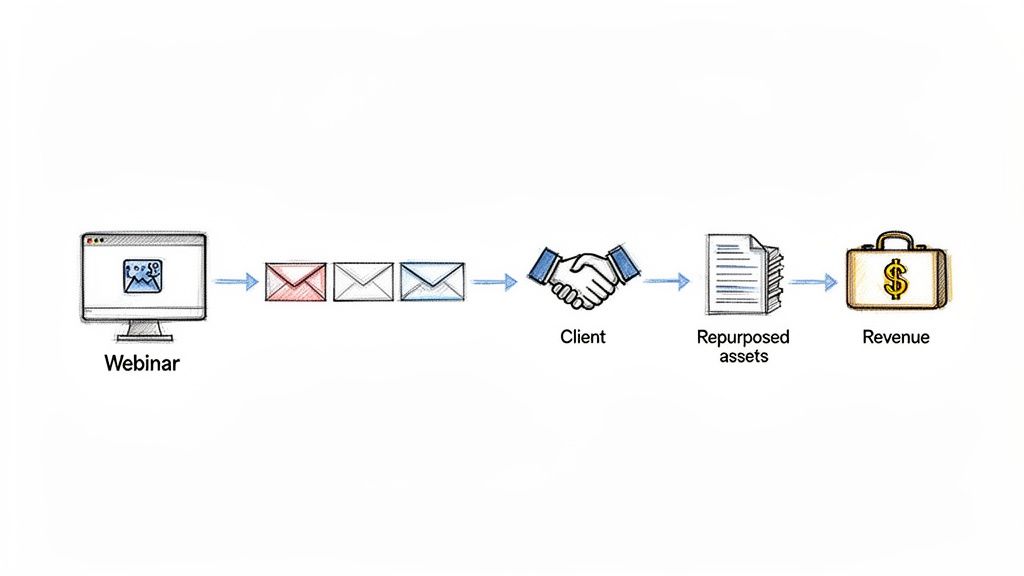
For B2B SaaS marketing professionals, the real work kicks off the second your live webinar ends. This post-event phase is where potential pipeline turns into tangible revenue, but only if you have a system in place.
Sending just one generic follow-up email is a significant missed opportunity, leaving a large portion of your hard-earned engagement and potential MQLs on the table. The solution is a thoughtfully engineered, multi-touch webinar follow-up email sequence.
This isn’t just a nice-to-have; it's a critical revenue driver. Data shows that webinar follow-up emails can achieve open rates as high as 58%, proving you have a highly engaged audience hungry for more. The objective is to transform a one-hour event into a lasting demand generation asset that fuels your content engine for months.
Core Objectives of a Strategic Sequence
A high-performing sequence for a B2B SaaS firm is built around three core business objectives. Each one targets a specific outcome and maximises efficiency—a critical benefit for content teams facing limited resources and the constant pressure for consistent content output.
- Convert Engaged Attendees: Your most valuable prospects are those who showed up and participated. The sequence must provide immediate value—like the on-demand recording and key resources—and then present a clear, compelling next step, such as booking a demo or starting a free trial.
- Nurture Warm Leads: Not every attendee is ready to buy immediately. For this segment, your sequence should deliver additional, value-packed content repurposed from the webinar itself. This could include case studies, in-depth blog posts, or practical checklists. This builds trust and keeps your solution top-of-mind. You can dive deeper into this strategy in our guide to creating a 90-day content distribution framework from your webinar assets.
- Re-engage No-Shows: With average B2B webinar attendance rates sitting around 46%, almost half of your registrants likely missed the live event. An effective sequence for this segment creates a sense of FOMO while making it exceptionally easy to watch the content on-demand, pulling them straight back into your marketing funnel.
By automating this process, you build an efficient engine for lead generation and qualification. It ensures no lead is left behind and guarantees that the significant investment made in producing a quality webinar delivers a measurable return long after the event concludes.
Get Personal: How to Segment Your Audience for Follow-up That Works
Sending the same generic email to every person who registered for your webinar is a surefire way to neutralise your ROI. You wouldn't use the same messaging for a marketing qualified lead (MQL) and a sales qualified lead (SQL), so why treat your webinar audience as a monolith?
The secret to a high-performing webinar follow up email sequence lies in intelligent segmentation. It’s about delivering the right message to the right person based on their actual behaviour. Personalised emails don't just feel more relevant; they deliver 6x higher transaction rates. Yet, many marketing teams skip this step, assuming it’s too resource-intensive.
It's not. You can achieve significant impact by splitting your audience into three primary groups. Each has a different level of engagement and requires a distinct communication track.
The Attendees: Your Most Engaged Group
These individuals are your VIPs. They showed up, they stayed, and they listened. They invested their most valuable asset—their time—which signals genuine interest and sales-readiness. Your objective isn't to re-sell the webinar topic; it's to build on the momentum you've already created.
Think of your first email as a direct continuation of the conversation.
- Your Goal: Guide them towards the next logical step in the buyer's journey, whether that’s booking a demo or downloading a related case study.
- The Vibe: Helpful, confident, and action-oriented.
- What to Send: Start by delivering exactly what you promised: the on-demand recording, the presentation slides, and any other resources mentioned. Subsequent emails can then go deeper with content that builds on the webinar's core themes.
A subject line like, "Here are the resources from today's session on [Topic]" is simple, clear, and gets straight to the point. Open with something equally direct: "Thanks for joining us for [Webinar Title] today. As promised, here’s the link to the full recording and slides." This is an easy win that immediately builds trust.
The No-Shows: Interested, but Distracted
Let's be realistic: schedules are packed. A last-minute meeting or a client emergency doesn't signal a lack of interest. With B2B webinar attendance rates hovering around 46%, this group often constitutes more than half your registration list. Your challenge is to recapture their initial curiosity and create a slight sense of FOMO (Fear Of Missing Out).
The key is to position the recording not as a second-best option, but as an exclusive opportunity to catch up on what they missed. No guilt trips, just helpfulness.
This group needs a bit more convincing to click play.
- Your Goal: Generate just enough FOMO to get them to watch the on-demand version and pull them back into your funnel.
- The Vibe: Understanding, but compelling. "We missed you, and here's what you missed out on."
- What to Send: The recording is the hero asset. To add impact, include a bulleted list of the top 3 questions from the live Q&A to showcase the dynamic conversation they missed.
Try a subject line like, "Sorry we missed you at [Webinar Title] – catch up here". The email could start with, "We get it, things get busy! While we missed having you for the live Q&A, you can still get all the insights from [Webinar Title] on-demand." This approach is empathetic but cleverly reinforces the unique value of attending live.
The Early Leavers: The Ones Who Bailed
This is the segment most marketers forget, but it holds significant potential. These are the individuals who attended but left early. Perhaps they found the answer they needed, or maybe a technical issue arose. Your job is to pull them back in.
The best way to do this is by highlighting the value they missed, which is often concentrated at the end of the session—think exclusive Q&A, a special offer, or a key summary. When you mention what happened after they left, you demonstrate attention to detail and pique their curiosity. To really nail this, you might want to explore different customer segmentation strategies.
This level of tailored messaging shows a level of sophistication that makes your brand feel more human and sets you apart from the competition.
Post-Webinar Audience Segmentation Strategy
To help you visualise this, think about your audience in these distinct buckets. Each requires a slightly different touch to be effective. Getting this right is the difference between a sequence that drives action and one that ends up in the trash folder.
| Audience Segment | Key Characteristics | Primary Communication Goal | Sample Content Focus |
|---|---|---|---|
| Attendees | Attended the live event; highly engaged. | Deepen engagement & guide to conversion. | Recording, slides, advanced content, case studies. |
| No-Shows | Registered but did not attend live. | Create FOMO & drive on-demand views. | Recording link, Q&A highlights, "what you missed." |
| Early Leavers | Attended but left before the end. | Re-engage & highlight missed value. | Recording link, summary of final section/Q&A. |
| Post-Viewers | Watched the recording on-demand. | Nurture interest & provide next steps. | Follow-up resources, related content, demo offer. |
By breaking down your communication this way, you're not just sending emails; you're continuing a conversation that started the moment they registered. This targeted approach respects their time and attention, making it far more likely they'll take the next step with you.
Building Your Multi-Touch Email Cadence
Alright, you’ve sorted your audience into neat, actionable segments. Now it’s time to build the engine that converts that initial interest into a qualified sales opportunity. I’m talking about your multi-touch email cadence.
This isn’t just about sending a few emails. Think of it as a structured, value-driven dialogue designed to guide prospects from curiosity to a final decision. For any B2B SaaS company, a single follow-up email is a massive wasted opportunity. To convert those high-value leads, you need a sustained approach, and an optimised webinar follow up email sequence is the only way to do it.
The flowchart below illustrates how your communication should fork based on audience behaviour. This is the foundation of your entire cadence.
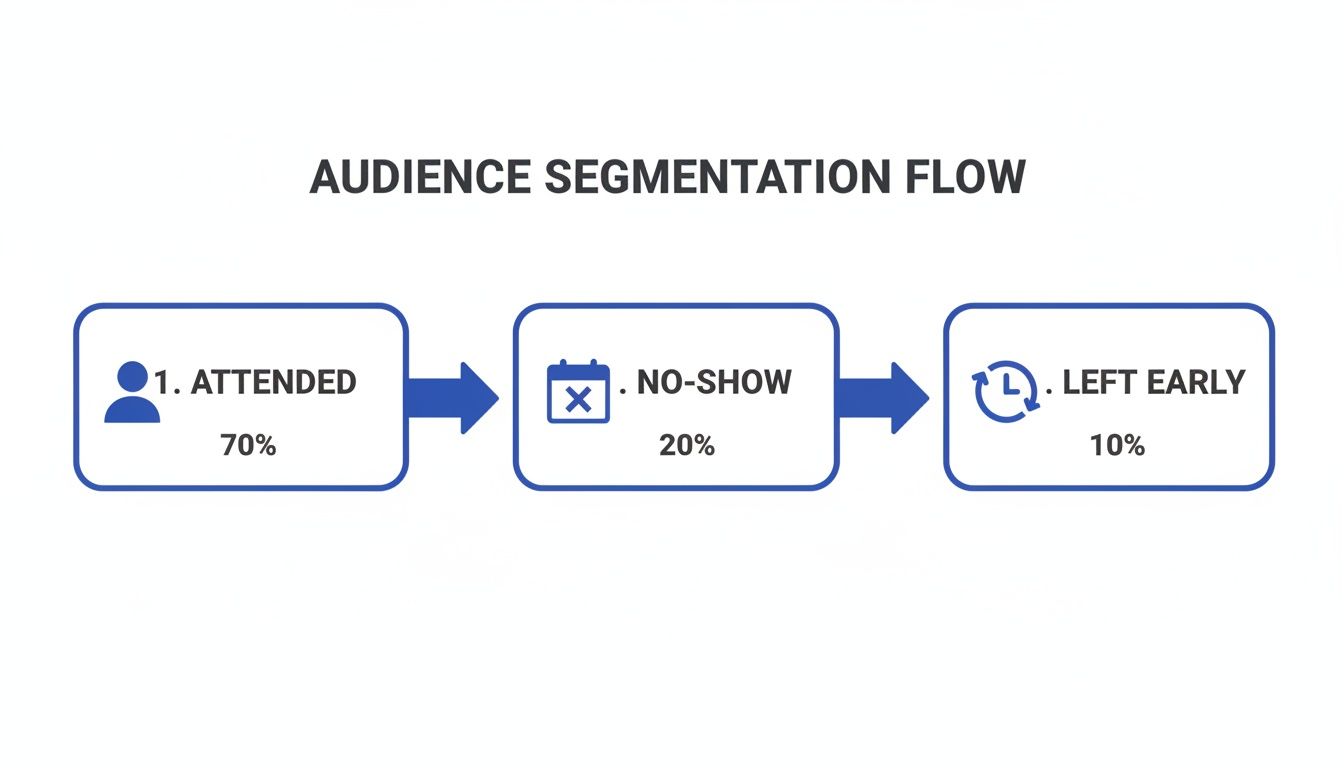
Each of those paths represents a distinct conversational track. Getting this right ensures your messages feel relevant and consistently hit the mark.
Email 1: The Immediate Thank You and Recording
This is your first, and arguably most important, touchpoint. It needs to land in inboxes within 2-4 hours after the webinar concludes. Speed is critical here. You must capitalise on the momentum and keep the topic fresh in their minds.
- Timing: 2-4 hours post-webinar.
- Audience: Segmented for Attendees and No-Shows.
- For Attendees: A genuine thank you, a direct link to the on-demand recording and slides, and perhaps a quick recap of a key insight.
- For No-Shows: A friendly "Sorry we missed you" tone works best. Frame the recording as their chance to catch up and highlight what they missed (e.g., "Here are the top 3 questions we answered").
- Call-to-Action (CTA): Keep it simple: "Watch the Recording" or "Download the Slides."
This first email sets a professional tone for everything that follows. Nailing it builds instant credibility and reminds them why they signed up in the first place. And of course, your open rates hinge on a solid subject line, so it pays to brush up on the latest email subject line best practices.
Email 2: The Value-Add Resource
Two days later, it’s time to deliver something extra. This email shouldn't be about the webinar itself, but about solving a related problem. It’s the perfect opportunity to feature repurposed content created with Cloud Present.
- Timing: 2 days after Email 1.
- Audience: All segments (you can create a special version for no-shows who clicked the recording link).
- Content: A link to a genuinely useful asset. For a FinTech SaaS, maybe it’s a "Quarter-End Compliance Checklist." For a MarTech platform, it could be a "Guide to Building a Content Attribution Model."
- CTA: "Download the Checklist" or "Get the Guide."
This is how you position your company as a strategic partner, not just another vendor. You’re demonstrating an understanding of their challenges and providing practical solutions. That builds serious authority.
Email 3: The FAQ and Objection Handler
Your third email, hitting their inbox around day five, needs to be tactical. Proactively address the questions and objections that arise after they've engaged with your content. Tackling these hurdles stops them from becoming deal-breakers.
- Timing: 3 days after Email 2.
- Audience: All engaged segments.
- Content: Frame it around the top 3-5 questions from the live Q&A or the common pushback your sales team hears. For example: "A lot of you asked about integration with [Platform X]..."
- CTA: "Read the Full Q&A" (linking to a blog post) or "See How We Solve [Objection]."
When you address concerns head-on, you build transparency and trust. It proves you're listening and aren’t afraid of the tough questions, which instantly sets you apart.
Email 4: The Social Proof and Case Study
You've delivered value and handled objections. Now it's time to build confidence with compelling social proof. Send this email about a week after the event, featuring a punchy case study or client quote that’s directly related to the webinar topic.
- Timing: 3-4 days after Email 3.
- Audience: All engaged segments.
- Content: Showcase a success story. A powerful client quote alongside a link to a short case study is perfect. Detail the problem, your solution, and the quantifiable results. For example, "How [Client Name] increased their MQL-to-SQL conversion rate by 25%."
- CTA: "Read the Full Case Study" or "See Their Results."
This email is all about proving the ROI. For a B2B decision-maker, seeing hard evidence of results from a similar company is often the final nudge they need to take the next step.
Don't forget, multi-touch sequences consistently outperform single-contact attempts. Data shows that the sweet spot for follow-ups is between 5-8 contacts. The kicker: 50% of all sales happen after the fifth contact, yet most people give up after just two. That’s a lot of revenue left on the table.
Email 5: The Low-Pressure Demo Offer
The final email in your core sequence, sent around day 10-12, is your direct ask. However—and this is critical—it shouldn't feel like a hard sales pitch. Frame it as a low-pressure, high-value conversation.
- Timing: 3-4 days after Email 4.
- Audience: Your most engaged leads (those who clicked multiple links or watched most of the recording).
- Content: A short, personal message offering a no-strings-attached chat to discuss their specific challenges. Mentioning their engagement shows this isn't just a generic email blast.
- CTA: "Book a 15-Minute Strategy Call" or "Schedule a Brief Demo."
You’ve earned the right to ask for their time, so make it an easy and valuable next step. If you're looking for more ideas on what to write, check out our tools for post-webinar follow-up.
This five-part cadence transforms a single webinar from a one-off event into a powerful, automated machine that feeds your sales team with genuinely qualified opportunities.
Keeping Things Compliant and Professional
For B2B SaaS companies, especially those in regulated industries like FinTech or HealthTech, a webinar follow up email sequence is more than a marketing exercise. It's a formal piece of communication that must adhere to strict data privacy and communication rules. Getting this wrong doesn't just damage your brand's reputation; it can lead to serious legal and financial penalties.
Every email needs to be crafted with precision, upholding your company's professional standards while effectively nurturing leads. Think of compliance not as a final checkbox, but as the foundation of your entire strategy. It builds trust and avoids costly fines.
Getting Disclaimers and Opt-Outs Right
In a data-conscious world, what you don’t say is often just as critical as what you do. The email footer is prime real estate for managing compliance, and it needs to be crystal clear, comprehensive, and user-friendly.
- No Unproven Claims: Any statistic or piece of data you share must be accurate and verifiable. Steer clear of promising specific outcomes, like "guaranteed ROI." Instead, talk about processes and potential, backed up by case studies or solid data.
- GDPR and Easy Opt-Outs: The unsubscribe process must be a single, straightforward click. Hiding the link or requiring a login to opt out is a clear violation of regulations like GDPR and can lead to hefty fines. Don't see unsubscribes as a failure—it's your list cleaning itself.
- Clear Disclaimers are a Must: Standard disclaimers are non-negotiable. This language clarifies that your content is for informational purposes and does not constitute formal legal or financial advice.
Here’s a solid example of compliant footer language for a SaaS platform:
This email and its contents are for informational purposes only. To unsubscribe from future marketing communications, please click here. [Your Company's Name], [Address], [Company Number].
Automating CLE and CPE Credit Delivery
For many professionals, a key incentive for attending a webinar is to earn Continuing Legal Education (CLE) or Continuing Professional Education (CPE) credits. Managing the delivery and tracking of these certificates can be a significant administrative burden. This is where automation becomes a strategic advantage, adding value and improving efficiency.
Your email sequence can be configured to handle this critical function automatically, freeing up your team to focus on higher-value activities.
Here’s how an automated certificate workflow looks in practice:
- Track Attendance: Your webinar platform, ideally integrated with your CRM, tracks who attended and met the minimum viewing time required to qualify for credit.
- Send a Triggered Email: Immediately after the webinar, an automated email is sent only to eligible attendees. This is a separate, dedicated email—not the general "thank you"—focused entirely on their professional credit.
- Deliver the Certificate: The email contains a unique link to download their personalised certificate of completion, often generated dynamically with their name and the number of credit hours.
- Confirm and Keep Records: The moment they download the certificate, a tag can be applied to their contact record in your CRM. This creates a clean, simple audit trail for your compliance records.
This automated workflow does more than just save time. It delivers a polished, professional experience for your attendees and builds a robust, defensible record of credit distribution. By integrating this into your webinar follow up email sequence, you turn a logistical headache into a seamless touchpoint that reinforces your company's professionalism.
Measuring Performance and Optimising Your Sequence
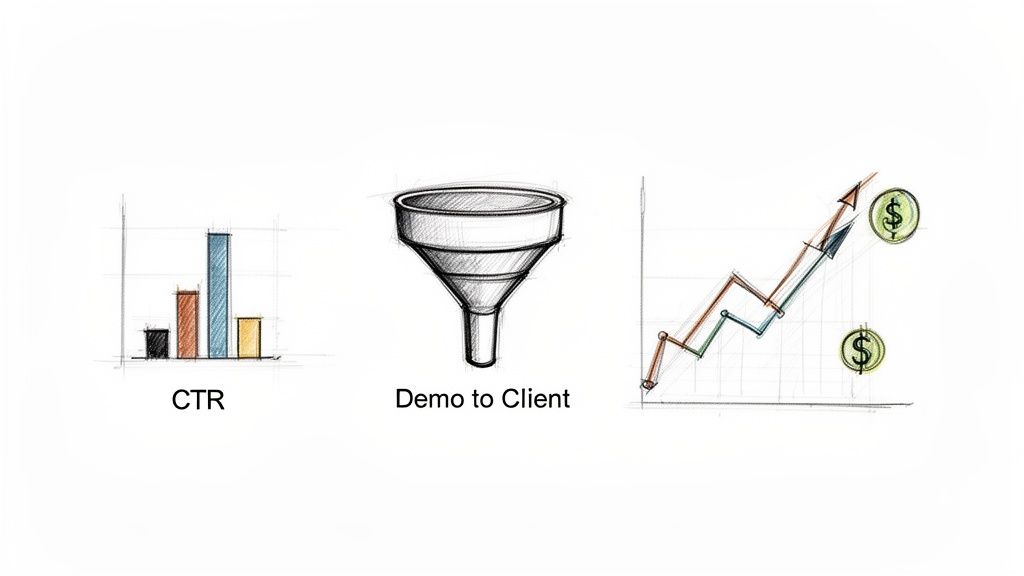
An elegant follow-up sequence is great, but it’s only as good as the results it generates. To prove its worth and justify the investment, you must look past vanity metrics and focus on the numbers that signal genuine business impact.
A high open rate feels good, but it doesn't contribute to the sales pipeline. The real test is tracking actions that move prospects further down the funnel. This data-driven approach allows you to continuously refine your strategy, ensuring your entire webinar programme delivers a measurable return on investment (ROI).
Key Performance Indicators That Actually Matter
For B2B SaaS companies, success is measured in qualified leads and conversions, not just clicks. To get a true sense of your sequence's performance, you need to track these bottom-of-the-funnel metrics.
- Click-Through Rate (CTR) on Key Assets: Pay close attention to which links are driving engagement. Is it the case study download, the blog post, or the demo request link? A high CTR on a case study, for example, is a strong indicator that your audience is in a consideration phase.
- Demo Request Conversion Rate: This is a crucial metric. You need to know the percentage of recipients who click your call-to-action and successfully book a demo. This is your direct line for measuring how effectively your emails are generating sales-qualified leads (SQLs).
- Meeting Booked Rate: For many SaaS businesses, this is the ultimate goal. The number of consultation calls booked directly from your sequence is the clearest sign that you're bridging the gap between marketing and sales.
- Attributable Revenue: The gold standard. By using UTM parameters and a properly configured CRM, you can trace the journey from an email click all the way to a signed contract. Being able to attribute US$25,000 in new ARR directly to your follow-up sequence is the most powerful way to prove its value. To get deeper into this, you can learn more about tracking and interpreting your webinar analytics.
A Framework for Continuous Optimisation
Data is useless if you don't act on it. The insights you gather should fuel a constant cycle of testing and refinement. One of the most effective methods for this is A/B testing, where you compare two versions of an email to determine which one performs better.
A sequence is a living asset, not a static campaign. The most successful B2B marketing teams are those who are relentlessly testing, learning, and iterating based on real performance data. This commitment to optimisation is what separates a good sequence from a great one.
The key is to test one variable at a time to ensure your results are clean. Email remains a dominant channel for webinar follow-ups, and even small tweaks can lead to significant gains. We know that personalised subject lines alone can boost open rates by 26%, which demonstrates the importance of that custom touch.
Practical A/B Tests to Run
Not sure where to start? Here are three high-impact tests you can run in your next webinar follow-up sequence to see what truly resonates with your B2B SaaS audience.
- Subject Line Variations: Test a benefit-driven subject line ("Unlock Q4 Performance Insights") against a more direct one ("Recording: Your Webinar on Q4 Performance Metrics"). You might be surprised which one drives more opens.
- Call-to-Action (CTA) Phrasing: Pit a direct "Book a Demo" against a softer "See How It Works". A subtle change in language can have a huge impact on click-through and conversion rates.
- Sender Name: Test your company's name (e.g., "The Team at Cloud Present") against the name of the webinar speaker. A personal touch from a recognised expert often builds more trust and encourages more opens.
By methodically testing these elements, you can systematically improve your sequence. It transforms from a simple follow-up tool into a highly optimised demand generation engine, proving the strategic value of your webinar programme to key stakeholders.
Your Top Questions, Answered
When you get down to the practical planning of a webinar follow-up sequence, a few key questions always surface. Let's tackle the most common ones I hear from B2B SaaS marketing teams, with actionable answers to help you sharpen your strategy.
How Soon Is Too Soon for the First Email?
The short answer: you can't be too soon. The first email, containing the recording link and a brief 'thank you', needs to go out fast. Aim for 2 to 4 hours after the webinar ends, at the absolute latest.
Why the urgency? Simple. Your webinar is still top-of-mind. The concepts are fresh, engagement is high, and your attendees haven't been pulled into a dozen other tasks yet. If you wait 24 hours, you’ve lost that critical momentum. Acting quickly demonstrates professionalism and respect for their time.
What’s the Magic Number of Emails for a Sequence?
For most B2B SaaS companies, the sweet spot is a sequence of 5 to 7 emails sent over two or three weeks.
This cadence provides enough touchpoints to deliver real value, address common questions, and guide prospects toward a decision without overwhelming their inbox. Any shorter, and you're likely leaving potential pipeline on the table. Any longer, and you risk audience fatigue and unsubscribes. Each email must have a distinct purpose—sharing a key insight, offering a case study, answering an objection—to justify its place in the sequence.
A quick note on unsubscribes: Don't view them as a failure. Think of them as a natural filter. A clean, engaged list is always more valuable than a huge, passive one. If you see a spike in unsubscribes on a particular email, that’s just feedback telling you what to fix next time.
Should I Bother Personalising Beyond a First Name?
Absolutely. Using {{first_name}} is table stakes in 2024. The real impact comes from segmenting your audience based on their behaviour. At a minimum, you need different communication tracks for attendees, no-shows, and those who left early.
But you can take it a step further for high-value prospects. Did someone ask a brilliant question during the live Q&A? Reference it in your email. Did they respond to a specific poll? Mention it. This level of detail shows you’re not just blasting a list; you're actively listening. It proves you see them as an individual, which is how you begin building a real business relationship.
How Should I Handle Unsubscribes?
First, treat unsubscribes as a positive—it’s list hygiene. Your primary responsibility is to make the process painless and compliant with regulations like GDPR. Your unsubscribe link must be obvious and work with a single click. No hoops to jump through.
Second, use that data strategically. If you notice Email #3 (the one where you tackle common objections) consistently receives the highest unsubscribe rate, that’s a massive clue. It indicates that the content or the call-to-action isn't landing correctly. That's not a failure; it's free, valuable feedback to make your next campaign even more effective.
Ready to turn your webinars into a predictable pipeline of qualified leads? Cloud Present acts as your outsourced webinar studio and strategic partner, handling everything from production to repurposing. We deliver broadcast-quality webinars and a suite of high-impact content assets in days, not weeks, so your content team can focus on strategy and building relationships.
Discover how we transform single webinars into lasting revenue drivers


