10 Hybrid Event Best Practices for B2B Marketing Teams in 2026
Discover 10 hybrid event best practices for B2B marketers. Learn actionable tips on webinar production, repurposing, and ROI for professional services.
For B2B SaaS marketing professionals and content teams, the challenge is clear: deliver high-impact content that generates pipeline, engages customers, and builds thought leadership without draining internal resources. Hybrid events present a powerful solution, but only when executed flawlessly. Generic advice on simply streaming your in-person event online is no longer sufficient. Success requires a strategic framework that blends broadcast-quality production with measurable engagement and a robust content repurposing engine.
This guide moves beyond the basics, offering actionable hybrid event best practices designed to address the core pain points of modern marketing teams: the relentless demand for content, limited production capacity, and the critical need to prove ROI. We'll explore ten specific, tactical strategies that transform a single event investment into a long-term demand generation asset. You will find practical implementation steps tailored for teams where professional quality, efficiency, and lead generation are paramount.
From designing distinct experiences for your two unique audiences to establishing data-driven content workflows, each practice is supported by real-world examples and specific metrics. The goal is to provide a clear blueprint for planning, producing, and measuring hybrid events that consistently deliver value, helping you maximise your content’s reach and impact long after the live event concludes.
1. Dual-Screen Experience Design for Engaged Audiences
One of the most critical hybrid event best practices is to move beyond simply live-streaming an in-person event. Instead, you must intentionally design a dual-screen experience where both physical and digital audiences feel equally valued. This approach involves consciously planning every visual and interactive element, from speaker positioning to slide layouts, ensuring they translate effectively on a stage and on a screen.
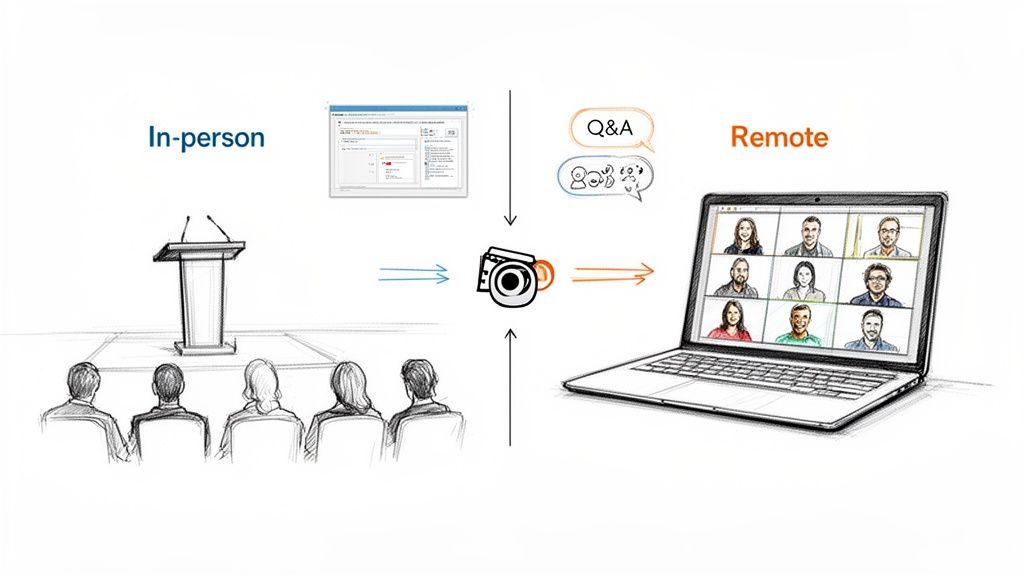
For B2B SaaS marketers, this means that complex product demos, detailed analytics dashboards, or strategic frameworks are crystal clear for everyone, regardless of their location. The goal is to create a single, unified event, not two separate ones happening simultaneously. Thoughtful design prevents the remote audience from feeling like passive observers of a live event they weren't invited to, which can increase virtual attendee drop-off rates by up to 40%.
How to Implement a Dual-Screen Experience
To achieve this synchronised experience, consider the practical production elements that impact both audiences. Since many virtual attendees will join from smaller screens, it’s crucial to apply strategies for creating videos for mobile to ensure your content remains legible and engaging.
- Strategic Camera Setup: Position cameras at the speaker's eye level to create a direct, personal connection with the virtual audience. Avoid backlighting that can obscure the speaker's face on screen.
- Acknowledge Both Audiences: Brief speakers to make eye contact with both the in-room cameras and the live audience. Acknowledging questions from both groups makes the experience feel inclusive.
- Technical Direction: Employ a dedicated technical director to manage the broadcast. Their role is to switch between different views, such as a close-up of the speaker, a wide shot of the room, and the presentation slides, to create a dynamic viewing experience.
- Content Legibility: Design presentations with large fonts (minimum 28pt) and high-contrast colours. What looks good on a large projector screen may be unreadable on a laptop or mobile phone.
By meticulously planning the visual journey for both sets of attendees, you can significantly increase engagement and ensure your key messages land with maximum impact. You can discover more engagement tactics in our guide on how to create interactive webinars.
2. Strategic Pre-Recording with Live Interactive Elements
A key challenge in hybrid events is managing live broadcast quality while ensuring speakers deliver complex information flawlessly. One of the most effective hybrid event best practices to solve this is combining professionally pre-recorded core content with live interactive elements. This approach allows you to present perfectly polished, error-free educational material while maintaining the spontaneous, relationship-building energy of live engagement.
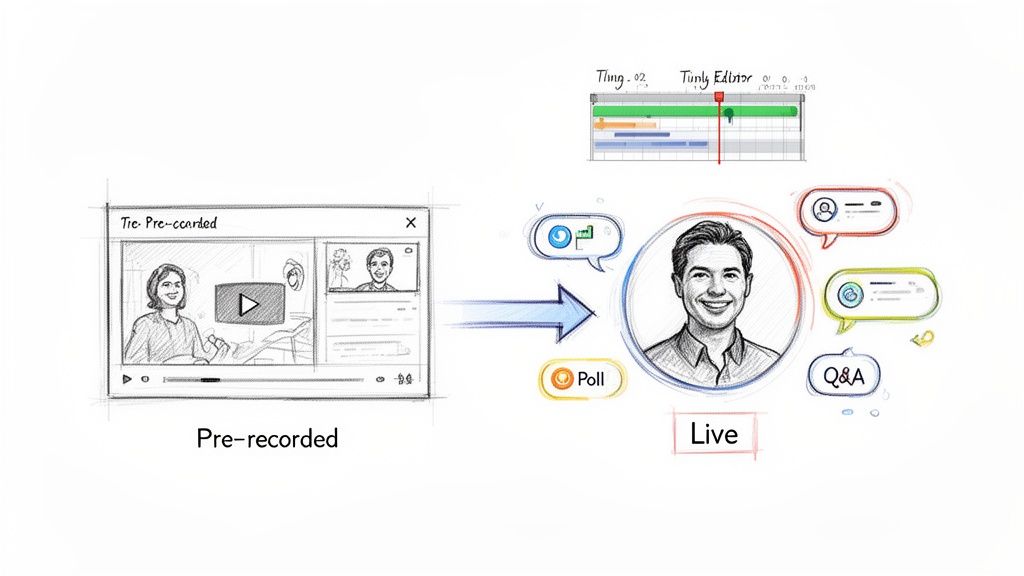
For B2B SaaS teams, this means a technical product webinar can feature a pre-recorded segment demonstrating a complex workflow, followed by a live Q&A with product managers. This 'simulive' format de-risks the most critical part of the presentation from technical glitches or speaker errors, freeing up your experts to focus entirely on authentic, real-time audience interaction. The result is a high-production-value experience that doesn't sacrifice genuine engagement.
How to Implement Pre-Recording with Live Elements
Successfully blending recorded and live content requires seamless transitions and clear communication to avoid confusing the audience. The goal is to make the experience feel cohesive, not disjointed.
- Structure Your Segments: Keep pre-recorded segments concise, ideally under 15-20 minutes. This maintains audience attention before you transition to a live interactive element like a poll or Q&A session.
- Script Smooth Transitions: Prepare clear hand-off language for your live host. For example, they might say, "Now, we have a detailed walkthrough from our lead engineer on this feature," before playing the video, and, "That was a fantastic overview. Let's now take your questions live," upon its conclusion.
- Indicate Broadcast Status: Use on-screen graphics or lower-thirds to clearly label whether a segment is "Pre-Recorded" or "Live." This manages audience expectations and enhances transparency.
- Prepare 'Seed' Questions: To kickstart engagement during live Q&A, have 3-5 pre-prepared questions ready. This ensures the conversation starts immediately, encouraging other attendees to participate.
- Record the Entire Session: Ensure you record the full broadcast, including the live interactive parts. This complete recording becomes a valuable on-demand asset that captures the entire, authentic event experience for future repurposing.
3. Integrated Lead Capture and Audience Segmentation
A core hybrid event best practice involves transforming your event from a simple broadcast into a strategic demand generation engine. This requires implementing sophisticated registration, gating, and tracking systems that capture detailed attendee data. The objective is to segment audiences based on their behaviour, engagement, and firmographic information, allowing you to turn new attendees into marketing-qualified leads (MQLs) and existing customers into engaged advocates.
For B2B SaaS companies, this is non-negotiable. A fintech SaaS hosting a webinar on regulatory compliance can gate an in-depth whitepaper for qualified financial institutions, while a martech firm can segment attendees by company size to tailor follow-up demos. This granular approach moves beyond a simple attendance list, providing deep insights for highly personalised, and therefore more effective, post-event follow-up that accelerates the sales cycle.
How to Implement Integrated Lead Capture
Effective lead capture starts long before the event begins and continues well after it ends. The key is to create a seamless data journey that feeds directly into your CRM and marketing automation platforms, a process popularised by HubSpot and Marketo integration methodologies.
- Optimise Registration: Keep initial registration forms concise, ideally with 5-7 critical fields to maximise conversions. Use progressive profiling to gather additional data on subsequent interactions, such as when an attendee downloads a resource.
- Track Engagement Depth: Move beyond tracking simple attendance. Monitor metrics like time watched (aim for >75% of total duration), polls answered, Q&A participation, and resource downloads to build a detailed profile of each attendee's interests and intent.
- Use Dynamic Gating: Implement conditional logic so that returning customers or prospects don't have to re-enter their information. This creates a frictionless experience and recognises their existing relationship with your brand.
- Implement UTM Tracking: Use UTM parameters and referral source tracking to understand which marketing channels, from LinkedIn campaigns to partner emails, drive the highest-quality registrants, allowing you to optimise future promotional spend.
- Ensure CRM Integration: Your event platform must have a native integration or robust API to push engagement data directly into your CRM. This ensures your sales development and marketing teams have the context needed for relevant, timely outreach.
4. Multi-Format Content Repurposing Strategy
A cornerstone of modern hybrid event best practices is to treat your event not as a single, fleeting moment, but as the beginning of a long-term content engine. Instead of letting your valuable insights disappear after the live session, you must systematically break down the event into numerous distinct assets. This strategy maximises the return on your initial content investment, extending the lifespan of a single webinar from a few days to several months and lowering your overall cost per lead.
For a SaaS content team, this approach transforms a one-hour product webinar into a multifaceted campaign. Imagine that single event becoming five powerful LinkedIn video clips, a comprehensive blog post detailing key features, a three-part email nurture series for prospects, and a podcast episode featuring the product manager. The goal is to create a library of high-value content from one primary effort, ensuring you meet diverse audience preferences on their chosen channels without draining your resources.
How to Implement a Content Repurposing Strategy
To execute this effectively, plan your repurposing efforts before the event even begins. Briefing speakers on key soundbites or data points that can be easily extracted for short-form video will streamline the post-production workflow significantly. This foresight ensures your content is not just recorded, but engineered for maximum reuse.
- Plan Your Asset Calendar: Create a detailed repurposing calendar that maps which assets will launch on specific channels and on which dates. A typical event can fuel 4-6 weeks of sustained content promotion.
- Professional Segmentation: Use professional editing to isolate the most impactful segments. A typical 60-minute webinar can yield 6-10 high-quality, short-form clips (30-90 seconds) suitable for social media platforms like LinkedIn or Twitter.
- Optimise for Search: Enhance event transcripts by adding timestamps, speaker names, and clear topic headers. Publish this as a blog post to capture long-tail keyword traffic and make the content more discoverable by search engines.
- Track Performance with UTMs: Implement unique UTM parameters on every repurposed asset. This allows you to track precisely which formats (e.g., video clips, blog posts, infographics) drive the highest engagement and conversions, informing future content strategy.
By adopting a repurposing mindset, you transform each hybrid event into a strategic asset that continuously generates leads and reinforces thought leadership. You can explore a more detailed framework in our complete guide to repurposing content.
5. Compliance-First Production Workflow for Regulated Industries
For B2B SaaS firms in regulated sectors, one of the most critical hybrid event best practices is adopting a compliance-first production workflow. This involves integrating a rigorous quality assurance and compliance review process directly into every stage of event planning and content creation, rather than treating it as a final hurdle. This proactive approach ensures all financial, legal, and data privacy information meets stringent industry standards before it reaches your audience.
In fields like fintech, healthtech, and legaltech, a single inaccurate statement can expose your firm to significant liability and regulatory penalties. A fintech webinar presenting investment analytics, for instance, requires pre-approval of all performance claims and disclosures. Similarly, a healthtech webinar must ensure all data shown is anonymised and HIPAA-compliant. This workflow turns compliance from a potential bottleneck into a streamlined, risk-mitigating asset.
How to Implement a Compliance-First Workflow
Embedding compliance checks from the outset protects your firm’s reputation and ensures the integrity of your content. For businesses operating globally, understanding frameworks like ISO 27001 and Australian data privacy laws is non-negotiable, ensuring all collected attendee data is handled securely and legally.
- Embed Reviewers Early: Involve compliance officers or legal reviewers in the initial scripting and content planning stages, not just at the final review. This prevents costly and time-consuming revisions later on.
- Create Industry-Specific Checklists: Develop a detailed compliance checklist template for your specific industry (e.g., FINRA for finance, HIPAA for healthcare). Regularly update this document as regulations evolve.
- Use a Digital Approval System: Implement a digital signature or approval workflow. This creates a documented, auditable trail showing that all stakeholders have reviewed and signed off on the content.
- Build in Buffer Time: Assume at least one to two rounds of compliance-driven revisions. Build this buffer time (e.g., 3-5 business days) into your production schedule to avoid last-minute rushes and potential errors.
- Archive Meticulously: Maintain detailed archives of all event versions, along with their corresponding approval documentation, for a minimum of three to seven years, depending on your industry’s specific regulatory requirements.
6. Real-Time Analytics and Engagement Monitoring Dashboard
One of the most transformative hybrid event best practices is leveraging data in real-time. This involves deploying a live analytics dashboard that tracks key audience behaviours, such as attendance, poll responses, and Q&A submissions as they happen. This data-driven approach allows moderators and speakers to make immediate, informed decisions, shifting from a static presentation to a dynamic, responsive conversation.
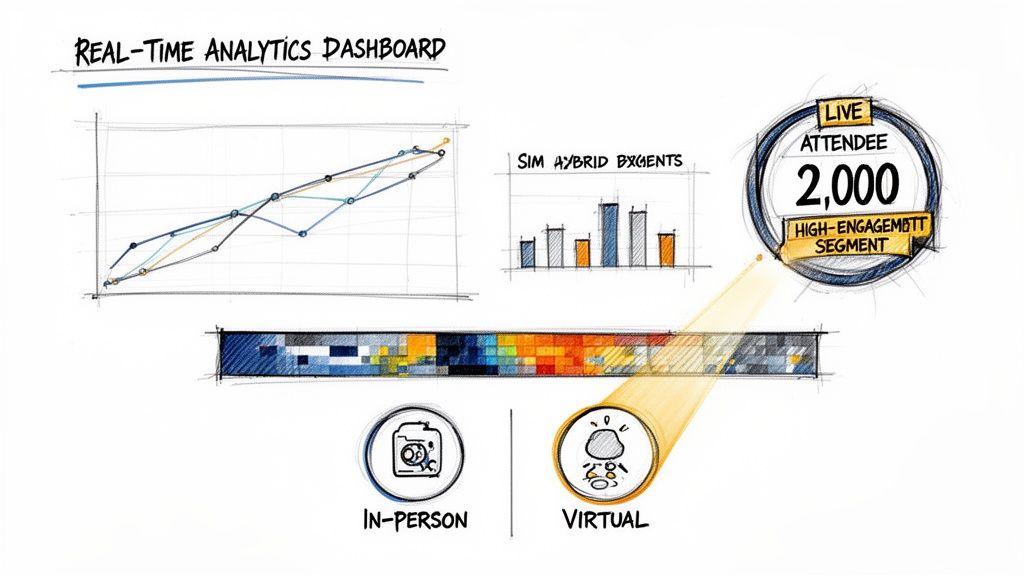
For B2B marketing teams, this real-time feedback loop is invaluable. A presenter can see engagement spike during a specific product feature demo and choose to spend more time on that topic, directly addressing audience interest. This ensures the content is not just delivered but is actively resonating, maximising its impact and preventing audience drop-off.
How to Implement Real-Time Analytics
A successful live dashboard focuses on clarity and actionability, providing just enough information to guide in-the-moment decisions without overwhelming the production team. Platforms like ON24 and Hopin have pioneered these real-time analytics, making this a standard feature for high-stakes B2B events.
- Focus on Critical Metrics: Display only 5-7 key metrics on the live dashboard for the moderator, such as live attendee count, engagement score, and the number of open questions. Detailed analytics can be shared with stakeholders post-event.
- Set Engagement Alerts: Configure automated alerts that notify the moderator if engagement drops below a pre-set benchmark (e.g., a 10% drop in active viewers). This is a cue to launch a poll, ask a direct question, or switch to a more interactive segment.
- Track Audience Segments: Monitor which audience segments, such as by company size or industry, show the highest engagement. This insight is crucial for refining future event targeting and content strategy.
- Analyse Heat Maps: Use engagement heat maps to identify 30-second segments of your presentation that received the most interaction. These are prime candidates for high-performing social media clips.
- Enable Sales Immediately: Export the Q&A log and attendee data immediately after the event. This allows your sales or business development teams to follow up on high-intent questions while the topic is still top-of-mind.
7. Dedicated Production Team and Studio Infrastructure
To consistently deliver high-calibre hybrid events, B2B SaaS firms must move beyond ad-hoc setups and invest in dedicated production resources. This involves engaging professional video producers, directors, and technical staff who operate within a purpose-built studio environment or as a dedicated remote partner. This infrastructure guarantees a polished, broadcast-quality output for every webinar and live stream, removing the technical burdens from your subject matter experts.
This model is a cornerstone of effective hybrid event best practices because it eliminates the variability and friction of coordinating external vendors for each event. It allows marketing teams to produce dozens of monthly thought leadership webinars with predictable quality and efficiency gains of over 50% in setup time. This approach ensures that complex product demos are presented with the clarity and professionalism your brand demands, directly supporting demand generation and customer education goals.
How to Implement a Dedicated Production Model
Establishing a professional production workflow, whether in-house or with a partner, is about creating a repeatable system for excellence. The key is to standardise processes to ensure every speaker, regardless of their on-camera experience, is set up for success and every broadcast meets a rigorous quality standard.
- Develop Standardised Workflows: Create detailed production checklists and templates for common formats like product demos or customer case studies. This standardisation drastically reduces setup time and ensures consistency.
- Invest in a Modular Studio: A flexible studio setup is crucial. Design a space that can accommodate various formats, from a single-presenter keynote to a multi-speaker panel discussion, without requiring a complete overhaul for each event.
- Train Producers for Context: Ensure your production team understands the nuances of your product and market. A producer who can guide a subject matter expert on pacing and depth adds immense value beyond just technical execution.
- Establish a Speaker Prep Process: Create a comprehensive speaker preparation guide that covers on-camera best practices, from framing and lighting to microphone technique. A mandatory 30-minute pre-session tech check can boost speaker confidence and improve the final output.
By building or partnering with a dedicated production team, you transform your hybrid events from one-off projects into a reliable, scalable content engine. To better understand the investment and ROI, explore our complete cost analysis of in-house webinar production versus an expert partner.
8. Audience-Specific Content Customisation and Personalisation
A powerful hybrid event best practice involves tailoring content for specific audience segments, moving away from a one-size-fits-all broadcast. Instead of delivering a single, generic message, you create multiple, slightly varied versions of your event content. Each version is customised to address the unique pain points, priorities, and contexts of different viewer groups, such as prospects versus customers, or C-suite leaders versus operational staff.
This level of personalisation ensures maximum relevance and engagement. For a SaaS company, this could mean presenting the same core product demo but customising the use cases for attendees from the retail, finance, and healthcare sectors. The core features remain consistent, but the application feels bespoke, demonstrating a deeper understanding of each audience’s world and significantly increasing the perceived value and conversion rates.
How to Implement Content Customisation
To execute this strategy without multiplying your workload, focus on efficient production and intelligent automation. The key is to plan for customisation from the outset, designing a core presentation that can be easily adapted for different segments.
- Identify Key Segments: Before production, define your 3-5 most important audience segments based on your ideal customer profile (ICP). For a cybersecurity SaaS, this might be CISOs, IT managers, and compliance officers.
- Plan Modular Content: Structure your event to include a universal core section, with specific slots for segment-specific intros, case studies, or data points. This allows you to record the main content once and insert custom modules later.
- Use Registration Logic: Implement registration forms that automatically route attendees to the appropriate content version based on their submitted data, such as job title, industry, or company size.
- Leverage Simple Editing: Employ professional editors to seamlessly insert customised video clips, graphical overlays, or title cards. This avoids the need to re-record entire presentations, saving significant time and resources.
- Track Performance by Version: Analyse engagement metrics, such as viewing duration and conversion rates, for each customised version. This data will reveal which messages resonate most effectively with each segment, informing future content strategy.
9. Integrated CLE/CPE Credit and Certification Management
For B2B SaaS firms targeting regulated professions, one of the most powerful hybrid event best practices is to structure your content to qualify for continuing education credits. By designing events that offer Continuing Legal Education (CLE), Continuing Professional Education (CPE), or other industry-specific certifications, you immediately elevate their value proposition. This strategy transforms a standard marketing webinar into a mandatory professional development opportunity, attracting a highly qualified and motivated audience.
This approach is exceptionally effective for legaltech, fintech, and compliance software companies, where product features naturally align with professional development requirements. Instead of simply generating leads, you are providing essential, career-advancing education. This builds immense credibility and positions your company as an indispensable industry authority, attracting professionals who are actively seeking accredited learning to maintain their licences.
How to Implement Integrated Credit Management
Integrating certified learning requires meticulous planning and adherence to the standards set by governing bodies. The process must be rigorous to ensure the credits you offer are valid and recognised, turning your educational content into a significant draw for professionals.
- Verify Eligibility Early: Before finalising your event topic, consult the relevant governing bodies (e.g., state bar associations, NASBA) to confirm that your proposed content and speakers meet their specific accreditation criteria.
- Structure for Compliance: Design your presentation as a formal educational programme, not a sales pitch. Clearly define learning objectives, allocate appropriate time for each topic, and ensure the content is substantive and instructional.
- Communicate Value Clearly: In all promotional materials, prominently feature the number and type of credits available. This is a primary motivator for attendance and should be stated on registration pages, in email invitations, and at the beginning of the event.
- Maintain Meticulous Records: Use your event platform to track attendance with precision, including log-in/log-out times and total duration viewed. This data is non-negotiable for compliance audits and is required to issue valid certificates.
- Automate Certificate Delivery: Build automated certificate generation and distribution into your post-event workflow. This ensures that attendees receive their proof of completion promptly, finalising a professional and seamless experience that reflects well on your brand.
10. Post-Event Follow-Up Sequencing and Sales Enablement
The value of a hybrid event extends far beyond the final session; its true ROI is often realised in the days and weeks that follow. A critical hybrid event best practice is to implement systematic, multi-touch follow-up sequences triggered by attendee behaviour. This approach moves beyond a generic “thank you for attending” email, equipping sales and business development teams with the context needed to convert interest into pipeline.
For B2B SaaS teams, this means that a prospect who asked a detailed question about API integration receives a completely different follow-up journey than a current customer who only viewed the first 20 minutes. Strategic follow-up amplifies the demand generation impact by ensuring no opportunity is missed and every qualified prospect receives personalised nurturing. This organised process transforms a one-time event into a sustained, data-driven sales conversation.
How to Implement Post-Event Sequencing and Sales Enablement
A well-structured follow-up plan requires segmenting your audience and arming your sales team with relevant, timely information. This turns your event data into actionable intelligence that drives meaningful business development conversations.
- Segment by Engagement: Group attendees based on variables like attendance percentage, questions asked, and polls answered. A high-engagement prospect who watched 90% of a webinar and asked a question should receive a direct outreach sequence from a sales development representative (SDR). A lower-engagement attendee might be added to a longer-term content nurture stream.
- Establish a Multi-Touch Cadence: Map out a clear follow-up timeline. A best practice cadence includes a thank-you email with the recording within 24 hours, a relevant case study or resource on day three, and a soft outreach or demo invitation around day seven.
- Arm Your Sales Team: Don’t just send a list of leads. Provide specific talking points referencing what each prospect watched or asked. For example: "I saw you attended our session on data integration and were interested in the section on API performance." This creates a warm, relevant opening.
- Create Differentiated Journeys: Design separate automated sequences for different segments. For instance, prospects from target accounts get a high-touch sequence involving phone calls, while attendees from existing customer accounts might receive information about new features or an invitation to an exclusive workshop.
10-Point Comparison of Hybrid Event Best Practices
| Item | Implementation Complexity | Resource Requirements | Expected Outcomes | Ideal Use Cases | Key Advantages |
|---|---|---|---|---|---|
| Dual-Screen Experience Design for Engaged Audiences | High — multi-camera sync and live coordination | Professional cameras, technical director, hybrid platform integrations | Equalized in-person & remote experience; high-quality repurposable footage | Large hybrid webinars for product launches or thought leadership | Maximizes reach; captures both audiences in one session |
| Strategic Pre-Recording with Live Interactive Elements | Medium — scripting and seamless switching needed | Editing team, live moderator/host, streaming tools with integration | Broadcast-quality content with live authenticity and faster turnaround | Technical demos or polished presentations that still need live Q&A | Guarantees quality while preserving live engagement |
| Integrated Lead Capture and Audience Segmentation | Medium–High — forms, tracking, CRM mapping | CRM, progressive forms, tracking pixels, privacy/compliance controls | Higher-quality leads and personalized nurture; clear ROI metrics | Demand-gen webinars aiming to convert attendees into pipeline | Improves lead qualification and automates lead routing |
| Multi-Format Content Repurposing Strategy | Medium — structured post-production workflows | Transcript & editing tools, content team, repurposing calendar | Extended content lifespan; more channels and lower long-term CPL | SaaS firms seeking sustained content marketing from single webinars | Multiplies reach and amortizes production costs |
| Compliance-First Production Workflow for Regulated Industries | Medium — multi-step review and sign-off processes | Legal/compliance reviewers, version control, specialized transcription | Reduced regulatory risk; audit-ready records and faster approvals | Highly regulated sectors (fintech, healthtech, legaltech) | Minimizes liability and ensures compliant distribution |
| Real-Time Analytics and Engagement Monitoring Dashboard | Medium — integrations and dashboard configuration | Analytics platform, live dashboard, analyst or moderator alerts | Immediate insights to adjust pacing and prioritize leads | Live/hybrid events where in-session optimization matters | Enables data-driven adjustments and lead prioritization |
| Dedicated Production Team and Studio Infrastructure | High — in-house build and operational management | Studio facility, producers, editors, broadcast-grade equipment | Consistent broadcast quality and rapid 3–5 day turnaround | High-volume webinar programs and firms needing brand control | Consistency, speed, and lower long-term production costs |
| Audience-Specific Content Customisation and Personalisation | High — multiple versions and segmentation logic | Editors, segmentation/data infrastructure, conditional delivery tools | Higher relevance and conversion for each audience segment | ABM campaigns, multi-audience events (C-suite vs. practitioners) | Increases conversion and enables targeted follow-up |
| Integrated CLE/CPE Credit and Certification Management | Medium–High — accreditation and jurisdiction checks | Certification platforms, attendance tracking, compliance support | Increased professional attendance and premium positioning | Webinars targeting attorneys, CPAs, and regulated professionals | Attracts recurring attendees and enables monetization via credits |
| Post-Event Follow-Up Sequencing and Sales Enablement | Medium — automation plus sales alignment | Marketing automation, CRM integration, sales playbooks & assets | Higher conversion, faster pipeline progression, reduced lead leakage | Lead-generation webinars requiring timely sales outreach | Systematic, data-driven nurture and improved sales efficiency |
From Event to Engine: Your Strategic Partnership in Webinar Excellence
Mastering the hybrid event is no longer an optional skill for B2B SaaS marketing teams; it is a critical differentiator in a crowded digital landscape. Throughout this guide, we have explored the essential hybrid event best practices that separate the standard, forgettable webinar from a powerful, strategic asset. We've moved beyond the basics of technology and scheduling, delving into the nuanced strategies that drive meaningful engagement, ensure compliance, and generate a tangible return on investment.
From designing a dual-screen experience that respects both in-person and remote attendees to integrating live interactive elements with pre-recorded content, the core theme is clear: intentionality. A successful hybrid event does not happen by accident. It is the result of a meticulously planned production workflow that considers every touchpoint, from the first registration to the final post-event follow-up sequence. It requires a fundamental shift in perspective, viewing the webinar not as a one-off marketing activity but as the cornerstone of a scalable content engine.
The Key Takeaway: From Management to Production
The most crucial insight to take away from these best practices is the transition from an event management mindset to an asset production mindset. Consider the difference:
- Event Management: Focuses on logistics for a single point in time. Success is measured by attendance and a smoothly run live session. The value is fleeting and hard to quantify beyond initial lead capture.
- Asset Production: Focuses on creating a high-value, evergreen resource. Success is measured by long-term engagement, lead generation from repurposed content, and the creation of a library of intellectual property. The value is cumulative and compounds over time.
This production mindset is what underpins effective strategies like multi-format content repurposing and integrated sales enablement. You are not just hosting a one-hour session; you are producing a core piece of content that will be atomised into video clips, blog posts, social media carousels, and internal training materials. This is how leading B2B teams achieve efficiency at scale, maximising the impact of their subject matter experts' limited time.
Putting Best Practices into Action
Implementing these advanced strategies consistently can be a significant challenge for internal teams already stretched thin. Juggling compliance reviews for regulated industries, managing complex production technology, and executing a sophisticated content repurposing plan requires a specialised skill set and dedicated resources. This is where a strategic partnership can transform your entire webinar programme.
Instead of your marketing managers or product experts becoming part-time producers, they can focus on what they do best: developing compelling content and nurturing customer relationships. By outsourcing the technical production, strategic repurposing, and compliance-driven workflows, you are not just delegating tasks; you are embedding hybrid event best practices directly into your operations. This ensures every webinar is broadcast-quality, fully compliant, and strategically leveraged to its full potential without overburdening your team. The goal is to make excellence the default standard, turning your webinar programme from a resource-intensive chore into a predictable, high-performance engine for demand generation and customer education.
Ready to transform your webinar programme into a strategic content engine? Cloud Present acts as your outsourced Head of Webinars, embedding these best practices into a streamlined, end-to-end production service. We deliver broadcast-quality, compliant hybrid events and repurpose them into 10+ high-impact marketing assets, so you can focus on strategy, not logistics.


