A Modern B2B Webinar Strategy for SaaS Growth
Discover a high-ROI B2B webinar strategy for SaaS teams. Learn how to produce, repurpose, and convert virtual events into a consistent lead pipeline.
Forget one-off events. A modern B2B webinar strategy is about building a reliable growth engine for your SaaS business. It’s a repeatable system that connects your content, production, and promotion directly to business goals, whether that’s generating demand or increasing customer lifetime value. For B2B SaaS marketing professionals, the entire point is to create high-value programmes that deliver a real, measurable return on investment.
Building Your High-Performance Webinar Foundation
Before you even think about hitting ‘record’, the real work begins. The success of your virtual event strategy is decided long before the live date, right here in the strategic groundwork. A high-performance strategy isn't just about picking a trending topic; it’s about building a foundation where every single action ties back to a tangible business result. For busy SaaS content teams facing limited resources, getting this stage right is everything—it ensures your time and budget are spent where they'll make the biggest impact.
This process boils down to three core pillars: defining clear goals, knowing your audience inside and out, and picking the right KPIs to prove it all worked.
Starting with clear goals makes every other decision—from the title of your slide deck to the LinkedIn ad copy you write—infinitely easier and more effective.
Defining Your Core Objectives
First things first, you need to answer a simple question: "What business problem are we actually trying to solve with this webinar?" Without a clear answer, you’re just creating content for the sake of it, a common pitfall for teams needing consistent content output. Your goals must be specific, measurable, and plugged directly into your company's wider marketing objectives.
Most B2B SaaS webinar goals fall into one of these buckets:
- Top-of-Funnel Demand Generation: This is all about attracting new prospects by tackling broad industry pain points. The aim is to capture a high volume of quality leads for sales, with a key metric being the number of Marketing Qualified Leads (MQLs) generated. For example, a webinar titled "The Future of AI in Project Management" would target this stage.
- Mid-Funnel Pipeline Acceleration: Here, you're educating leads who are already in your world. Think product demos, implementation workshops, or deep-dive case studies. The goal is to move them closer to a purchase decision, measured by demo requests or pipeline velocity.
- Customer Retention and Upselling: Don't forget your existing customers. Providing value through advanced training or best-practice sessions boosts loyalty and product adoption. Success is measured by metrics like a 10% increase in feature adoption rates or a reduction in customer churn.
- Establishing Thought Leadership: This is about building your brand's authority. You might present proprietary data, host a panel of industry leaders, or discuss future trends. You'll track this through brand mentions, social media engagement, and inbound links to the on-demand asset.
Pinpointing Your Ideal Audience
Once you know why you're hosting the webinar, you have to define exactly who it's for. And I mean exactly. Generic job titles like "Marketing Manager" won't cut it. To ensure professional quality and relevance, you must build a detailed persona that gets into their specific challenges, what motivates them, and what their day-to-day work life actually looks like.
Ask yourself these questions to address their pain points:
- What specific workflow inefficiencies keep them up at night?
- What tools or solutions are they already using (or evaluating)?
- What industry jargon and concepts will actually resonate with them?
- Where do they consume professional content online (e.g., specific publications, LinkedIn groups, industry forums)?
Answering these helps you tailor everything—your content, your messaging, your promotion—to connect with the right people on their terms. The best webinars feel like they were made just for one specific person, making the content feel indispensable.
To give you a clearer picture, here's a simple framework mapping these pillars together.
SaaS Webinar Strategy Planning Framework
This table breaks down how your core strategic pillars connect to specific objectives, tactics, and the metrics you'll use to measure success. It’s a great way to keep your team aligned and focused on ROI.
| Strategic Pillar | Key Objective | Actionable Tactic | Success Metric |
|---|---|---|---|
| Goal Definition | Generate top-of-funnel leads | Host a thought leadership webinar on an emerging industry trend | 150+ Marketing Qualified Leads (MQLs) generated |
| Audience Identification | Engage mid-funnel prospects | Create a deep-dive product demo for a specific user persona | 25+ demo requests from attendees |
| Measurement & KPIs | Improve customer retention | Run an advanced best-practices session for existing users | 15% increase in feature adoption rate post-webinar |
Having this kind of simple, clear alignment from the start prevents a lot of headaches down the line and ensures everyone knows what success looks like.
Setting Meaningful KPIs and Budget
With your goals and audience locked in, the final piece of the foundation is measurement. Your Key Performance Indicators (KPIs) must mirror your initial objectives.
A classic mistake is getting obsessed with registration numbers. While it’s a nice vanity metric, real success lies in numbers that show business impact, like the number of sales-accepted leads or the value of pipeline influenced by the webinar in US Dollars.
And remember, webinars don't exist in a vacuum. To maximise efficiency gains, they must be a core part of a wider content marketing strategy, ensuring they work alongside your blogs, whitepapers, and other marketing activities.
The data backs this up. In the UK and Ireland, webinars are tied with in-person events as the most effective B2B marketing channel, with both scoring a 51% effectiveness rating. Confidence is high, too—over 70% of UK marketers are planning to increase their webinar budgets, which shows a strong belief in the ROI.
For a detailed walkthrough on structuring your event from A to Z, our ultimate webinar planning checklist will make sure you don't miss a single step.
Designing Webinar Content That Captivates and Converts
In a world overflowing with virtual events, generic content is the quickest way to lose an audience. Let’s be honest, your virtual event strategy needs to be built on topics and formats that aren’t just informative, but genuinely compelling. We have to move past simply filling a calendar slot and start crafting experiences that grab attention, hold it, and drive a specific action. This means treating content design as a strategic discipline, not an afterthought.
The most powerful webinar ideas are rarely born in a brainstorming vacuum. They come from listening to the signals your market is already sending. Start by mining your customer support tickets and talking to your sales team. These folks are on the front lines, hearing the most pressing challenges and FAQs directly from your ideal customer. Digging into these conversations will show you the real-world problems your audience is desperate to solve.
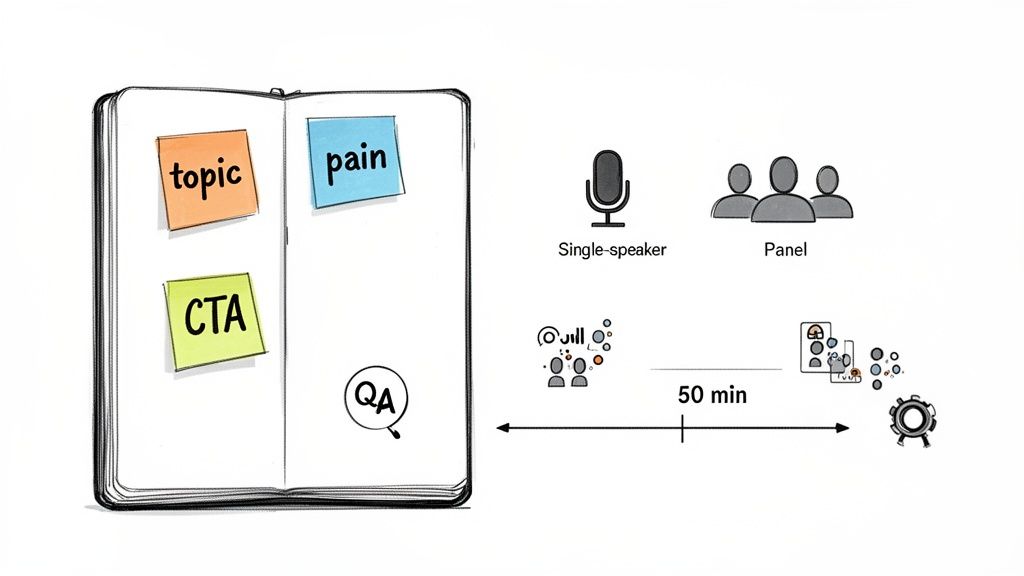
This data-first approach ensures your content hits the mark from the get-go, tackling genuine pain points instead of just making assumptions.
Choosing Formats That Align with Goals
The format you choose is just as critical as the topic itself. A single-speaker deep dive is perfect for unveiling a new feature, giving you total control of the narrative and a chance to show off technical expertise. On the other hand, a customer panel discussion might be far more effective for building social proof when prospects are in the consideration stage.
Consider these impactful formats for your B2B webinar strategy:
- The Expert Panel: Bring together 2-3 industry experts (including one of your own) to discuss a high-level trend. This format positions your brand as a convener of important conversations and is brilliant for top-of-funnel lead generation.
- The Tactical Workshop: Don't just talk about a concept—show your audience how to do it. A live, practical workshop on a specific task builds immense goodwill and demonstrates your product's value in a very tangible way.
- The Customer Showcase: Feature a successful customer walking through how they solved a problem using your solution. This format is pure gold for mid-funnel prospects, providing authentic, relatable proof of your product's ROI.
The key is to match the format to where your audience is in their buying journey and what you want to achieve with the event.
Structuring Your Narrative for Maximum Engagement
Holding an audience's attention online is a real challenge. Research shows the average B2B webinar viewing time is around 50 minutes, so your content needs a structure that maintains momentum from start to finish. A great narrative is essential for this.
Simply presenting a list of features or facts is a recipe for audience drop-off. A compelling webinar tells a story. It should present a problem, explore the challenges, and then reveal the solution—with your insights or product as the hero.
To keep viewers hooked, you must integrate interactive elements throughout the session. These moments break the passive viewing experience and turn it into an active, two-way conversation. Even for pre-recorded events, these elements are vital for engagement.
Interactive elements to include:
- Live Polls: Kick things off with an icebreaker poll to get people engaged immediately. Use more polls mid-webinar to gauge understanding or gather valuable data on audience pain points.
- Structured Q&A: Don't just save Q&A for the final few minutes. Announce that you'll pause for questions at specific points, which encourages viewers to stay attentive.
- Resource Drops: Link to a valuable whitepaper, checklist, or a relevant blog post in the chat. For instance, offering a well-designed webinar presentation template can provide immediate value and reinforce your expertise.
By thoughtfully designing the topic, format, and interactive flow, you create an event that doesn’t just educate but actually converts viewers into engaged leads. This focus on professional quality standards and strategic intent is what separates a forgettable presentation from a cornerstone content asset.
Executing Flawless Production and Driving Registration
Great content is only half the battle. The real difference between a polished, professional webinar and an amateur broadcast boils down to flawless webinar production.
For SaaS content teams already stretched thin, this is where a repeatable webinar strategy really proves its worth. It’s all about hitting broadcast-quality standards while running a promotion playbook that guarantees an engaged audience shows up to see it.
This process covers everything from pre-flight checks with your speakers to deploying a multi-channel campaign that fills your registration pipeline.
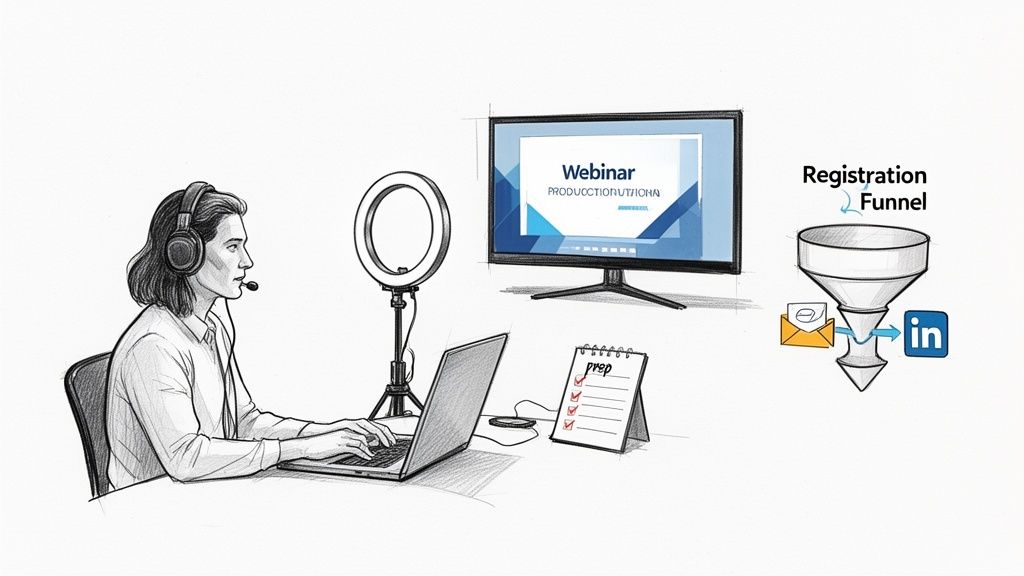
Let’s break down the two sides of this coin: nailing the production and driving high-quality registrations.
Achieving Broadcast-Quality Production
Your webinar is a direct reflection of your brand. Glitches, poor audio, and clumsy visuals can undermine even the most compelling content. To deliver a professional experience, you need to get proactive with your tech setup and speaker prep.
Start by sending your speakers a simple tech kit or checklist a week in advance. This isn't about spending a fortune; it’s about controlling the variables.
A solid speaker prep checklist should cover:
- A good quality USB microphone: This is the single biggest factor for clear, crisp audio.
- Stable, wired internet connection: Always advise speakers to plug directly into their router. Wi-Fi is just too unpredictable.
- Good lighting: A simple ring light positioned in front of the speaker can dramatically improve video quality.
- A branded virtual background: This ensures a consistent, professional look across all presenters.
The goal here is to minimise day-of surprises. A mandatory 30-minute tech rehearsal a few days before the event is non-negotiable. Use this time to test everyone’s audio, video, screen sharing, and the overall flow. Trust me, this simple step prevents 90% of common technical issues.
Creating slick on-screen assets like branded slide templates, lower-thirds for speaker names, and holding slides for the start and end of the event also adds a layer of polish that elevates the entire experience. For teams looking to guarantee this level of quality without the in-house headache, exploring professional webinar production services can offer a huge ROI in time saved and brand perception.
A Multi-Channel Playbook for Driving Registrations
A beautifully produced webinar is useless without an audience. Driving sign-ups demands a coordinated, multi-channel promotional strategy that kicks off 2-3 weeks before the event.
The data is pretty clear on what works. The most effective channels for B2B webinar registrations are typically the company website (80%), email marketing (76%), and social media (60%).
Your promotion schedule shouldn't be a series of random announcements, but a carefully orchestrated sequence.
The Registration Promotion Timeline
- Two Weeks Out: Announce the webinar to your email list and post it on LinkedIn. Focus your copy on the core problem you're solving and introduce the speakers to build credibility.
- One Week Out: Send a follow-up email that highlights a key takeaway or a compelling statistic from the presentation. On LinkedIn, share a short video clip of your speaker discussing the topic.
- Three Days Out: A classic "Don't Miss Out" email helps create a sense of urgency. This is also the perfect time to activate partner networks—ask your speakers or co-sponsors to share the event with their audiences.
- Day of Event: A final "Starting Soon" email reminder captures those last-minute registrants. A surprising 17% of attendees register on the day of the event, so this final push is crucial.
Don't forget the registration page itself. It must be optimised for conversion. Keep the form simple—name, company, and email are usually all you need. The copy should be benefit-driven, clearly stating what attendees will learn and why it’s worth their time. We've seen high-performing webinar landing pages hit conversion rates of up to 51%, turning your promotional efforts directly into confirmed attendees.
Turning Webinars into Evergreen Content Assets
The live event is just the beginning.
For B2B SaaS content teams stretched thin on resources, the real magic happens after the webinar ends. A single 60-minute recording isn’t a finished product; it’s the raw material for a dozen high-impact marketing assets. This mindset of content repurposing solves the relentless demand for fresh content without burning out your team.
By building a content engine around your webinars, you stretch their value and ROI, nurturing leads across different channels long after the live session is over. It transforms a one-time effort into an asset that works for you around the clock.
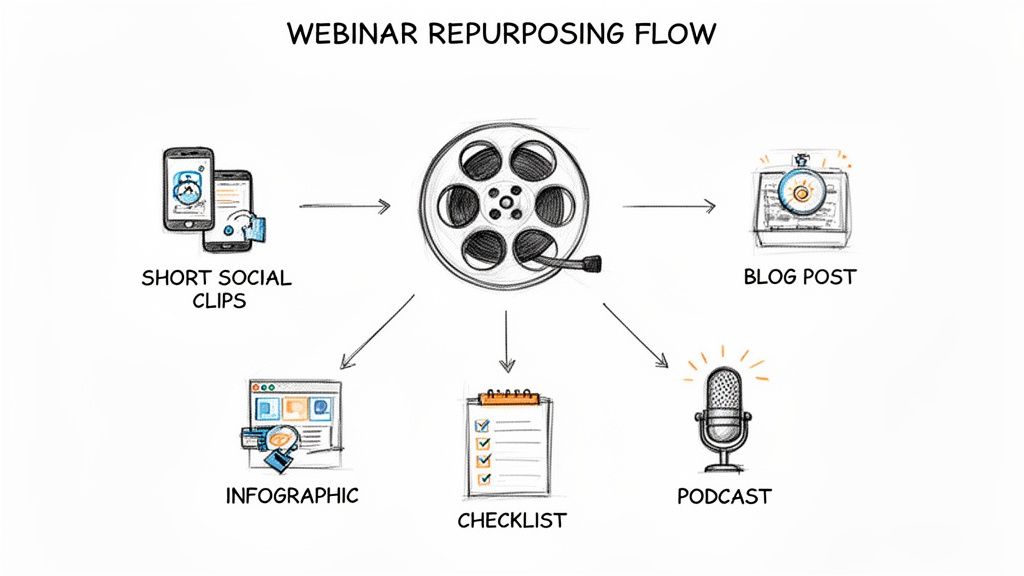
From Recording to Content Hub
First things first: you need to deconstruct the webinar into its core components. An hour-long session is usually packed with quotable moments, key data points, actionable advice, and compelling stories. Your job is to mine these gems and repackage them for different platforms and audiences.
To get this done efficiently, it helps to leverage AI summary tools for webinars. They can quickly condense the entire recording into key insights and timestamp the most valuable segments, giving you a clear roadmap for what to repurpose first.
A single webinar recording is a content goldmine. With a smart content repurposing strategy, you can create a month’s worth of high-quality content, from social media clips to in-depth articles, all from one initial investment of time and effort. This is a crucial efficiency gain for any content team.
This shift in thinking is crucial. Instead of constantly brainstorming new ideas from scratch, you create one big pillar asset and then atomise it.
Your Tactical Repurposing Playbook
Once you’ve identified the high-value moments, it’s time to get tactical. The goal is to create a variety of formats that appeal to different consumption habits—from the quick scroller on LinkedIn to the deep reader looking for detailed guidance.
Here's a practical playbook for turning your webinar into a content machine:
- Short-Form Video Clips: Isolate 3-5 of the most impactful moments—a surprising statistic, a powerful quote, or a key "aha!" moment. Edit these into snappy 60-90 second clips with branded captions. They’re perfect for sharing on LinkedIn to drive traffic back to the on-demand recording.
- In-Depth Blog Post: Use the webinar transcript as the foundation for a comprehensive blog post. Don't just copy and paste; expand on the key topics, embed your new video clips, and add relevant data or examples. This creates a powerful SEO asset that captures organic traffic for months.
- Actionable Checklists or Templates: Did your speaker outline a specific process or framework? Turn this into a downloadable PDF checklist. This becomes a brilliant lead magnet you can offer within your blog post to capture new contacts.
- Quote Graphics and Infographics: Pull out the most memorable quotes and statistics. Design simple, branded graphics for social media. If your webinar presented a lot of data, consolidate it into a shareable infographic that visualises the key findings.
This systematic approach ensures you get maximum mileage from every event. It’s not just about creating more stuff; it’s about maintaining a consistent, professional output that reinforces your brand’s expertise everywhere.
The SaaS Webinar Repurposing Matrix
Creating the assets is one thing, but you need a plan to get them in front of the right people. Mapping your repurposed content to a calendar ensures you release each piece strategically over several weeks.
This matrix offers a simple framework for planning your distribution, showing how one webinar can feed multiple channels with distinct goals.
| Original Asset | Repurposed Format | Target Channel | Primary Goal |
|---|---|---|---|
| 60-Minute Webinar | On-demand recording behind a form | Website/Landing Page | Lead Generation |
| Key Speaker Quote | 1-minute video clip with captions | LinkedIn, Twitter | Drive on-demand views |
| Webinar Transcript | 1,500-word blog post | Company Blog | SEO & Organic Traffic |
| Actionable Framework | Downloadable PDF checklist | Blog Post CTA | Gated Content/Lead Capture |
| Webinar Slides | SlideShare presentation | SlideShare, LinkedIn | Thought Leadership |
An organised approach like this prevents content fatigue and ensures each asset has a clear purpose. By making content repurposing a core part of your B2B webinar strategy, you create a system that turns your virtual events into a predictable source of leads and authority, delivering a far greater ROI than the live session alone.
Measuring Performance and Optimising Your Strategy
A successful B2B webinar strategy is built on data, not guesswork. While seeing a high registration count feels great, those numbers are just the start of the story. To prove your programme’s value and ROI, you need to dig deeper than vanity metrics and focus on what actually impacts the bottom line. That means analysing how engaged your audience was, tracking who converts, and tying real pipeline influence back to your webinar efforts.
This data-driven approach is what elevates a series of one-off events into a predictable growth engine. It’s how you’ll refine future content, dial in your format, and consistently demonstrate the ROI of your virtual event strategy.
Moving Beyond Attendance Numbers
First things first: let's look beyond who simply showed up. True engagement is a far more powerful indicator of a high-quality lead. Modern webinar platforms are packed with rich data that tells you exactly how your content landed with the audience.
Start by tracking these core engagement metrics:
- Average Viewing Time: If you ran a 50-minute webinar and the average viewing time was only 20 minutes, that’s a massive red flag. Your content isn't holding attention. Pinpoint the drop-off moments to see which sections are losing people.
- Poll Participation Rate: This metric shows you who's actively involved versus just passively watching in another tab. A low rate could mean your polls aren’t compelling enough or you’ve timed them poorly.
- Q&A Engagement: Pay attention to the volume and, more importantly, the nature of the questions. A flood of buying-intent questions (think pricing, implementation, or feature specifics) is a fantastic signal for your sales team.
- Resource Downloads: Did you offer a downloadable checklist or whitepaper? Tracking how many people clicked the link demonstrates a much deeper level of interest and intent.
Getting granular with these numbers helps you understand what's actually working. For instance, if you see a huge audience drop-off 15 minutes in, go back and watch that part of the recording. Was the speaker's energy flat? Was the content too basic or overly technical? Use these insights to make your next event even better.
Connecting Webinars to Pipeline and Revenue
Ultimately, the true measure of success for any B2B marketing effort is its impact on revenue. Attributing webinar activity to the sales pipeline requires a tight integration between your marketing automation platform (like HubSpot or Marketo) and your CRM (like Salesforce). This connection is what allows you to prove your ROI in US Dollars.
Your main goal is to track the journey from attendee to customer. Here’s a practical way to measure pipeline influence:
- Lead Source Tracking: Make sure every single webinar registrant is tagged with the correct lead source in your CRM. This simple step is crucial for seeing which webinars are generating the most valuable leads.
- MQL to SQL Conversion Rate: Track the percentage of webinar attendees who become Marketing Qualified Leads (MQLs) and then Sales Qualified Leads (SQLs). This shows how well your content is filtering for sales-ready prospects.
- Pipeline Influence Reporting: Build a report in your CRM that shows how many open sales opportunities have a key contact who attended one of your webinars. This "pipeline influence" metric is gold for demonstrating value, even if the webinar wasn't the final touchpoint.
Don't just measure lead volume; measure lead velocity. How quickly do webinar-generated leads move through the sales cycle compared to leads from other channels? A faster velocity is a powerful indicator of higher lead quality and a strong ROI.
Industry benchmarks can give you a useful baseline for what's possible. On average, the webinar registration-to-attendee rate hovers around 57%, which helps with forecasting. More impressively, top-performing webinars see 20% to 40% of attendees become qualified leads, with 2-5% of those eventually converting into customers. You can read the full report on these benchmarks to better understand performance standards for specific industries like legal and finance.
Using Data for Continuous Optimisation
Your performance data is a goldmine for improving your entire B2B webinar strategy. I highly recommend setting up a regular post-webinar review meeting with key stakeholders from marketing and sales to go over the results and plan your next moves.
Use your findings to answer critical questions:
- Content Optimisation: Which topics pulled in the most engaged audience and the highest quality leads? Let that data inform your content calendar for the next quarter.
- Format Refinement: Did the panel discussion get better engagement than the single-speaker session? Don't be afraid to experiment with different formats and let the numbers guide your decisions.
- Promotion Effectiveness: Which channels drove the most registrations? Should you put more budget behind LinkedIn ads, or is it time to refine your email nurture sequences?
By embedding this cycle of measuring, analysing, and optimising into your workflow, you transform your webinar programme from a series of isolated activities into a strategic, data-informed system that consistently delivers business results. This is how you prove value and secure the resources you need to scale.
Partnering for Success with Cloud Present
For busy SaaS marketing teams, trying to run a high-calibre webinar strategy in-house is a massive resource drain. The planning, webinar production, and content repurposing needed to generate real ROI isn't just a task—it's a full-time job. This is where a strategic partner can completely change the game, turning your programme from a source of stress into a predictable growth engine.
At Cloud Present, we’ve built our end-to-end service to map directly to the pillars of a successful B2B webinar strategy. Instead of you having to juggle freelancers or pull your team off critical projects, you get what is essentially an outsourced Head of Webinars, totally dedicated to flawless execution. We handle everything from the nitty-gritty of technical production to the long game of content repurposing, so your experts can do the one thing that matters most: deliver brilliant content.
Your Outsourced Webinar Team
Think of us as a natural extension of your marketing department. We bring the specialised skills needed to deliver professional quality and efficiency gains that are genuinely difficult to achieve on your own.
- Guaranteed Speed: We turn around a fully polished, broadcast-quality webinar recording within a 3–5 day window. That speed lets you maintain content momentum without ever sacrificing an ounce of quality.
- On-Brand Professionalism: From custom-branded assets to expert editing, we make sure every webinar reflects the authority and quality of your brand. It’s all about building trust with your audience.
- Efficiency and ROI: With an average cost per lead from webinars sitting at US$72, our streamlined process helps you generate high-quality leads more cost-effectively than many other channels.
When you partner with Cloud Present, you’re not just buying a service. You’re investing in a system that guarantees a consistent, high-quality output. This frees up your team to focus on strategy, not logistics.
Let us worry about the complexities of webinar production and content repurposing. With our support, you can scale your webinar programme, keep your content pipeline constantly full, and finally prove the direct impact of your efforts on the bottom line.
Ready to see how we can become your outsourced webinar studio? Explore our end-to-end webinar services and discover how we can help you achieve more.
Burning Questions Answered
When you're building a webinar programme from the ground up, a few common questions always pop up. Let's tackle them head-on with some practical advice for B2B SaaS marketing professionals.
What’s the Sweet Spot for Webinar Length?
Everyone's busy, so how long should you aim for? We've found the magic number is around 45 minutes of solid content, followed by a 10-15 minute Q&A.
This lands you just under the hour mark, which feels manageable for most attendees. Industry data backs this up, showing the average attendance time hovers around 50 minutes. Of course, if you're running a deep-dive technical demo or a complex masterclass, pushing to 75 minutes is fine—just be upfront about it in your promotional copy so people know what to expect.
Should We Go Live or Pre-Record?
This is a big one, and honestly, there's a strong case for both.
Live webinars are fantastic for creating buzz and genuine, in-the-moment interaction. There's an energy to a live event that's hard to replicate.
But for SaaS content teams looking to scale, pre-recorded webinars—something we specialise in at Cloud Present—are a game-changer. They let you nail the delivery every single time, with polished editing and perfectly integrated graphics.
Pre-recording also eliminates the stress of live tech fails. No more awkward pauses or screen-sharing mishaps. Plus, it opens the door to flexible formats like 'simulated live' broadcasts or a library of on-demand content, turning your webinars into an evergreen demand generation machine.
How Early Should We Start Promoting?
You'll want to kick off your promotion 2-3 weeks before the event. This gives you enough runway to build momentum without fatiguing your audience. A multi-channel game plan always wins here.
Start with a launch announcement to your email list and on LinkedIn. Then, sprinkle in reminders and social posts that tease specific takeaways or introduce your speakers. Don't ease up at the end, either. A surprising number of people—often around 17%—sign up in the last 48 hours. That final 'last chance to register' push is crucial for getting as many people over the line as possible.
Ready to turn your webinars into a reliable growth engine without burning out your team? Cloud Present can be your outsourced webinar studio, handling everything from slick webinar production to smart content repurposing. You focus on the content; we’ll handle the rest.
Explore our end-to-end webinar services and see how we can help you scale your impact.


